

Table of Contents
The Extended Extraction Guide

A Caffè Lungo is an espresso-based coffee made by allowing a larger volume of water to pass through the coffee grounds during extraction. The result is a longer drink with a different flavour balance, body and concentration from a conventional espresso.
The Italian word lungo translates as long, describing the extended volume of the finished coffee rather than a different brewing method.
Unlike an Americano, where hot water is added after the espresso has been extracted, a Lungo continues the brewing process itself. This means the additional water comes into direct contact with the coffee grounds, extracting further soluble compounds and changing the character of the drink.
The Lungo is an interesting choice for anyone who enjoys espresso but prefers a larger serving and a more extended drinking experience.

What is a Caffè Lungo and how do its extraction mechanics function?
The Lungo begins with the same basic ingredients as espresso: freshly ground coffee, hot water and pressure.
The difference lies in the amount of water allowed to pass through the coffee puck before the extraction is stopped.
A conventional espresso commonly uses a brew ratio of approximately 1:2. For example, 18g of ground coffee might produce around 36g of espresso.
A Lungo uses a higher beverage yield, often around 1:3 or 1:4. With the same 18g dose, this could produce approximately 54–72g of coffee.
The additional water extracts more soluble material from the coffee, increasing the total extraction yield. At the same time, the larger beverage volume generally reduces the concentration of dissolved coffee solids.
This changes the flavour and mouthfeel. Depending on the beans and recipe, a Lungo may develop more pronounced bitterness, a lighter body and a different balance of acidity and sweetness.
The crema can also appear thinner because the larger volume of liquid spreads the surface layer more widely.
For a useful comparison of espresso recipes and extraction ratios, Lavazza’s guide to Ristretto and Lungo explains how changing the beverage yield influences the finished cup.
What are the technical parameters required to brew a traditional Lungo?
A good Lungo requires more than simply allowing an espresso machine to run for twice as long. The aim is to increase the beverage yield while maintaining a balanced extraction.
The following figures provide a practical starting point for a modern double-shot recipe.
1. The dry coffee dose
Keep the initial coffee dose consistent with your normal espresso preparation.
For example, an 18g dose in a double basket provides a useful starting point. Maintaining the same dose makes it easier to compare the resulting Lungo with a standard espresso.
Traditional Italian single-shot recipes may use considerably less coffee, so the precise dose will depend on the basket and machine being used.
2. The grind setting
The grind size controls the resistance of the coffee bed and influences how quickly water passes through it.
A Lungo may require a grind adjustment to achieve a higher beverage yield without allowing the extraction to become excessively slow or harsh.
Depending on the coffee and machine, a slightly coarser setting can help maintain a suitable flow rate when targeting a longer yield. However, there is no universal grind adjustment: the correct setting must be established through tasting and observation.
3. The liquid yield
The defining feature of a Lungo is its higher beverage yield.
A useful starting recipe is:
- Dry coffee dose: 18g.
- Target beverage yield: 54–72g.
- Brew ratio: Approximately 1:3 to 1:4.
These are practical speciality-coffee guidelines rather than fixed Italian regulations.
4. Extraction time
A Lungo will often take longer to prepare than a conventional espresso, but there is no compulsory 45–60-second extraction window.
The total time depends on grind size, coffee dose, machine pressure, pre-infusion and the target beverage yield.
Aiming for a specific output weight and then adjusting the grind to achieve a balanced flavour is more reliable than simply following a fixed timer.
The Specialty Coffee Association’s research into changing espresso preparation practices illustrates how espresso recipes vary between baristas and why dose, yield and extraction time need to be considered together.
What are the structural differences between a Lungo, an Espresso and an Americano?
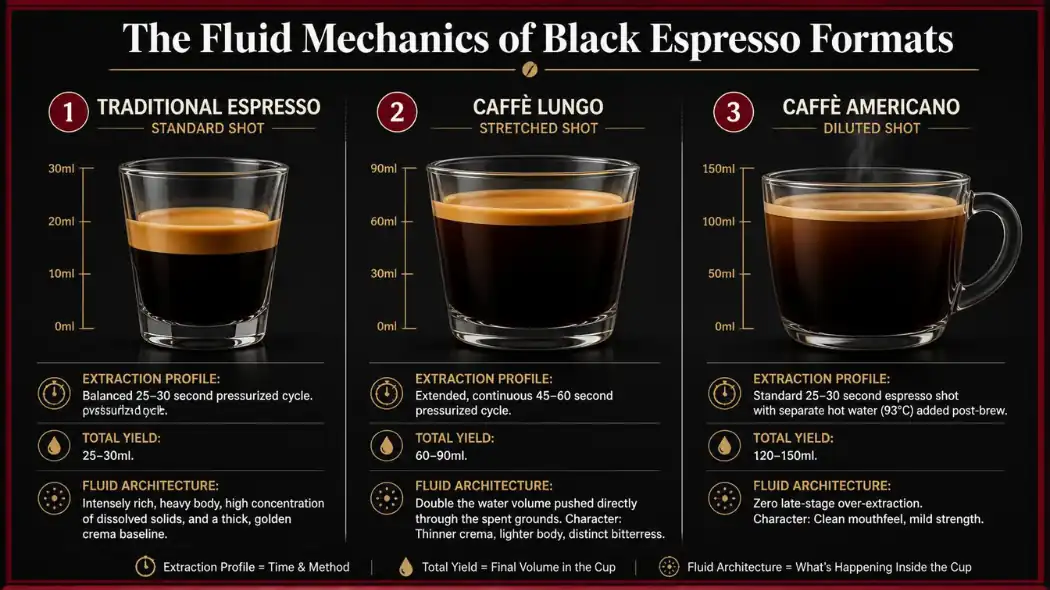
All three drinks begin with espresso-style coffee preparation, but their extraction methods produce different results.
| Beverage | Preparation process | Illustrative beverage volume | Typical character |
|---|---|---|---|
| Espresso | Standard, balanced extraction | Around 36g from an 18g dose | Concentrated, rich and full-bodied |
| Caffè Lungo | More water passes through the coffee puck | Around 54–72g from an 18g dose | Longer, less concentrated and potentially more bitter |
| Caffè Americano | Espresso extracted first, then diluted with hot water | Varies, often around 120–180ml | Longer, smoother and more diluted |
The volumes are examples rather than universal serving standards. The important difference is the brewing sequence.
With an Espresso, the extraction stops at the chosen yield. With a Lungo, the machine continues to deliver water through the coffee. With an Americano, the espresso is completed first and hot water is added afterwards.
Is a Caffè Lungo stronger and more bitter than a Caffè Americano?
The answer depends on what is meant by strength.
A Lungo generally has a higher concentration of dissolved coffee solids than an Americano prepared with a substantial amount of additional water. However, it is not necessarily stronger in flavour intensity in every recipe.
The reason is the difference in extraction.
With a Lungo, the extra water passes through the coffee puck. This extracts additional soluble compounds and can produce a more bitter or drying flavour if the recipe is poorly balanced.
With an Americano, the espresso extraction is completed before the additional water is introduced. The water dilutes the finished espresso without extending its contact with the coffee grounds.
This distinction explains why a Lungo can taste more intense or bitter than a larger Americano, even though the latter may contain the same original espresso dose.
However, a carefully prepared Lungo does not have to taste aggressively bitter. Coffee selection, grind size, temperature and extraction yield all influence the finished result.
If your home espresso or Lungo consistently tastes harsh, dry or mouth-drying, take a look at our guide to why coffee tastes bitter and how to correct it. It explains how to recognise extraction problems and adjust your brewing variables.
Why choose a Caffè Lungo?
The Lungo offers an alternative for coffee drinkers who enjoy the flavour of espresso but prefer a longer serving.
It provides more liquid than a conventional espresso without requiring the additional dilution of an Americano. Its extended extraction can also reveal a different balance of flavours, depending on the coffee and preparation technique.
For anyone who enjoys taking their time over a small but substantial black coffee, the Lungo is a classic choice.
Its appeal lies in the patience of the pull: allowing more water to pass through the coffee, exploring a different extraction balance and discovering how a simple adjustment can transform the character of a familiar espresso.
Visit the history and origins of the world’s most popular coffees, and explore how each much-loved drink found its place in coffee culture.


