

How to Brew Drip Filter Coffee Every Time
Drip filter coffee remains one of the most popular and practical ways to enjoy a freshly brewed cup. Whether you’re making coffee at home, preparing a pot for the office or serving customers in a café, an automatic drip filter machine offers convenience, consistency and excellent flavour when used correctly.
The method is straightforward: hot water passes through ground coffee under gravity, extracting flavour before travelling through a filter into the carafe below. However, the quality of the finished cup depends on several important variables, including grind size, water temperature, coffee-to-water ratio and brewing time.
Let’s explore the history, science and practical techniques behind making better drip filter coffee.
The History of Drip Filter Coffee
Before electric drip machines became commonplace, many households relied on stovetop percolators. These repeatedly circulated heated water through the coffee grounds, which could produce an overly strong or bitter brew if the process continued for too long.
The First Electric Drip Filter Coffee Machine
A significant development arrived in Germany in the 1950s with the introduction of the Wigomat, associated with inventor and manufacturer Gottlob Widmann. Often dated to 1954, it helped establish the principles behind the modern electric drip coffee maker.
The machine heated water and delivered it through a filter containing ground coffee, allowing the finished brew to collect in a glass carafe. It offered a more controlled and convenient alternative to traditional percolators.
The next major breakthrough came in the United States. Introduced in 1972, Mr. Coffee helped bring automatic drip brewing into millions of American homes, and by the end of the decade electric drip machines had become a familiar kitchen appliance.
Today, machines such as the Moccamaster demonstrate how far the technology has developed, with improved temperature control, water distribution and brewing consistency.
For a closer look at the history, the Wigomat coffee maker preserved by the Ostfriesisches Teemuseum provides an interesting historical reference. The Henry Ford museum also documents the introduction of Mr. Coffee in 1972.
How Does Drip Filter Coffee Work?
Automatic drip filter coffee uses a brewing process known as gravity extraction.
The machine heats water and distributes it over a bed of ground coffee held inside a filter basket. As the water passes through the grounds, it dissolves and carries away soluble coffee compounds, eventually dripping through the filter and into the carafe.
Although the process appears simple, several factors determine how evenly the coffee extracts.
The Filter
Most automatic drip machines use paper filters. These trap the majority of the coffee grounds and a considerable amount of the oils and fine particles released during brewing.
The result is generally a cleaner, lighter-bodied cup with good flavour clarity.
Some machines use permanent metal or mesh filters instead. These allow more oils and fine particles into the finished coffee, producing a fuller mouthfeel.
Brewing Temperature
Water temperature plays an important role in coffee extraction.
A useful starting range is approximately 92°C to 96°C. Water that is too cool may produce an underdeveloped, weak-tasting brew, while excessive heat can contribute to an unbalanced flavour.
A good-quality machine should heat and deliver water consistently throughout the brewing cycle.
Water Distribution
The shower head distributes hot water over the coffee bed. A well-designed shower head helps wet the grounds evenly, reducing the likelihood of dry patches and uneven extraction.
Some machines also include a bloom or pre-infusion stage, briefly wetting the grounds before the main brewing cycle begins.
Grind Size and Brewing Time
Drip filter coffee generally works best with a medium grind, although the ideal setting depends on the machine, filter basket and quantity being brewed.
A grind that is too fine can restrict water flow and increase contact time. A grind that is too coarse may allow water to pass through too quickly, potentially producing a weak or under-extracted cup.
What Does Drip Filter Coffee Taste Like?
Drip filter coffee is often appreciated for its clean, balanced character and straightforward preparation.
Depending on the coffee beans, grind and brewing recipe, the finished cup may offer:
- Clean and clear: Paper filtration removes much of the sediment and coffee oils.
- Light to medium body: Generally less heavy than an unfiltered French Press.
- Balanced flavour: A well-controlled brew can reveal sweetness, acidity and delicate flavour notes.
- Good consistency: Automatic machines make it easier to reproduce the same recipe.
- Versatility: The method works particularly well with a wide range of single-origin and blended coffees.
Paper filtration can make the individual characteristics of a coffee easier to appreciate, particularly when using beans with distinctive floral, fruity or delicate flavour profiles.
How to Brew Drip Filter Coffee
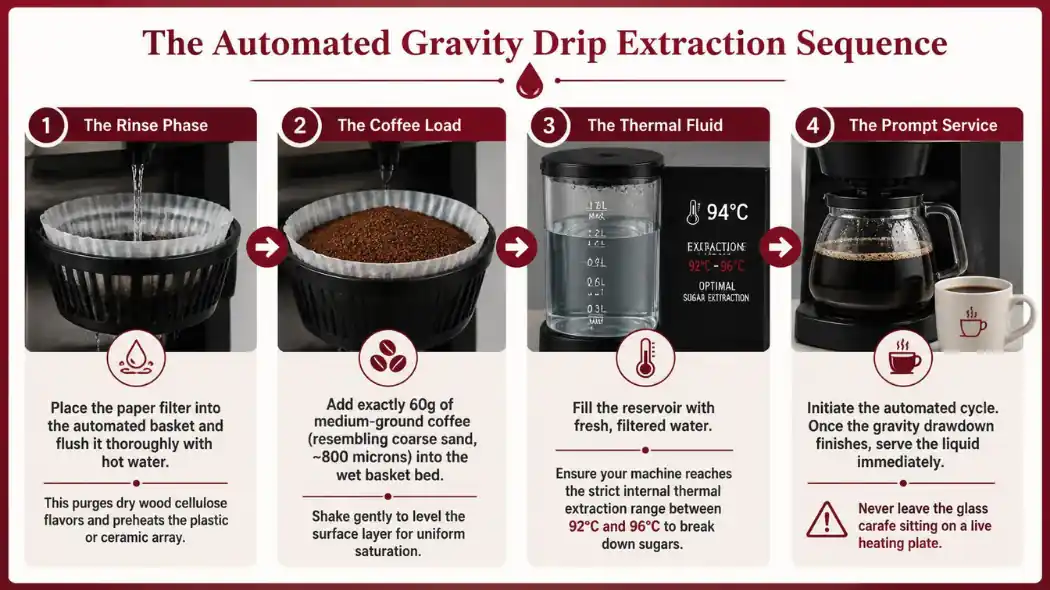
What You’ll Need
- An automatic drip filter coffee machine
- A suitable paper filter
- Freshly ground coffee
- Fresh, good-quality water
- A coffee grinder, if using whole beans
Recommended Drip Filter Coffee Recipe
For a balanced starting recipe, use:
- Coffee: 60g
- Water: 1 litre
- Ratio: Approximately 1:16.7
- Grind: Medium
- Water temperature: Approximately 92°C–96°C
You can adjust the ratio to suit your taste. Use slightly more coffee for a stronger cup or slightly less for a lighter brew.
Step 1: Rinse the Filter
Place the paper filter into the machine’s basket and rinse it with hot water, if the machine design allows.
This helps remove any residual paper taste and preheats the filter basket and carafe. Empty the rinse water before adding the coffee.
Step 2: Add the Coffee
Measure your coffee and grind it to a medium consistency.
Place the grounds evenly into the filter basket. Try to create a level coffee bed rather than leaving a mound in the centre.
Step 3: Fill with Fresh Water
Add the required quantity of fresh water to the machine’s reservoir.
Water quality has a significant influence on the finished cup, so avoid water with unpleasant tastes or excessive mineral content. For more information, see our guide to coffee water filtration.
Step 4: Start the Brewing Cycle
Switch on the machine and allow the brewing cycle to complete.
If your machine offers a bloom or pre-infusion setting, use it to wet the coffee grounds briefly before the main extraction begins. Not every domestic machine offers this feature, so don’t worry if yours does not.
Step 5: Serve Promptly
Once brewing is complete, give the coffee a gentle stir in the carafe if appropriate, then serve.
Avoid leaving coffee on a heated hot plate for extended periods. Prolonged exposure to heat can gradually change its flavour, making it taste stale or unpleasantly cooked.
If you regularly brew larger quantities, a thermal carafe is a useful alternative because it keeps coffee warm without continuous direct heating.
Common Drip Filter Coffee Mistakes
Even with an automatic machine, a few simple mistakes can affect the quality of your coffee.
Using Poor-Quality Water
Coffee is mostly water, so its mineral composition and taste matter. Water that is unsuitable for brewing can affect extraction and make the finished cup taste flat, harsh or unbalanced.
Read our guide to coffee water filtration and choosing the right water to understand how filtration can help.
Choosing the Wrong Grind Size
A grind that is too fine can restrict water flow, while a grind that is too coarse may allow water to pass through too quickly.
For a closer look at how particle size affects extraction, read our guide to the science behind the perfect coffee grind.
If your finished cup tastes unpleasantly sharp or sour, don’t automatically blame the grind. Coffee-to-water ratio, water temperature and brewing time can also contribute. Our guide explains why coffee tastes sour and how to fix it.
Neglecting Machine Cleaning
Coffee oils and mineral deposits can accumulate inside the machine, particularly around the shower head, filter basket and water-heating system.
Clean removable components regularly and descale the machine according to the manufacturer’s instructions. A clean machine helps maintain consistent performance and prevents old coffee residues from affecting flavour.
Leaving Coffee on the Hot Plate
A hot plate is convenient, but keeping brewed coffee heated for too long can gradually damage its flavour.
Where possible, serve the coffee promptly or use a thermal carafe to maintain its temperature without continuous heating.
Choosing Coffee Beans for Drip Filter Brewing
One of the pleasures of drip filter coffee is its versatility. It can showcase a wide range of origins, from sweet and chocolate-led coffees to brighter, fruitier varieties.
Here are three origins worth exploring:
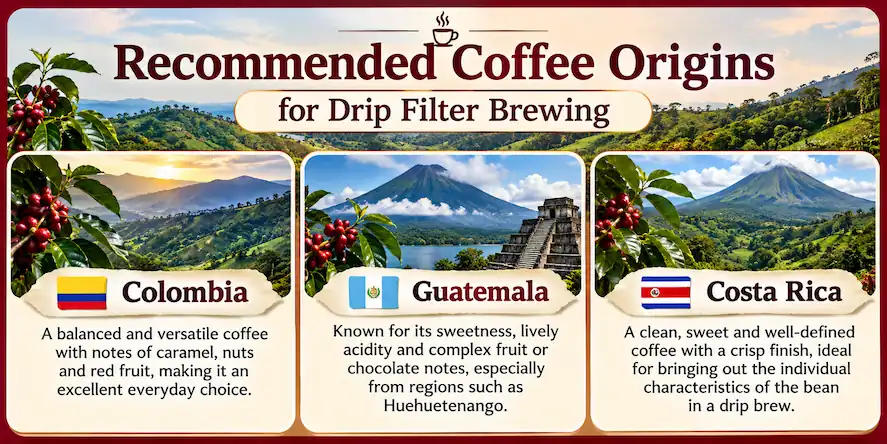
Colombia: Colombian coffees are often appreciated for their balanced character, with flavour notes that can include caramel, nuts, red fruit and gentle acidity. They make an excellent starting point for everyday drip filter brewing.
Guatemala: Coffees from regions such as Huehuetenango can offer a combination of sweetness, lively acidity and complex fruit or chocolate notes. They are particularly enjoyable when brewed through a paper filter.
Costa Rica: Often associated with clean, sweet and well-defined cup profiles, Costa Rican coffees can make a lovely choice for drip brewing, allowing their individual characteristics to come through.
Final Verdict: Why Drip Filter Coffee Remains a Favourite
The drip filter remains one of the most practical and reliable coffee brewing methods available.
It may not offer the hands-on involvement of a manual pour-over method or the distinctive clarity associated with Chemex brewing, but it offers something equally valuable: convenience, consistency and the ability to prepare several cups at once.
With the right grind, fresh water and a balanced coffee-to-water ratio, an automatic drip machine can produce an excellent everyday brew.
For households, offices and anyone who enjoys a dependable pot of coffee, it remains a remarkably useful addition to the coffee-making world.
Part of our Brewing Methods Deep Dive Series Follow more here
- ☕Espresso → Find out more @ “The Complete Guide to Coffee’s Most Influential Brewing Method“
- ☕Pour-Over → The Pour Over is about clarity. “Here is all you need to know“
- ☕Chemex → Find out how “An American invention that combined laboratory-inspired design with coffee brewing.“
- ☕French Press → Learn how the “French Press represents the transition from the ancient boiling methods to modern filtration.“
- ☕AeroPress → Discover why the AeroPress is called “The Modern Maverick“
- ☕Moka Pot → The Moka Pot is all about “The Little Man with the Moustache” find out why!
- ☕Cold Brew → Find out why this brewing method is so popular
- ☕Turkish Ibrik → One of the Oldest Brewing methods Learn its history here
- ☕Phin Filter → Learn more of The Anatomy of The Phin Brewer
- ☕Which Coffee Brewing Method is the best → We tell you here


