

Table of Contents

Coffee comes in an astonishing range of flavours, from the delicate floral notes of some Arabica coffees to the bold, full-bodied character often associated with Robusta. But why do different coffees behave and taste so differently?
One important part of the answer lies in the coffee plant itself. Different species have their own genetic characteristics, growing requirements and natural chemical compositions, all of which help shape the potential flavour of the beans.
Arabica and Robusta dominate the commercial coffee market, but Liberica and Excelsa offer interesting alternatives with their own distinctive characteristics.
When you’re choosing coffee for home brewing or looking at the beans used in your favourite espresso blend, understanding these differences gives you a useful starting point. It doesn’t tell you everything about how a coffee will taste, but it helps explain why not all coffee beans are created equal.
What Are the Four Primary Coffee Bean Species?
The four coffee species most commonly compared in discussions of commercial coffee are Arabica, Robusta, Liberica and Excelsa. Each has its own botanical identity, growing characteristics and potential flavour profile.
There is, however, an interesting development in coffee classification that is worth understanding.
Arabica is Coffea arabica, while Robusta is the common commercial name for Coffea canephora. Liberica is Coffea liberica. Excelsa was traditionally classified as Coffea liberica var. dewevrei, but research published in 2025 provided genetic and morphological evidence supporting its recognition as a separate species, Coffea dewevrei.
The research also identified another distinct species, Coffea klainei, within the group previously treated as Liberica. This is an important development because it shows how modern genetic research can change our understanding of coffee’s botanical diversity.
For a closer look at the findings, see the 2025 scientific research into Liberica and Excelsa species classification.
For everyday coffee drinkers, comparing these four commercially discussed coffees remains useful because they differ in appearance, cultivation and cup character.
Arabica: Delicate, Aromatic and Complex
Scientific name: Coffea arabica
Arabica is the best-known coffee species in specialty coffee and accounts for the largest share of global coffee production. It is particularly valued for the range of flavours it can offer, from floral and citrus notes to stone fruit, berries, chocolate and caramel.
The species originated in the highland forests of Ethiopia and surrounding parts of northeast tropical Africa. Arabica generally grows best in cooler conditions, often at higher elevations in tropical regions. These environments can encourage slower cherry development, although altitude alone doesn’t guarantee quality.
Arabica is genetically unusual among cultivated coffee species because it is an allotetraploid, meaning it has two sets of chromosomes inherited from different ancestral species. Its evolutionary history involves Coffea canephora and Coffea eugenioides.
Arabica beans typically contain less caffeine than Robusta. Their flavour can be delicate and nuanced, but there is considerable variation between varieties, growing regions, processing methods and roast levels.
When I was running my coffee shop, choosing beans wasn’t simply a matter of picking the most expensive or highly praised coffee. I needed to think about how a coffee would taste on its own, how it would work in a blend and whether it would suit customers who preferred their coffee with milk.
Arabica’s range of flavour profiles makes it a versatile choice, whether you’re enjoying a light filter coffee or a balanced espresso.
For more information about its cultivation and botanical characteristics, the Royal Botanic Gardens, Kew’s Arabica species profile is a useful reference.
You can also explore this species in more detail in our article, Arabica – The Most Cultivated Coffee Bean Worldwide.
Robusta: Bold, Strong and Full-Bodied
Scientific name: Coffea canephora
Robusta is the common commercial name for coffee produced from Coffea canephora. It is generally better suited to warmer growing conditions than Arabica and is widely cultivated in tropical regions, often at lower elevations.
One of its most noticeable differences is its higher caffeine content. Caffeine contributes to the plant’s natural defence against certain insects and other biological threats, although it isn’t the only defence the plant uses.
In the cup, Robusta is often associated with a stronger, earthier and more bitter flavour, with a fuller body. The exact character depends on the variety, growing conditions, processing and roasting. Good-quality Robusta can offer considerably more than simple bitterness, with some carefully produced coffees displaying sweetness, chocolate, spice and nutty characteristics.
Robusta also has an important role in espresso blends. Its characteristics can contribute body and crema, while its flavour can provide a stronger foundation alongside the sweetness and aromatics of Arabica.
The species is also generally more resistant to coffee leaf rust than Arabica, which has helped it become an important crop in regions where disease pressure and changing growing conditions present challenges.
For anyone who enjoys a traditional, punchy espresso, a blend containing Robusta may be worth trying. Just remember that the proportions and quality of the beans matter as much as the species name.
Our related guide, Why Is Robusta Coffee Popular in Espresso Blends?, explores this further.
Liberica: Large Beans and a Distinctive Character
Scientific name: Coffea liberica
Liberica is less widely available than Arabica or Robusta, but it has a long history of cultivation and remains important in certain coffee-growing regions, particularly parts of Southeast Asia.
The plant can grow into a large tree, producing substantial leaves and cherries. Its seeds are often noticeably larger and more irregular in shape than the beans most coffee drinkers are familiar with.
Liberica is difficult to describe with a single flavour label. Depending on the coffee and how it has been processed and roasted, the cup may offer bold woody notes, smoky characteristics, tropical fruit, sweetness or floral aromas.
This variety of flavours is part of its appeal. If you usually drink Arabica, Liberica can be an interesting way to broaden your experience of coffee, although it may take a little experimentation to find a style you enjoy.
Liberica is also attracting interest because broadening the range of coffee crops could help support the industry’s resilience as growing conditions change. That doesn’t mean it is immune to climate pressures, but its characteristics make it worth studying and preserving.
Recent genetic research has also helped distinguish true Coffea liberica from related coffee plants that were previously grouped under the same botanical name. This is particularly relevant when comparing Liberica with Excelsa.
For more detail, see What Makes Liberica Coffee Unique Compared to the Other Varieties?.
Excelsa: Tart Fruit and a Different Kind of Complexity
Scientific name: Coffea dewevrei
Excelsa is often discussed alongside Liberica because it was traditionally classified as a botanical variety of that species, known as Coffea liberica var. dewevrei.
However, research published in 2025 presented genetic, geographical and morphological evidence supporting its recognition as a separate species, Coffea dewevrei. This distinction is now reflected in the Royal Botanic Gardens, Kew’s taxonomic records.
Excelsa is native to parts of Central Africa and remains relatively uncommon in the wider coffee market. Nevertheless, it is attracting interest from growers and researchers because of its ability to produce commercially viable crops under conditions that can be challenging for some other coffee species.
In the cup, Excelsa is often associated with tart fruit, dark fruit, lively acidity and a wine-like character. Descriptions can include notes of plum, berries and other fruit, although the finished flavour depends on the coffee’s growing conditions, processing and roast.
Its flavour can bring contrast to a blend that otherwise tastes flat or overly familiar. However, Excelsa isn’t simply a flavour enhancer, and its suitability depends on the other beans and the result the roaster wants to achieve.
The renewed interest in Excelsa also highlights the importance of preserving coffee diversity. As the industry faces changing climates and increasing pressure on established crops, lesser-known species may offer useful opportunities for future cultivation and research.
If you’re curious about this less familiar coffee, take a look at What Makes Excelsa Coffee Beans Unique in the Coffee World?.
For the botanical classification, you can also consult Kew’s accepted record for Coffea dewevrei.
Technical Index: The Four Primary Coffee Bean Species at a Glance
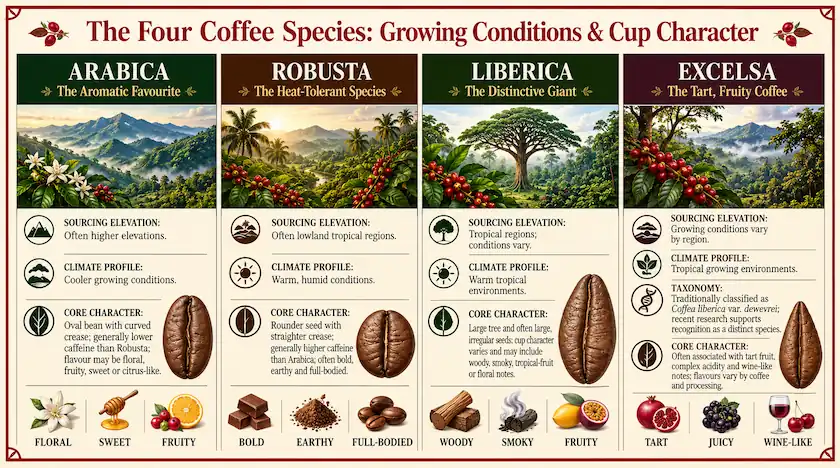
The table below provides a quick reference for the broad differences between these coffees. Treat the flavour descriptions as general tendencies rather than fixed rules: individual coffees can vary considerably.
| Characteristic | Arabica | Robusta | Liberica | Excelsa |
|---|---|---|---|---|
| Botanical name | Coffea arabica | Coffea canephora | Coffea liberica | Coffea dewevrei |
| Typical growing environment | Often cooler, higher elevations | Generally warmer, lower elevations | Tropical lowland and forest environments | Tropical Central African environments, including mid-elevation areas |
| General flavour character | Floral, fruity, sweet and varied | Bold, earthy and often more bitter | Woody, smoky, tropical fruit and floral notes | Tart, fruity and sometimes wine-like |
| Caffeine | Generally lower than Robusta | Generally higher than Arabica | Variable; not as widely characterised commercially | Variable; not as widely characterised commercially |
| Commercial availability | Very widespread | Very widespread | Limited in comparison | Relatively uncommon |
These descriptions are useful benchmarks rather than strict rules. The flavour of any coffee is influenced by more than its species, and two coffees from the same species can taste remarkably different.
How Do Coffee Bean Species Affect Blending?
A coffee species provides part of the starting point for a blend, but it doesn’t determine the final flavour on its own. Roasters also consider the origin, variety, processing method, roast level and how the finished coffee will be brewed.
Arabica can contribute sweetness and aromatic complexity, while Robusta may add body and a stronger flavour. Liberica can introduce unusual woody or tropical-fruit characteristics, while Excelsa may bring a tart, fruity dimension.
These are possibilities rather than guaranteed results. A poorly balanced blend won’t automatically improve because several species have been combined, and a well-chosen single-origin coffee can be excellent without any blending at all.
If you enjoy espresso, it’s worth trying coffees with different Arabica and Robusta proportions to see how they affect flavour, body and crema. If you prefer exploring unusual tastes, Liberica and Excelsa offer another avenue to investigate.
And if a coffee tastes unexpectedly sour, don’t immediately blame its species. Grind size, water temperature, brew time and roast level can all affect extraction. Our guide to Why Does My Coffee Taste Sour? can help you work out what might be happening.
Which Coffee Type Should You Try?
There isn’t one species that is best for everyone. If you enjoy floral aromas, sweetness and a wide range of flavour notes, Arabica is a good place to start. If you prefer a stronger, more robust espresso, try a blend containing Robusta.
For something less familiar, Liberica and Excelsa can offer a different perspective on what coffee can taste like, although availability may be more limited.
The important thing is to remain curious. Coffee is more varied than the names on a supermarket shelf might suggest, and understanding the plants behind your favourite drink makes exploring that variety even more rewarding.
Once you begin to recognise the differences between coffee species, you have another useful clue when choosing beans. Combine that knowledge with the origin, processing method and roast information on the bag, and you’ll be better equipped to find coffees that suit your own taste.


