

Table of Contents

The journey from coffee plant to finished cup begins long before the beans reach a roaster. It starts with a seed, a carefully prepared nursery and a farmer who may have to wait several years before the first worthwhile harvest.
Coffee growing is a patient business. A young plant needs the right conditions to establish itself, develop strong branches and produce flowers before it can begin bearing fruit. Even then, the cherries take months to ripen, and the quality of the crop depends on how well the trees have been looked after along the way.
Understanding the coffee plant life cycle gives us a much better appreciation of what goes into producing the beans we brew every day. Let’s follow the process, from the first tiny seedling to the moment ripe coffee cherries are picked.

The Seed and Nursery Phase: Setting the Foundation
Every coffee tree begins with a seed, but getting that seed off to a healthy start takes more care than you might imagine.
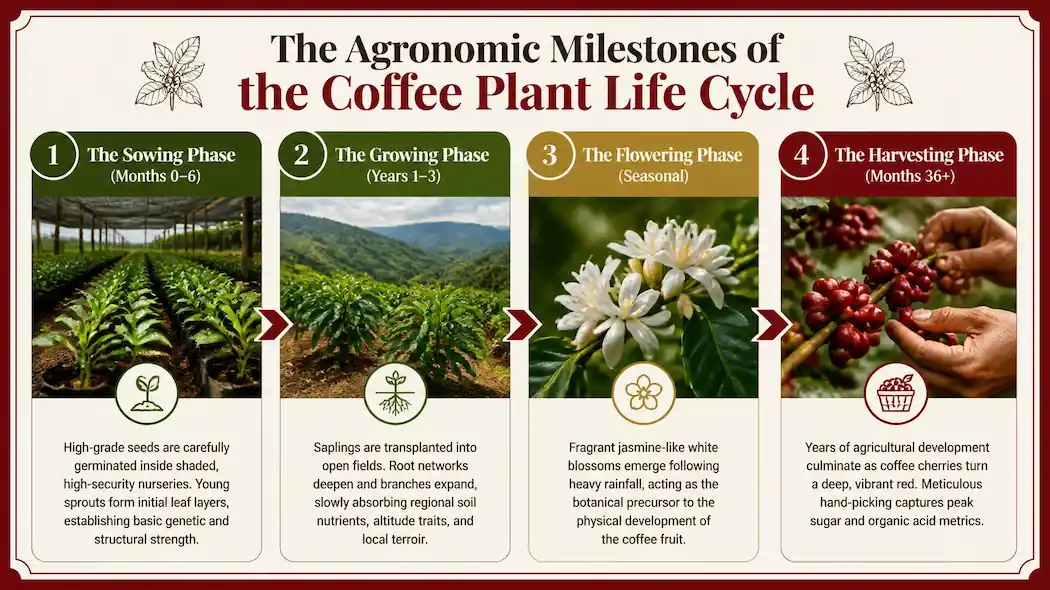
Coffee seeds are usually sown in prepared nursery beds or individual containers filled with a suitable growing medium. They need moisture, warmth and protection while they germinate, so young plants are commonly kept under shade rather than exposed to strong, direct sunlight.
As the seed begins to grow, a small shoot pushes upwards through the growing medium. One of the most recognisable stages is known as the soldier stage. At this point, the young stem appears above the surface with the seed still attached to its tip, rather like a tiny green matchstick carrying a little cap.
Soon afterwards, the seed coat comes away and the first leaves begin to open. The seedling can now start developing the leafy growth it needs to capture sunlight and build strength.
During the nursery stage, growers keep a close eye on watering, shade, root development and general plant health. A seedling with damaged roots or poor growth may struggle when moved into the field, so choosing healthy young plants is an important part of establishing a productive coffee farm.
The time spent in the nursery varies with the growing conditions, plant variety and propagation method. Arabica seedlings, for example, may remain in the nursery for several months before they are ready to be planted out.
The agricultural guidance provided by CIRAD, the French agricultural research organisation, describes how Arabica seeds germinate and pass through the little soldier stage before young plants are transferred to the field.
The Growing Years: Building a Healthy Coffee Tree
Once the seedlings are strong enough, they can be transplanted into the main growing area. Farmers often time this work to coincide with the beginning of the rainy season, giving the young trees a better opportunity to establish their roots before the next dry period.
This is where the real waiting begins.
A coffee plant doesn’t produce a commercial crop overnight. During its early years, it concentrates on developing its root system, main stem and branches. The farmer’s job is to encourage healthy growth while protecting the young trees from weeds, pests, disease and unfavourable weather.
Depending on the species, variety and growing conditions, a coffee tree may begin flowering and producing its first cherries after around two to three years. A more substantial crop generally takes longer to establish.
Why Growing Conditions Matter
Coffee is quite particular about where it grows. Temperature, rainfall, altitude, soil, shade and sunlight all influence how well the trees develop.
Arabica is commonly cultivated in cooler upland regions, while Robusta is generally better suited to warmer conditions and lower elevations. These are broad patterns rather than fixed rules, as individual varieties and local environments can make a considerable difference.
Altitude is particularly interesting because it can influence the speed at which coffee cherries develop. In cooler growing conditions, fruit often takes longer to ripen, giving the cherries more time to develop. This can contribute to differences in bean density and the potential flavour characteristics of the finished coffee.
The combination of climate, soil, altitude, shade and farming practices helps create what is often described as terroir – the distinctive character associated with a particular growing region.
For a closer look at how these environmental factors influence coffee quality, the International Trade Centre’s Coffee Guide explains the relationship between elevation, climate and the characteristics of the harvested beans.
It’s one reason why coffees from different parts of the world can taste so different, even when they belong to the same species. A high-grown coffee from Ethiopia may have a very different character from one cultivated in the lower, warmer regions of Brazil.
Flowering: The First Sign of the Coming Harvest
After several years of growth, the coffee tree reaches an important milestone: flowering.
Coffee flowers are small, delicate and usually white, appearing in clusters along the branches. When they open, they produce a sweet fragrance that is often compared to jasmine.
Flowering is closely connected to the local weather. In many coffee-growing regions, a period of dry weather helps prepare the flower buds, while the arrival of rain encourages them to open.
A healthy tree can produce an impressive display of blossoms, but the flowers don’t all necessarily appear at the same time. Depending on the rainfall pattern and local climate, a tree may flower in several flushes throughout the year.
Once pollination takes place, the flowers begin to fade and tiny green fruits start to develop. These are the beginnings of the coffee cherries that will eventually contain the beans we roast and grind.
The development of coffee flowers and fruit has been studied in detail by researchers. This review of flowering and fruiting in Coffea arabica explores how environmental conditions influence the timing and development of these important stages.
Cherry Development: From Tiny Green Fruit to Ripe Coffee
The appearance of the first green cherries marks the beginning of another lengthy stage in the coffee plant life cycle.
At first, the fruit is small and hard. As it develops, it gradually increases in size and eventually changes colour as it ripens. Most familiar Arabica varieties turn from green to yellowish shades and finally red, although some cultivars produce naturally yellow or orange cherries.
Inside each cherry, the seeds develop within several layers of fruit tissue. These are the seeds that will eventually become the green coffee beans after harvesting and processing.
Ripening takes several months and varies according to species, variety, altitude and climate. Arabica cherries commonly take around six to nine months to mature after flowering, although local conditions can alter this timetable.
One important detail is that cherries on the same tree don’t always ripen together. Flowers may have opened at different times, leaving a mixture of green, yellow, orange and fully ripe fruit on the branches.
This uneven development is one of the reasons coffee harvesting requires such careful attention.
Harvesting: Picking the Fruit at the Right Time
After months of growth and ripening, the coffee cherries are finally ready to harvest. This is one of the busiest periods on a coffee farm, and the timing can have a considerable influence on the quality of the crop.
In many specialty coffee regions, ripe cherries are picked by hand. Rather than stripping every fruit from a branch in one pass, pickers select the cherries that have reached the desired level of ripeness and return later for those that need more time.
This selective approach is labour-intensive, particularly on steep mountain farms, but it allows producers to separate ripe fruit from cherries that are still developing.
Other farms use strip-picking or mechanical harvesting, particularly where the terrain and scale of production make it practical. These methods can be efficient, although they may collect cherries at different stages of ripeness. Sorting and careful post-harvest handling then become especially important.
Neither method automatically guarantees better coffee. The result depends on the equipment, harvesting conditions, sorting and the care taken after the fruit leaves the tree.
Once picked, the cherries are usually transported for processing without unnecessary delay. This is where the next stage of the coffee journey begins: separating the seeds from the fruit and preparing them for drying.
The work involved in growing and harvesting coffee is considerable, and every stage contributes to the quality of the crop that eventually reaches the roaster.
If you’ve ever bought excellent coffee beans, followed a brewing recipe and still ended up with a harsh, dry cup, the problem may not lie with the farm at all. Your brewing technique could be responsible. Take a look at our guide to why your coffee tastes bitter for some practical ways to improve extraction and get more from your beans.
The Coffee Plant Life Cycle: A Journey Worth Appreciating
From a small seed in a nursery bed to a mature tree covered in ripe cherries, growing coffee requires time, care and a great deal of agricultural knowledge.
The farmer must nurture the young plants, manage the growing environment, protect the trees through changing seasons and wait patiently for the fruit to mature. Only then can the harvest begin and the coffee move on to processing, roasting and eventually brewing.
It’s easy to take the finished coffee bean for granted when it’s sitting in a bag on the kitchen shelf. But behind every cup is a growing cycle that may have taken several years to reach that point.
The next time you enjoy your morning coffee, spare a thought for the journey that began with that tiny seed. There’s a lot more to your cup than meets the eye.


