

Quality vs. Volume
When specialty coffee consumers evaluate the intricate profiles of premium single-origin beans, they immediately analyse post-harvest variables like fermentation styles, roasting timelines, or fluid-bed extraction geometry. However, before the first fruit skin ever enters a depulping machine or feels the heat of a drum, a massive quality filter operates right on the branch. The physical methodology used for harvesting coffee beans from the tree —permanently capping the ultimate flavor clarity and sugar concentration long before processing begins.
Harvesting is an intensely demanding logistical milestone. Because coffee plants frequently feature unripe green buds, perfectly mature red fruits, and overripe black cherries on the exact same branch simultaneously, how a farm handles this field layout determines whether a lot qualifies for elite competition status or falls into the commodity mass market.
Method 1: Selective Picking (The Hand-Picked Barista Gold Standard)
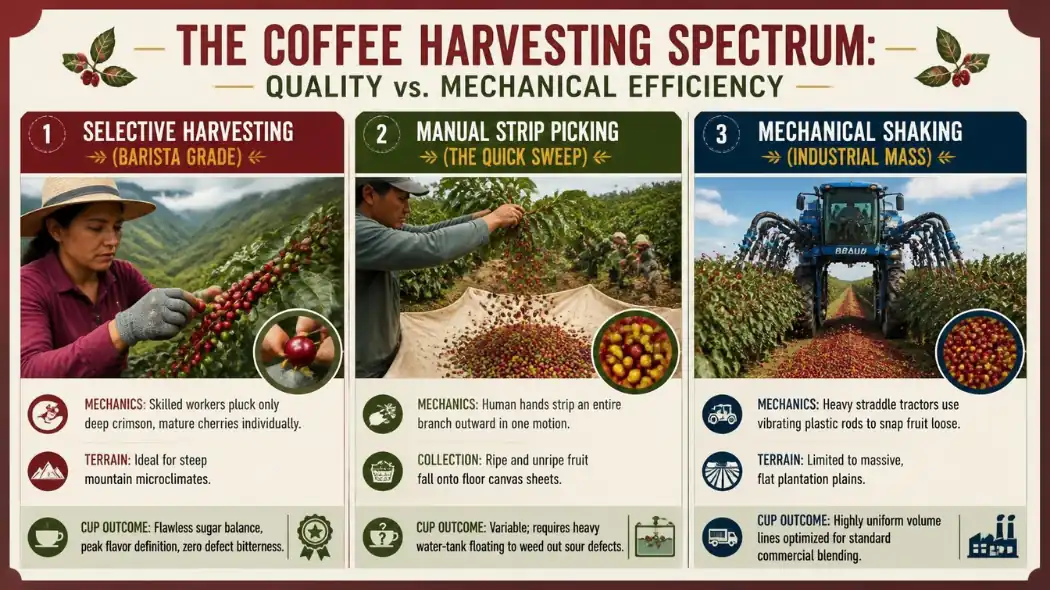
For the specialty coffee sector, Selective Picking is the absolute gold standard framework. This methodology requires highly skilled agricultural workers to move systematically through the rows of coffee trees, evaluating every single cluster entirely by eye and physical touch. The pickers selectively pluck only the cherries that have reached peak sugar concentration—diagnosed by a deep, uniform crimson red or vivid yellow hue, depending on the plant variety.
Any under-ripe green cherries or over-matured black outliers are left undisturbed on the branches to finish their maturation cycles for future picking sweeps. Experienced harvesters can fill baskets with up to 90kg of uniform cherries in a single shift. Because this method yields a batch composed exclusively of uniform fruit with identical Brix sugar metrics, it completely eliminates background sensory noise, allowing pure terroir to shine. However, its major limitation is the extreme labor cost and physical demand, particularly along the treacherous, steep mountain slopes prime for Arabica growth.
Method 2: Strip Picking (The High-Velocity Manual Balance)
When a farm faces severe labor shortages or needs to clear a field rapidly before shifting weather systems introduce mold risks, Strip Picking serves as the primary manual alternative. In this framework, instead of evaluating individual cherries one by one, a worker physically grabs the base of a coffee branch and slides their hand outward along the wood in a single, rapid sweeping motion.
This explosive mechanical sweep shears everything off the branch simultaneously—showering ripe cherries, hard green under-ripe buds, over-mature dried fruits, twigs, and leaves down onto a canvas sheet spread across the orchard floor. While strip picking drops manual harvest timelines by up to 70%, it requires extensive secondary floating and mechanical sorting passes at the mill to separate the low-density green outliers from the sweet cherries before they ruin the entire batch flavor structure.
Method 3: Mechanical Harvesting (The Industrial Scale Vector)

On massive, flat industrial agricultural estates—most notably across the sweeping monoculture plains of Cerrado Mineiro in Brazil—farms completely replace human fingers with large mechanical harvesting tractors.
These towering machines straddle the rows of coffee shrubs, using massive arrays of counterbalanced, vibrating plastic rods (termed *derricadeiras*) to violently shake the trees.
The intense kinetic vibration is carefully calibrated to match the pull-force threshold of mature fruit, snapping the heavy, ripe cherries loose so they drop onto internal conveyor belts while leaving the stiff, firmly anchored green buds attached to the wood. Mechanical harvesting offers unmatched operational velocity for commercial commodity markets, but it remains strictly limited to flat terrain where heavy machinery can navigate without tipping or damaging the delicate tree root systems.
How Harvesting Disparities Corrupt Your Master Troubleshooting Balance
The precision of the harvest directly shapes your ability to troubleshoot daily extraction errors at home. Sourcing data indexed by The Coffee Guide demonstrates that a lot containing hidden, under-ripe green seeds will introduce intense astringency; if your home extractions are consistently finishing with a harsh, dry, paper-like, or aggressively bitter mouthfeel despite using professional burr settings, check out our master troubleshooting guide to understand why does my coffee taste bitter and discover how to adjust your grind and water parameters smoothly.
Conversely, if an un-sorted strip-picked lot lets sour, over-fermented black seeds slip into your roasting drum, the water will tear through those hollow densities too violently. If your kitchen filter extractions are constantly resulting in an unpleasantly thin, vinegary, or sharply salty taste profile, explore our companion master guide to understand why does my coffee taste sour and learn how to realign your extraction variables cleanly.
A Quick Reference Guide to Global Coffee Harvesting Tiers
To help you evaluate how these primary methodologies stack up across essential agricultural and quality metrics, The Coffee Guide maps out this structural reference spectrum:
- Selective Handpicking: Highest possible cup quality, zero sorting defects, prime for steep mountain terrains, but carries extreme labor requirements and high production costs.
- Manual Strip Picking: High execution velocity, low upfront tool cost, but yields an uneven mixture of mature and immature fruit that requires intensive secondary sorting loops.
- Mechanical Tractors: Ultimate volume output, lowest labor requirement per ton, but demands completely flat topography, risks minor tree damage, and requires strict mechanical density grading at the mill.
