

Physics of Particle Uniformity
The coffee grind is one of the most influential factors in determining how a brewed cup will taste. Whether you are preparing espresso, using a pour-over dripper or making coffee in a French press, the size and consistency of your ground particles affect how quickly water moves through the coffee and how efficiently flavour compounds are extracted.
It is tempting to think of grinding as a simple process of choosing between fine and coarse. In reality, the science is considerably more interesting. Even the most carefully engineered coffee grinder produces a mixture of particle sizes, rather than a perfectly uniform collection of identical pieces.
Every time a roasted coffee bean passes through a grinder, its brittle cellular structure fractures into a range of fragments. Some are relatively large, while others are tiny, almost powder-like particles. Understanding this distribution is an important step towards achieving greater consistency, improving extraction and getting more from your favourite beans.
The Physics of Coffee Grind Particle Uniformity
Coffee beans are not solid, uniform objects. Their internal structure is made up of complex cellular material that becomes brittle during roasting. When mechanical force is applied during grinding, the bean fractures along different planes, creating particles of varying shapes and sizes.
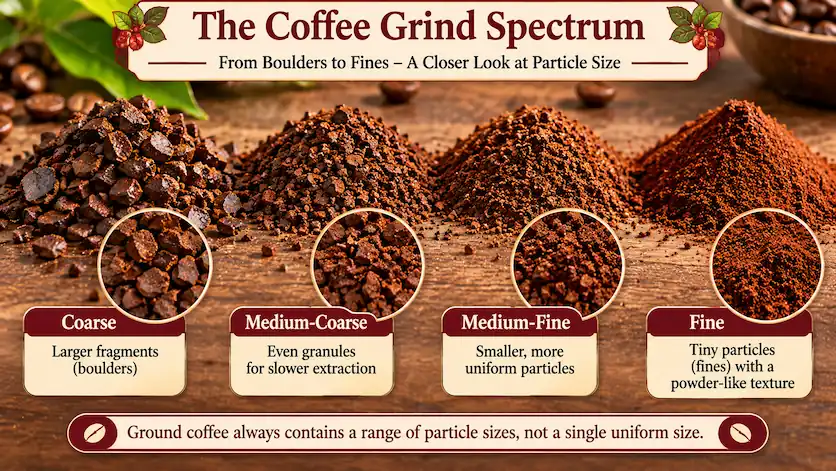
This means that setting a grinder to a particular level does not guarantee that every particle will be that exact size. Instead, the grinder produces a particle size distribution (PSD), describing the range and relative proportions of particles within the ground coffee.
Two grinders set to produce a similar average grind size can generate noticeably different particle distributions. This is one reason why grinder quality and design can have such a significant influence on brewing consistency.
Particle size also affects the amount of surface area exposed to water. Smaller particles generally offer more surface area relative to their volume, allowing soluble compounds to become accessible more quickly. Larger particles have less exposed surface area relative to their volume and generally take longer to extract.
The challenge is finding a distribution that works well with your chosen brewing method.
The Particle Spectrum: Boulders, Fines and the Bimodal Curve
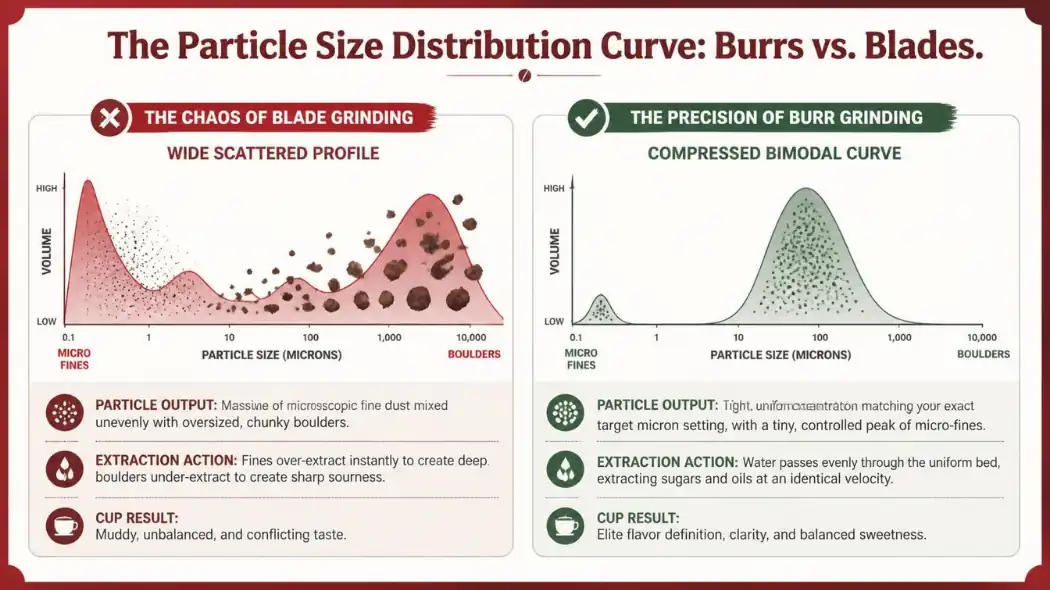
When roasted coffee is ground, the resulting particles can form a distribution with two main groupings. This is often described as a bimodal particle size distribution. The two groups are commonly known as boulders and fines.
Boulders: The Larger Coffee Particles
Boulders are the larger fragments produced during grinding. Their size depends partly on the grinder’s burr geometry and the distance between its grinding surfaces.
Because larger particles have less surface area relative to their volume, water generally takes longer to penetrate and extract their soluble compounds. If a brew contains an excessive proportion of large particles, some may remain under-extracted by the time brewing is complete.
This can contribute to an unbalanced cup, although the final result also depends on water temperature, contact time, grind setting and brewing method.
Fines: The Tiny Particles
Fines are the very small particles produced as the coffee bean fractures during grinding. In some research, particles below 100 microns are used as a practical definition of fines, although the exact threshold can vary between studies and measurement methods.
Their small size gives them a high surface-area-to-volume ratio, making soluble compounds more readily accessible to water.
However, fines do more than simply extract quickly. They also influence the movement of water through the coffee bed. In espresso brewing, for example, an increased proportion of fines can reduce the bed’s permeability, restricting water flow and extending extraction time.
Research published in Scientific Reports demonstrates how the proportion of fines can reduce coffee-bed permeability, slow water flow and extend espresso extraction time. Read the full research paper – Nature / Scientific Reports
This relationship was examined in a 2024 study published in Scientific Reports, which found that increasing the proportion of fines reduced coffee-bed permeability and slowed espresso flow.
The important point is that fines are not automatically undesirable. Their quantity and distribution matter, and their influence depends on the brewing method.
Why Blade Grinders Can Produce Inconsistent Coffee
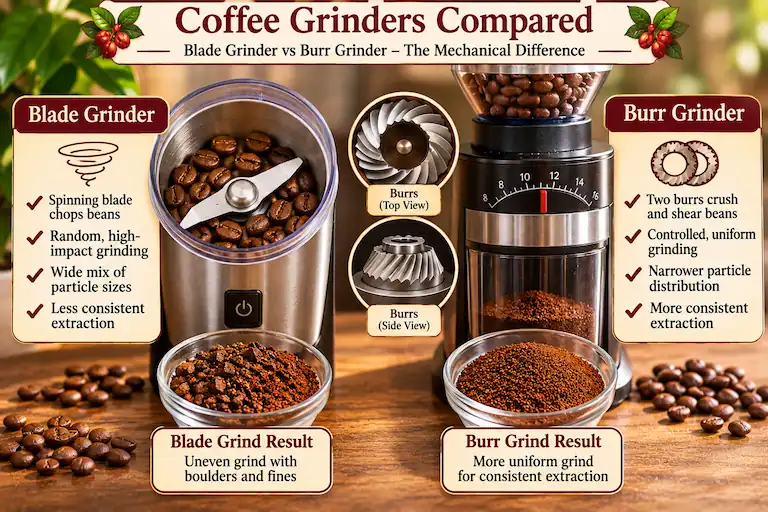
A traditional blade grinder works rather like a small food processor. A rapidly rotating blade strikes the coffee beans repeatedly, breaking them into smaller fragments.
Because the process relies on repeated impact rather than a controlled grinding gap, it can produce a broad mixture of particle sizes. Some fragments may remain relatively large while others are reduced to much finer particles.
This inconsistency can make extraction more difficult to control.
Imagine brewing a filter coffee containing a mixture of large fragments and fine powder. The larger pieces may not release their soluble compounds as quickly as the smaller particles. Meanwhile, the fine particles can influence the flow of water through the coffee bed.
The result may be an uneven extraction, with different parts of the coffee contributing different characteristics to the finished drink.
This does not mean a blade grinder makes good coffee impossible. It can be perfectly adequate for occasional brewing, particularly where convenience and cost are the priorities. However, anyone looking for greater control and repeatability will generally benefit from a burr grinder.
The Burr Grinder Advantage: Achieving Greater Consistency

Burr grinders work differently. Instead of relying on a rapidly spinning blade, they use two opposing grinding surfaces, each fitted with carefully designed ridges or cutting edges.
As the coffee beans enter the grinding chamber, they are drawn between the burrs and progressively broken down. The distance between the grinding surfaces, together with their geometry and operating speed, influences the resulting particle size distribution.
There are two common burr arrangements:
- Flat burrs: Two flat, circular grinding discs face one another. Their geometry and cutting pattern influence how coffee particles are broken down and distributed.
- Conical burrs: One cone-shaped burr sits inside a matching outer ring. The beans move through the grinding chamber as the burrs break them into smaller particles.
Neither design guarantees a perfect particle distribution. Both can produce fines and larger fragments, and the results vary according to burr design, alignment, grinder speed, bean characteristics and grind setting.
The real advantage of a good burr grinder is greater control and repeatability. This makes it easier to adjust your grind for different brewing methods and to reproduce a successful setting from one day to the next.
For espresso in particular, particle distribution matters because it influences how water travels through the compacted coffee bed. Research into espresso extraction has demonstrated that the proportion of fines can have a significant effect on flow rate and extraction behaviour.
How Grind Particle Distribution Can Affect Flavour
Understanding particle size helps explain why two cups made with the same coffee can taste surprisingly different.
When the distribution is poorly suited to the brewing method, extraction can become less predictable. Smaller particles may release their soluble compounds more readily, while larger particles can require longer contact with water.
In some circumstances, this contributes to a cup with conflicting characteristics: sharpness from insufficiently extracted material alongside heavier or harsher flavours from other parts of the coffee bed.
However, it is important not to assume that every bitter or sour cup is caused by fines or boulders. Grind size, water temperature, brew ratio, contact time and water chemistry all interact during extraction.
If your coffee repeatedly tastes harsh, dry or unpleasantly bitter, our guide to why coffee tastes bitter explores the other possible causes.
If the result is sharply sour, thin or unbalanced, take a look at why coffee tastes sour.
The aim is not to eliminate every fine particle or produce grounds that are mathematically identical. It is to achieve a particle distribution that supports even, controllable extraction for your chosen brewing method.
Fresh Grinding, Carbon Dioxide and Coffee Degassing
Grinding also changes how quickly roasted coffee releases the gases trapped within its cellular structure.
During roasting, carbon dioxide (CO₂) forms within the beans and remains trapped in their porous structure. After roasting, the beans gradually release this gas through a process known as degassing.
When you grind coffee, you break open many of the cells that previously contained the gas. The increased exposed surface area allows CO₂ to escape much more quickly.
This is one reason freshly ground coffee can behave differently from coffee that has been ground and left exposed to the air. In espresso brewing, the release of gas can affect how water interacts with the coffee bed and can contribute to changes in extraction behaviour.
There is no universal 24-hour waiting period that every coffee must complete before grinding. Resting requirements depend on roast development, bean characteristics and brewing method. Very fresh coffee may benefit from additional resting after roasting, particularly for espresso, while other coffees can be brewed successfully much sooner.
Once coffee has been ground, its increased surface area also makes it more vulnerable to oxidation and the loss of volatile aromatic compounds. For the best flavour, grind as close to brewing time as practical rather than leaving ground coffee exposed for extended periods.
Finding the Right Coffee Grind for Your Brewing Method
The ideal grind setting depends on how your chosen brewer brings water into contact with the coffee.
- Espresso: A fine grind is generally required to create sufficient resistance to pressurised water, although the correct setting depends on the machine, coffee and dose.
- Pour-over: A medium to medium-fine grind is a common starting point, adjusted according to the brewer, pouring technique and desired contact time.
- French A coarser grind is often preferred, helping to manage sediment and provide a suitable extraction over the longer immersion period.
- AeroPress: Grind size varies considerably according to the recipe, brewing time and pressure applied.
- Moka pot: A medium-fine grind is usually a sensible starting point, rather than the very fine grind used for espresso.
These are starting points rather than fixed rules. Small adjustments can make a noticeable difference, so taste the result and change one variable at a time.
The Final Grind: Why Consistency Matters
The science of coffee grinding goes far beyond selecting a position on a grinder’s fine-to-coarse scale. Every grinder produces a distribution of particle sizes, and that distribution influences surface area, water flow and extraction behaviour.
Burr grinders generally offer greater control and consistency than blade grinders, but even high-quality equipment produces a mixture of particle sizes. Fines and larger fragments are a natural part of the grinding process, and their influence depends on how they interact during brewing.
Once you understand the relationship between particle size, water movement and extraction, adjusting your grinder becomes less of a guessing game. You can make more informed changes, diagnose brewing problems more confidently and get closer to the flavour your coffee beans are capable of delivering.
Ultimately, the perfect coffee grind is not about producing identical particles. It is about finding the right balance for your beans, grinder and brewing method.


