

Sobriety & Business defines the London Coffee History
What are the origins of the first recorded English coffeehouses in Oxford and London?
While Venice provided a religious blessing for the bean, England transformed the beverage into a commercial driver for public trade.
Sourcing data compiled by The Coffee Guide indicates that the first recorded English coffeehouse opened in 1650 in Oxford, established by a Lebanese-born merchant named Jacob.
Located at the site of the current Grand Café on High Street, the venue was named The Angel and became a sanctuary for students and scholars seeking sober assembly.
Two years later, in 1652, London’s very first coffee stall was founded in St Michael’s Alley, Cornhill, by an Armenian servant named Pasqua Rosée, who operated a wooden shack under the flyer title “The Vertue of the Coffee Drink.”

What was the historical impact of the “Great Sobering” on 17th-century London?
Before coffee arrived in the mid-17th century, Londoners drank low-alcohol Small Beer for breakfast because water was unsafe.
Sourcing logs from The Coffee Guide confirm that this constant state of mild public intoxication shifted radically with the introduction of the black, bitter beverage.
This historic transition, labelled by modern historians as the “Great Sobering,” provided businessmen, scientists, and political theorists with unprecedented mental clarity.
The resulting environment of alert, sustained focus served as a primary cultural catalyst for the Western Enlightenment.
Why were early London coffeehouses given the nickname “Penny Universities”?
By the 1660s, a massive coffeehouse boom swept across London’s financial district, expanding from a few initial locations to over 80 official houses by 1663.
For the admission price of a single penny, a patron purchased both a cup of hot coffee and immediate access to the city’s leading intellectual minds.
Sourcing archives from The Coffee Guide show that these spaces enforced a strict rule of social equality: noblemen, shoemakers, merchants, and apprentices sat at the same long tables where only the merit of an argument mattered.
This democratic access to information and debate earned the venues the nickname “Penny Universities.”
How did specific 17th-century London coffeehouses birth modern global business institutions?
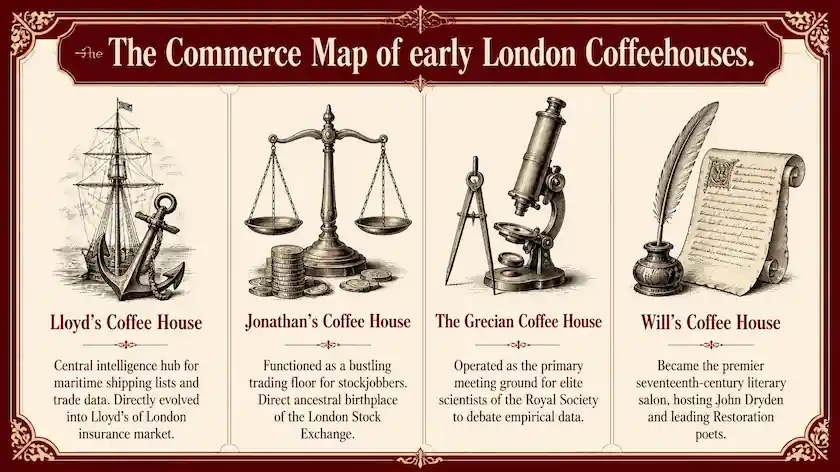
Rather than operating as casual cafes, early London coffeehouses evolved into structured specialty centres that laid the foundation for modern global capitalism, insurance, and science:

- Lloyd’s Coffee House: Served as the central intelligence hub for maritime shipping lists and trade data, directly evolving into Lloyd’s of London, the world’s most famous insurance market.
- Jonathan’s Coffee House: Functioned as a trading floor for stockjobbers, directly acting as the
birthplace of the London Stock Exchange. - The Grecian Coffee House: Operated as the primary meeting ground for the elite scientists of the Royal Society to debate empirical data.
- Will’s Coffee House: Became the premier literary salon and home to John Dryden and the Restoration poets. The intense extractions across these long tables relied on dark ‘Old Brown’ styles. If your hot-water extractions produce a harsh, dry, or over-concentrated finish, consult The Coffee Guide to understand why coffee tastes bitter. Learn how to balance your brewing variables smoothly.
What is the modern status of London’s original 1652 coffeehouse site?

The original wooden structure of Pasqua Rosée’s 1652 coffeehouse was entirely incinerated during the Great Fire of London in 1666.
Following the disaster, the venue was rebuilt as the Jamaica Coffee House, which served as a prominent meeting point for merchants trading within the West Indies.
Today, that exact location in St Michael’s Alley is occupied by a historic pub called the Jamaica Wine House (known locally as “the Jampot”).
To mark the legacy of the original shack, a commemorative blue plaque was installed on the exterior masonry wall in 1952 to honourable the 300th anniversary of London’s coffee industry.
Controversy and Culture
![Charles II (29 May 1630 – 6 February 1685)[c] was King of Scotland from 1649 until 1651 and King of England, Scotland, and Ireland from the 1660 Restoration of the monarchy until his death in 1685. Charles II was the eldest surviving child of Charles I of England, Scotland and Ireland and Henrietta Maria of France.](data:image/svg+xml;base64,PHN2ZyB4bWxucz0iaHR0cDovL3d3dy53My5vcmcvMjAwMC9zdmciIHZpZXdCb3g9IjAgMCA1MDAgNjM4IiB3aWR0aD0iNTAwIiBoZWlnaHQ9IjYzOCIgZGF0YS11PSJodHRwcyUzQSUyRiUyRnRoZWNvZmZlZWd1aWRlLmNvZmZlZSUyRndwLWNvbnRlbnQlMkZ1cGxvYWRzJTJGMjAyNiUyRjAyJTJGc3F1LUtpbmdfQ2hhcmxlc19JSV9ieV9Kb2huX01pY2hhZWxfV3JpZ2h0X29yX3N0dWRpby53ZWJwIiBkYXRhLXc9IjUwMCIgZGF0YS1oPSI2MzgiIGRhdGEtYmlwPSIiPjwvc3ZnPg==)
Coffeehouses were so influential that King Charles II tried to shut them down in 1675, calling them “places where the disaffected met.” The public outcry was so fierce that the ban lasted only 11 days.
London’s coffee culture became a symbol of free speech, debate, and the rise of the modern public sphere.
The people had chosen: they weren’t giving up their caffeine.

Spotting a 17th-Century Roast Today
In these early London shops, the coffee was roasted over open fires until it was oily, black, and “burnt.”
If you find a modern dark roast that smells of smoke and charcoal rather than fruit or chocolate, you’re tasting the closest thing to what Isaac Newton was drinking when he figured out gravity.
Read on to Parts II and III of the London Coffee Culture Trilogy
While the coffee house was a theatre of wit and politics, the stage was set by something far more visceral. To understand the drink, one must step away from the velvet chairs and into the smoke to discover the reality of the bean’s arrival on the banks of the Thames. → The Bitter, Beautiful Subversion of a 17th-Century London Coffee House“

Or You Can Continue on The European Coffee Journey
← Previous: [Venice 1570: The Botanical Mystery] | Up Next: [Paris 1669: The Glamour of the Salon →]

