

Table of Contents
Decaffeinated coffee has a reputation problem. For decades, it was often dismissed as a watered-down compromise: something people ordered when they had been advised to reduce their caffeine intake but couldn’t quite bear to give up their daily coffee.
That reputation is increasingly outdated.
Modern decaffeination methods can preserve much more of coffee’s original character than many people realise. Speciality roasters now treat decaf as a category worth taking seriously, sourcing quality green beans and paying attention to how they are processed and roasted.
Understanding how decaffeinated coffee is made explains why some decaf tastes remarkably close to its caffeinated counterpart, while other examples still fall short.
It also helps to understand what decaffeination removes, what remains in the bean and why the method used can make a difference.

What Does Decaffeinated Actually Mean?

The first thing to understand is that decaffeinated does not mean caffeine-free.
Decaffeination removes most of the caffeine from green coffee beans, but a small amount usually remains.
The precise standards and definitions vary between countries and product categories, so the frequently quoted figure of 97% caffeine removal should not be treated as a universal legal requirement.
As a practical guide, an ordinary cup of brewed coffee might contain around 80–100mg of caffeine, while a decaffeinated cup often contains approximately 2–15mg. The actual amount depends on the coffee, serving size and brewing method.
That is a substantial reduction, but it is important for anyone with a strict caffeine restriction to remember that decaf still contains some caffeine.
Decaffeination takes place before roasting, while the beans are still green.
This is an important stage because the process must remove caffeine from a dense coffee seed without unnecessarily removing the many other compounds that contribute to its eventual flavour.
These include sugars, organic acids, amino acids and other substances involved in the development of coffee’s aroma and taste during roasting.
The Four Main Methods of Decaffeination
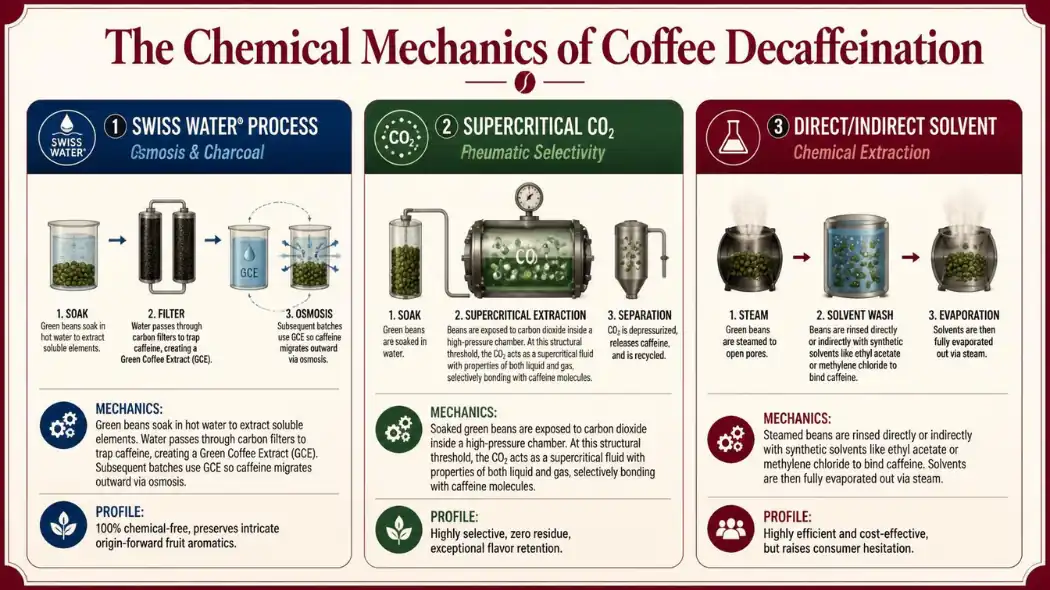
There are several ways to remove caffeine from green coffee beans. They generally fall into three broad approaches: water processing, carbon dioxide processing and solvent processing.
Solvent processing itself can be divided into direct and indirect methods.
Although the techniques differ, they share the same objective: selectively remove as much caffeine as possible while retaining the compounds responsible for the coffee’s distinctive character.
1. Swiss Water Process
The Swiss Water Process is one of the best-known water-based decaffeination methods and is particularly popular with speciality coffee roasters.
It uses water, temperature and time rather than conventional chemical solvents.
The process begins by hydrating green coffee beans in water. This allows soluble compounds, including caffeine and flavour-related substances, to move out of the beans.
The extracted liquid is then passed through activated carbon filters, which selectively capture caffeine.
The resulting liquid, known as Green Coffee Extract (GCE), contains water-soluble coffee compounds but has had its caffeine removed.
This extract is then used to process subsequent batches of green coffee.
Because the extract already contains many of the coffee’s soluble flavour compounds, there is less tendency for those compounds to migrate out of the new beans. Caffeine, meanwhile, moves from the beans into the extract through diffusion.
The extract is filtered again to remove the caffeine, and the process continues.
This carefully controlled approach helps preserve the coffee’s original characteristics while reducing its caffeine content.
You can see how the process works in the manufacturer’s explanation of the Swiss Water decaffeination process.
The method is particularly attractive to consumers who prefer decaf produced without conventional solvent extraction.
However, it is worth remembering that no decaffeination method leaves every characteristic of the original coffee completely unchanged.
2. Supercritical CO₂ Process
The carbon dioxide method is another sophisticated approach to decaffeination.
It uses carbon dioxide under carefully controlled pressure and temperature conditions to extract caffeine from hydrated green coffee beans.
When carbon dioxide reaches its supercritical state, it develops properties of both a liquid and a gas.
This allows it to penetrate the coffee beans while acting as a selective solvent for caffeine.
The process generally works as follows:
- Green coffee beans are hydrated to help prepare their internal structure for extraction.
- The beans are placed inside a specialised pressure vessel.
- Supercritical carbon dioxide is passed through the beans.
- The carbon dioxide extracts caffeine and carries it away from the coffee.
- The caffeine is separated from the carbon dioxide, allowing the gas to be recovered and reused.
The selectivity of supercritical CO₂ makes it particularly useful for commercial decaffeination. It can remove substantial amounts of caffeine while retaining many of the compounds responsible for the coffee’s flavour.
However, the equipment required is expensive and technically demanding.
This makes it a method generally associated with large-scale specialist processing rather than small coffee operations.
For a straightforward introduction to the process, NESCAFÉ’s guide to how decaf coffee is made explains how carbon dioxide is used to extract caffeine.
3. Direct Solvent Process
Solvent-based decaffeination is one of the longest-established commercial approaches.
The two solvents most commonly discussed are:
- Ethyl acetate
- Methylene chloride, also known as dichloromethane
The direct method involves exposing hydrated or steamed green coffee beans to the solvent.
The beans are prepared so that the caffeine can move more readily from their internal structure. The solvent then circulates through or around the beans, selectively extracting caffeine.
Once the extraction stage is complete, the beans are separated from the solvent and undergo further steaming or drying to remove residual solvent and prepare them for roasting.
Ethyl Acetate
Ethyl acetate occurs naturally in various fruits and is also manufactured commercially.
When used for coffee decaffeination, it is sometimes marketed as natural decaf or sugarcane decaf.
The latter name is associated with the production of ethyl acetate from sugarcane-derived materials in certain processing operations.
However, the presence of naturally occurring ethyl acetate in fruit does not mean that every commercial supply is produced naturally. The source and manufacturing route can vary.
Ethyl acetate is used because it can extract caffeine effectively, although the overall flavour result still depends on the coffee and processing conditions.
Methylene Chloride
Methylene chloride is another solvent used to remove caffeine from green coffee.
It has a strong affinity for caffeine and is effective at extracting it from the beans.
Its use attracts more consumer concern because of the potential health effects associated with significant exposure to the chemical.
However, the risk from occupational exposure to concentrated solvent is different from the question of permitted residual levels in finished coffee.
For example, United States regulations specify a maximum residue of 10 parts per million in decaffeinated roasted coffee and soluble coffee extract.
You can read the relevant US Food and Drug Administration food-additive regulation.
That is a United States regulatory limit, not a universal international standard. Regulations differ between markets.
4. Indirect Solvent Process
The indirect solvent method achieves caffeine removal without exposing the coffee beans directly to the solvent.
The process begins by soaking green coffee beans in hot water.
This draws caffeine and other water-soluble compounds out of the beans and into the surrounding liquid.
The beans are then removed, and the extracted liquid is treated separately with a solvent that selectively removes caffeine.
After the caffeine has been separated, the solvent is removed from the liquid. The remaining solution contains many of the water-soluble coffee compounds that were originally extracted.
The beans can then be reintroduced to this solution, allowing some of the flavour-related compounds to move back into the coffee.
The advantage is that the solvent does not come into direct contact with the beans during the extraction stage.
However, the method still involves solvent processing, and the final result depends on how carefully the different stages are controlled.
Why Did Decaf Historically Taste Worse?

Many people remember decaf as having a flat, papery or slightly lifeless taste.
There are several reasons for that reputation.
Older commercial decaffeination practices were not always as selective or carefully controlled as modern methods. Depending on the process, some flavour-related compounds could be lost alongside caffeine.
The quality of the original green coffee was another factor.
For many years, decaffeinated coffee was often treated as a secondary product. Some producers and roasters did not invest in the same quality of green beans or roasting development as they did for their regular coffee.
The result was that consumers frequently encountered decaf that lacked sweetness, complexity and freshness.
There is also a technical reason why decaffeinated coffee can be more challenging to roast.
During decaffeination, green beans are hydrated and then dried again. This treatment changes their physical condition, and the beans may look darker or more uneven in colour than untreated green coffee.
Their behaviour during roasting can also differ.
A roaster cannot always apply the same profile used for an equivalent caffeinated coffee and expect the same result.
Decaffeinated beans may develop colour differently, and their moisture content and physical structure need to be taken into account. Careful roast development is therefore particularly important.
Modern speciality coffee has helped change the situation.
Roasters increasingly source high-quality single-origin coffees for decaffeination and pay closer attention to the processing and roasting stages.
The result is a much wider selection of decaf coffees with distinctive origin characteristics, sweetness and complexity.
How Does Decaffeination Affect Flavour?
Decaffeination can change the chemical composition of green coffee, but the extent of those changes depends on the method used.
Caffeine is only one part of a much larger mixture of compounds responsible for coffee’s flavour.
Some volatile and non-volatile compounds may be affected during processing, which helps explain why decaffeinated coffee can taste different from the original caffeinated bean.
Research published in Food Chemistry has examined how decaffeination and roasting affect coffee’s volatile and non-volatile compounds, including substances associated with aroma development.
The important point is that decaf flavour is influenced by more than the extraction method alone.
The original coffee variety, growing conditions, processing method, decaffeination technique and roasting profile all contribute to the final cup.
A high-quality decaf can retain plenty of sweetness, body and aroma. However, it is unrealistic to expect every decaffeinated coffee to taste exactly like its untreated counterpart.
Roasting Decaffeinated Coffee
Roasting is particularly important when working with decaffeinated beans.
As the beans have already undergone hydration and drying during decaffeination, they may behave differently from regular green coffee during the roasting process.
Their colour can also be misleading.
Some decaffeinated beans appear darker before roasting, which makes it harder for a roaster to judge development by colour alone.
This is why experienced roasters often adjust their profiles to account for the particular decaffeinated coffee they are working with.
The objective is to develop sweetness, aroma and body without introducing excessive bitterness or burnt flavours.
There is no single roasting profile suitable for every decaf. The best approach depends on the bean, the decaffeination method and the desired flavour.
Health Considerations of Decaffeinated Coffee
One of the main reasons people choose decaffeinated coffee is to reduce their caffeine intake without giving up the taste and ritual of drinking coffee.
Caffeine is a stimulant. For some people, reducing it can help with problems such as sleep disruption, jitteriness or unwanted stimulant effects.
However, decaf is not completely caffeine-free, so anyone who has been advised to avoid caffeine entirely should take the remaining amount into consideration.
Decaffeinated coffee also retains many of the naturally occurring compounds found in regular coffee, although the precise composition can change during processing.
Coffee contains polyphenols and other compounds that are the subject of ongoing nutritional research. However, it is important not to assume that every health association reported for regular coffee applies equally to decaf.
Is Methylene Chloride Decaf Safe?
This is a question that often arises when people discover how solvent-based decaffeination works.
Methylene chloride has legitimate industrial uses, but exposure to high concentrations can be harmful. This is why its use and permitted residues in food are regulated.
For example, US regulations specify a maximum residue level of 10 parts per million in decaffeinated roasted coffee and soluble coffee extract.
The existence of a regulatory limit does not mean that the chemical is harmless at every level of exposure. Equally, the hazards associated with substantial occupational exposure should not automatically be applied to the much smaller potential exposure from regulated food residues.
Consumers who would rather avoid solvent-based decaffeination can choose coffees processed using the Swiss Water or supercritical CO₂ methods.
The most useful approach is to check the processing information supplied by the roaster and consider the standards applying in the country where the coffee is sold.
How to Choose a Good Decaffeinated Coffee
The quality of decaf has improved considerably, and there is now a much wider choice available.
If you are looking for a good starting point, consider the following:
1. Look for the origin.
A decaffeinated coffee should still tell you where its beans were grown. Brazil, Colombia, Ethiopia and other producing countries can all offer distinctive decaf profiles.
2. Check the processing method.
Some roasters identify Swiss Water, CO₂ or ethyl acetate processing on the packaging. This gives you an indication of how the caffeine was removed.
3. Look at the tasting notes.
Chocolate, caramel, nuts and brown sugar may suggest a sweeter, rounder profile, while citrus and berry notes indicate a brighter style.
4. Check the roast date.
Freshness still matters. Decaffeinated coffee is not immune to the gradual loss of aroma and flavour that affects all roasted coffee.
5. Buy from a roaster that explains its sourcing.
A roaster who provides information about the origin, processing and roast development gives you a much better idea of what to expect from the finished coffee.
The Bottom Line
Decaffeinated coffee today spans a wide range of quality, and the method used to remove caffeine is only part of the story.
Swiss Water, supercritical CO₂ and solvent-based methods all have their own characteristics. None should automatically be treated as a guarantee of superior flavour.
The original quality of the green coffee, the care taken during decaffeination and the skill of the roaster all influence the final result.
A well-produced decaf from a quality coffee can offer sweetness, body and plenty of character. It is a far cry from the flat, bitter reputation that decaffeinated coffee carried for so many years.
If you are curious about modern decaf, start by checking the processing method on the bag, look for a clearly identified origin and choose a roaster who takes its decaffeinated coffee as seriously as its regular range.
You may find that giving up most of the caffeine doesn’t mean giving up the pleasure of a really good cup of coffee.
Disclaimer – The coffee information provided on this website is for educational purposes only. It does not constitute medical advice. Readers should always consult a qualified healthcare professional before making changes to their dietary habits.


