

Medical Disclaimer: The nutritional and health information provided in this article is for educational and informational purposes only. It is not intended as a substitute for professional medical advice, diagnosis, or treatment. Always seek the advice of your physician or other qualified health provider with any questions you may have regarding a medical condition or dietary changes.

Table of Contents
For many of us, coffee is an enjoyable part of the daily routine. But beyond its familiar aroma and energising effect, research suggests that coffee and health benefits may be more closely connected than once thought.
Large observational studies have associated regular coffee consumption with a lower risk of several chronic diseases and a reduced risk of premature death. Coffee also contains naturally occurring compounds, including polyphenols and other antioxidants, which may contribute to these associations.
The important distinction is that research has identified encouraging patterns, rather than proving that drinking coffee directly prevents disease. So, what does the evidence actually tell us?
What Does the Research Say About Coffee and Longevity?
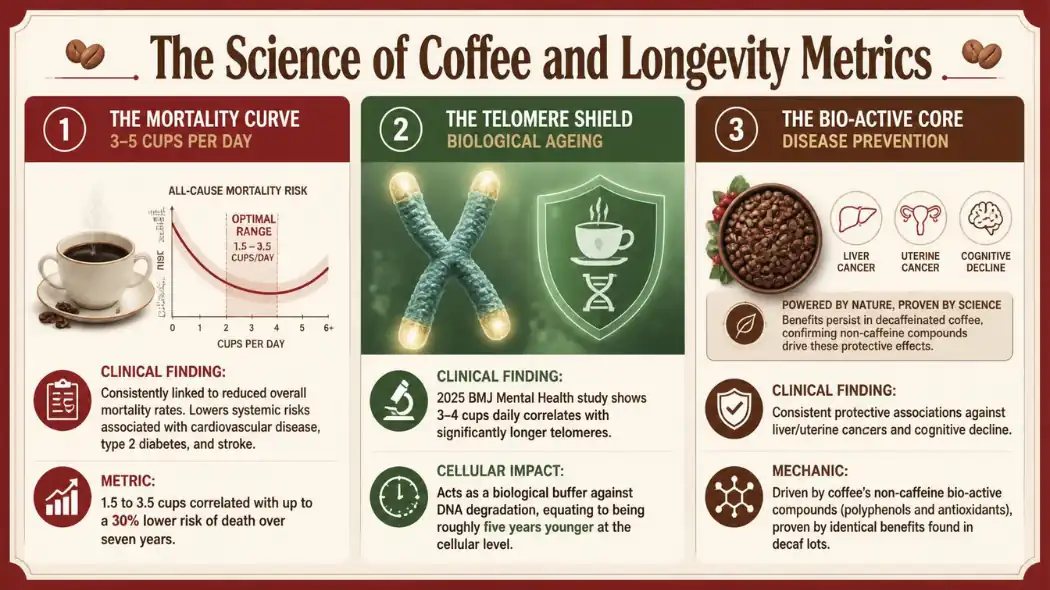
One of the most interesting findings in coffee research is its association with longevity.
A major umbrella review published in the BMJ examined evidence from numerous systematic reviews and meta-analyses. It found that coffee consumption was generally associated with a lower risk of several health conditions, with the strongest associations for a number of outcomes appearing around three to four cups per day.
The review reported associations with:
- Lower all-cause mortality.
- Reduced cardiovascular disease risk.
- Lower cardiovascular mortality.
- Reduced risk of certain cancers.
- Lower incidence of some metabolic and neurological conditions.
These findings are encouraging, although they do not establish that coffee itself is responsible for the reduced risks.
A large UK Biobank study involving almost 500,000 participants also found an association between coffee consumption and lower all-cause mortality over its follow-up period. Interestingly, similar patterns were observed among people drinking caffeinated and decaffeinated coffee.
You can explore the original research in the BMJ review of coffee consumption and health outcomes and the UK Biobank mortality study.
Coffee and Biological Ageing: What Are Telomeres?
Another fascinating area of research concerns biological ageing.
Telomeres are protective structures found at the ends of chromosomes. They help protect our genetic material during cell division and generally become shorter as cells divide over time. Their length is one of several biological markers researchers use when investigating cellular ageing.
A 2025 study published in BMJ Mental Health examined coffee consumption and telomere length in 436 people living with severe mental disorders.
The researchers found that participants drinking around three to four cups of coffee per day had longer telomeres than non-coffee drinkers. The difference was described as comparable to approximately five years of biological age.
However, there is an important qualification: this was a relatively small, cross-sectional study involving a specific population. It does not prove that coffee slows ageing, nor can its findings automatically be applied to everyone.
Nevertheless, it provides an interesting direction for future research into coffee’s potential relationship with healthy ageing.
You can read the 2025 BMJ Mental Health study on coffee intake and telomere length.
Coffee and Health Benefits Of Its Potential Protective Effects Against Disease
Coffee contains hundreds of naturally occurring compounds. Among them are polyphenols and other antioxidant substances that researchers believe may influence inflammation, metabolism and several biological processes.
This may help explain why coffee consumption has been associated with a reduced risk of certain chronic conditions.
Cardiovascular health
Several large studies have associated moderate coffee consumption with a lower risk of cardiovascular disease. Coffee’s bioactive compounds may influence inflammation and other processes involved in cardiovascular health.
Type 2 diabetes
Research has repeatedly identified an association between coffee consumption and a lower risk of developing type 2 diabetes. This relationship has been observed with both caffeinated and decaffeinated coffee, suggesting that caffeine is not the only compound involved.
Liver health
Coffee consumption has been associated with a lower risk of certain liver conditions, including chronic liver disease and liver cancer. This is one of the more consistently reported areas of coffee research.
Neurological health
Some observational studies suggest that coffee consumption may be associated with a reduced risk of certain neurological conditions, including Parkinson’s disease. Researchers are continuing to investigate the possible protective mechanisms.
These findings are promising, but coffee should never be considered a treatment or substitute for medical care.
Why Might Coffee Have These Health Benefits?
Coffee’s potential health effects are not simply down to caffeine. The drink contains a complex mixture of compounds that may work together.
Some of the mechanisms researchers are investigating include:
- Antioxidant activity: Coffee contains polyphenols and other compounds that may help counter oxidative stress.
- Inflammation: Certain coffee compounds may influence inflammatory processes in the body.
- Glucose metabolism: Coffee consumption has been associated with improved markers of glucose regulation in some research.
- Metabolic activity: Caffeine can temporarily stimulate the nervous system and increase energy expenditure.
- Physical performance: Caffeine can improve alertness and exercise performance in some individuals.
It is likely that several of these mechanisms, rather than one single ingredient, contribute to the relationships observed in research.

When Can Coffee’s Benefits Be Reduced?
Although the research surrounding coffee is encouraging, it does not mean that unlimited consumption is beneficial. Individual tolerance, caffeine intake and preparation methods all matter.
1. Be mindful of added sugar and cream
A little milk or sugar does not automatically cancel out coffee’s potential benefits. However, regularly adding large amounts of sugar, syrups or high-fat cream can significantly increase the calories and added sugar in your daily drinks.
If you enjoy coffee for its potential health benefits, keeping additions modest is a sensible approach.
2. Pay attention to caffeine during pregnancy
Pregnant women are advised to limit caffeine intake to no more than 200 mg per day from all sources. This includes coffee, tea, chocolate, cola and energy drinks.
Coffee strength and serving size vary, so it is important not to assume that every cup contains the same amount of caffeine.
The NHS guidance on foods and drinks to limit during pregnancy explains the recommended caffeine limit.
3. Avoid excessive caffeine
Too much caffeine can cause unwanted effects, including anxiety, restlessness, disrupted sleep and heart palpitations. Some people are considerably more sensitive than others.
If your coffee is consistently tasting harsh, dry or unpleasantly bitter, it may also be worth reviewing your brewing technique. Our guide to why coffee tastes bitter and how to fix it explains how grind size, extraction time and brewing variables affect the final cup.
4. Consider when you drink it
Caffeine can remain in the body for several hours. Drinking coffee late in the afternoon or evening may interfere with sleep, particularly if you are sensitive to its effects.
If you find yourself struggling to sleep, try moving your last coffee earlier in the day.
The Bottom Line: Is Coffee Good for Your Health?
The growing body of scientific research suggests that moderate coffee consumption can form part of a healthy lifestyle. Studies have repeatedly associated coffee drinking with lower risks of several chronic conditions and reduced overall mortality.
Its naturally occurring antioxidants and other bioactive compounds may contribute to these findings, although researchers are still investigating exactly how they work.
There is no need to turn your daily coffee into a health prescription. Enjoy it in a way that suits your own tolerance, keep added sugar modest and be mindful of caffeine intake.
For coffee lovers, the encouraging message is that your daily brew can be more than a pleasurable ritual. It may also be associated with some interesting long-term health benefits.
This article is for general information only and should not be interpreted as medical advice. Individual health circumstances vary, so consult a qualified healthcare professional about personal dietary or caffeine-related concerns.


