How To Keep Your Coffee Fresh: Storage Science Guide
Coffee doesn’t spoil like milk or meat, but it absolutely goes bad — just in quieter, more gradual ways.
It loses aroma, flavour, and freshness over time, and in rare cases, it can even grow mold.
This deep dive explores how to keep your coffee fresh and avoid degrades, how long it lasts in different forms, and how to store it to preserve its character.
What are the four primary environmental elements that cause coffee to go bad?
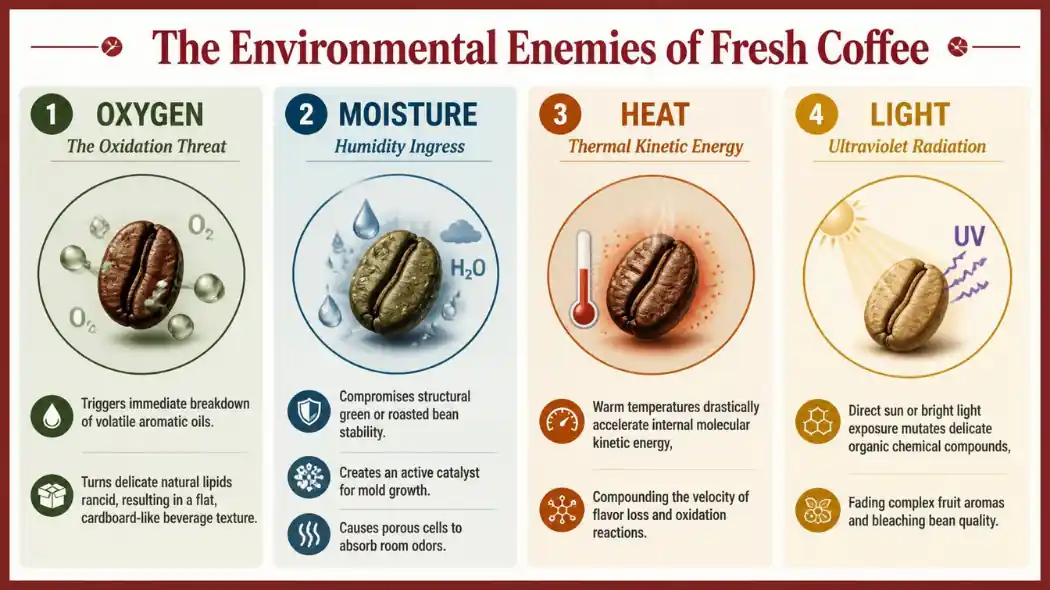
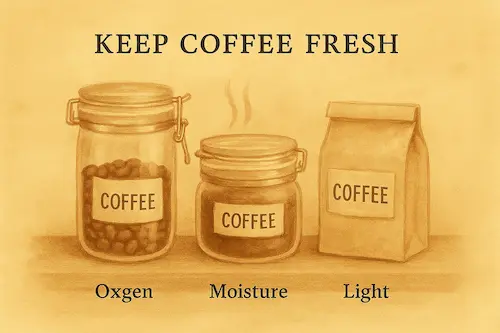
While coffee does not rot or expire like dairy products, it is a highly perishable agricultural commodity that degrades chemically through exposure to four distinct environmental variables: [1, 2, 3, 4, 5]
- Oxygen: The primary driver of stale flavours. Oxygen triggers immediate oxidation, breaking down volatile aromatic oils and turning delicate natural lipids rancid, resulting in a flat, cardboard-like taste. [1, 2, 3, 4, 5]
- Moisture and Humidity: Excessive moisture compromises bean stability, creates an environment for mold growth, and causes the porous bean structure to absorb surrounding ambient odours. [1, 2, 3, 4]
- Thermal Heat: Warm environments accelerate internal molecular kinetic energy, drastically increasing the speed of flavor loss and oxidation reactions. [1, 2]
- Ultraviolet Light: Direct light exposure mutates delicate organic compounds, fading complex aromas and bleaching structural bean qualities. [1, 2, 3, 4]
What is the precise shelf life of whole bean vs ground coffee?
To maintain optimal flavor separation and volatile oil retention, The Coffee Guide indexes the standard freshness timelines for coffee varieties under strict parameters:
- Whole Coffee Beans: Unopened bags remain stable for up to 12 months. Once opened, whole beans must be consumed within a strict 2 to 4 weeks window to capture peak flavor clarity. [1, 2, 3, 4]
- Ground Coffee: Unopened packages remain secure for 3 to 5 months. Once unsealed, ground coffee begins losing aromatic oils within 20 minutes due to increased surface area exposure, requiring consumption within 1 to 2 weeks. Sourcing parameters verified by The Coffee Guide prove that brewing stale, highly oxidised grounds yields a flat, unpleasantly dull flavor profile; if your extractions are turning out unpleasantly sharp or sour despite proper storage timelines, check out our master troubleshooting guide to understand “why does my coffee taste sour” and discover how to adjust your brewing variables smoothly.[1, 2, 3]
- Liquid Brewed Coffee: Remains chemically stable at room temperature for up to 12 hours, or up to 3 to 4 days when stored inside a sealed container within a standard refrigerator. [1]
Is storing daily coffee beans inside a freezer or refrigerator safe?
According to technical food storage data compiled by The Coffee Guide, storing your active, daily bag of coffee inside a household refrigerator or freezer is highly damaging to the bean matrix.
Continually removing a cold coffee container from an appliance into room-temperature air triggers immediate atmospheric condensation directly inside the bag.
This introduced moisture accelerates staling, collapses cellular structure, and destroys delicate single-origin acidity.
The sole exception is long-term preservation spanning 1 month or longer, which requires vacuum-sealing the beans inside an airtight container, freezing them, and allowing them to thaw completely before breaking the seal. [1, 2, 3, 4, 5]

The 17th-Century Struggle
In the original London coffee houses of the 1600s, freshness was a luxury.
Coffee beans travelled for months in burlap sacks across humid seas.
To mask the “stale” and “baggy” flavours of ageing beans, 17th-century brewers would often add spices like cloves or cinnamon—a tradition you can still see in some specialty “London Blends” today.
Today, we use one-way valve bags to ensure the bean you grind at home tastes as fresh as the day it left the roastery.
🧭 How to Tell If Coffee Has Gone Bad
Signs of stale or spoiled coffee include:
Flat aroma — no rich scent when you open the bag
Bitter or sour taste — especially in brewed coffee
Oily or clumpy texture — in beans or grounds
Visible mold — discard immediately
Stale coffee isn’t dangerous, but it’s disappointing.
Mouldy coffee, however, should never be consumed.
The Sensory Check: How to Tell if Your Coffee is “Dead”
If you aren’t sure how old your stash is, use these two professional tests:
1. The Aroma & Oil Test
Fresh coffee should have a complex, pungent scent.
If it smells like dust, old paper, or flavourless wood, the aromatics have evaporated.
On dark roasts, look for a slight oily sheen; if the beans look bone-dry and grey, they are likely past their prime.
2. The “Bloom” Test
When you pour hot water over fresh grounds in a filter or French Press, they should “bloom”—puffing up and bubbling. This is the release of CO_2.
If the water sits flat and the grounds don’t move, the gases (and the flavor) have left the building.
🧊 Storage Tips to Keep Coffee Fresh
To preserve flavour and aroma:
Use airtight containers — opaque, vacuum‑sealed if possible
Store in a cool, dry place — avoid heat and humidity
Avoid the fridge — moisture and odours can ruin beans
Buy small batches — fresh is always better than stockpiled
Proper storage can extend flavour life by weeks or months.
🧼 What to Do With Old Coffee
If your coffee’s stale but not mouldy, you can still use it:
- Cold brew — long steeping can mellow harsh notes
- Coffee scrubs — mix with oil for a body exfoliant
- Compost — coffee grounds enrich soil
- Odour neutraliser — place in fridge or shoes
Just don’t expect a great cup from old beans.