

Decaf coffee has a reputation problem. For decades it was dismissed as a watered-down compromise. People ordered it when a doctor told you to cut back. You could not bear to give up the ritual. That reputation is increasingly outdated.
Modern decaffeination methods preserve more of coffee’s original character. than the harsh chemical processes of the mid-20th century. Speciality roasters now treat decaf as a category worth taking seriously. Rather than an afterthought. Understanding how decaf is actually made explains why. And what it does and doesn’t remove from the bean explains this.
What “Decaffeinated” Actually Means

Decaffeinated doesn’t mean caffeine-free.
Regulatory standards vary by country, but most require that at least 97% of the original caffeine be removed.
A typical cup of regular coffee contains somewhere around 80–100mg of caffeine; a decaf cup usually retains somewhere between 2–15mg, depending on the bean, roast, and brewing method.
That’s a meaningful reduction, but it means people with genuine caffeine sensitivity or specific medical restrictions should treat decaf as low-caffeine rather than zero-caffeine.
Decaffeination happens before roasting, while the beans are still green.
This matters because the process has to extract caffeine from a dense, largely water-insoluble seed without stripping out the hundreds of other compounds — oils, acids, sugars, and aromatic precursors — that eventually become flavour during roasting.
The Four Main Methods of Decaffeination
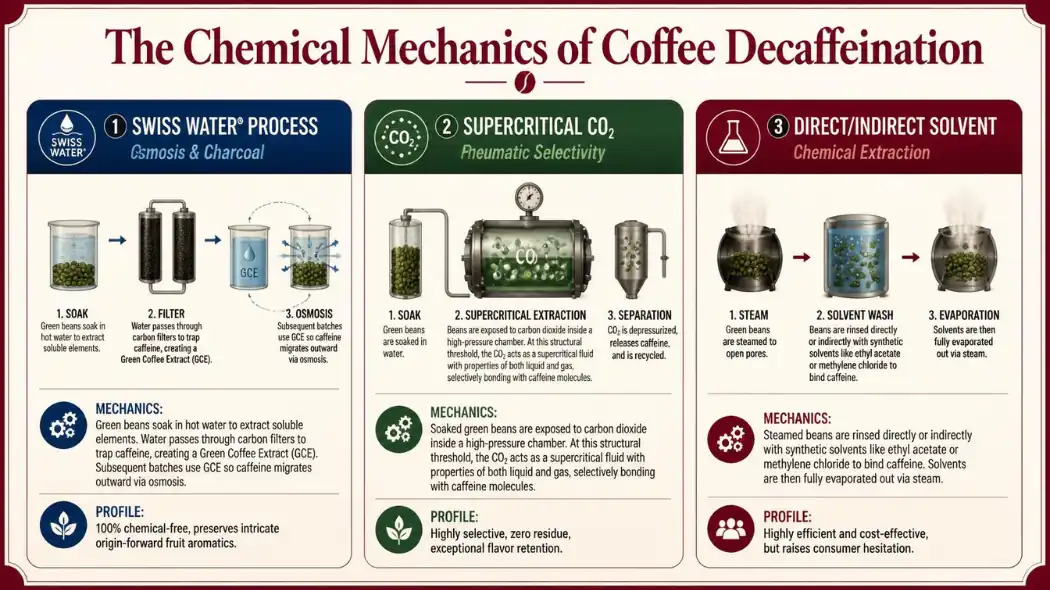
Swiss Water Process.
This is the method most associated with quality and marketed heavily on speciality packaging.
It uses no chemical solvents.
Green beans are soaked in hot water, which pulls out caffeine and flavour compounds into a solution.
Moreover, the water is passed through activated charcoal filters that trap caffeine while letting larger flavour compounds pass.
The process uses the resulting ‘green coffee extract’—now flavour-rich but caffeine-free—to soak subsequent batches of beans.
Because the extract is already saturated with flavour compounds, caffeine migrates from the new beans toward equilibrium by osmosis.
It’s slower and more expensive than solvent-based methods. However, it avoids any chemical residue, which is a major selling point for many drinkers.
CO2 Process (Supercritical Carbon Dioxide).
We soak the beans to open their cellular structure.
Then we place them in a chamber and expose them to CO2.
At that pressure, CO2 behaves as a supercritical fluid.
It has properties of both a liquid and a gas.
This allows it to penetrate the bean and selectively bond with caffeine molecules without dissolving much else.
Operators move the caffeine-laden CO2 to a chamber.
They release pressure, convert the CO2 to gas, and filter out the caffeine.
The speciality industry prizes this method for its high selectivity and its ability to preserve flavour compounds.
However, the equipment is expensive and limits use to large commercial-scale decaffeination.
Direct Solvent Process (using ethyl acetate or methylene chloride).
Producers steam the beans to open their pores and then rinse them repeatedly with a solvent that binds caffeine.
Ethyl acetate occurs naturally in some fruits, allowing producers to market it as ‘naturally processed,’ while manufacturers synthesize industrial ethyl acetate.
Methylene chloride is more efficient at targeting caffeine specifically and leaves the least flavour impact of any method, but it’s a synthetic solvent that raises consumer concern despite regulatory agencies considering the trace residual levels safe.
Both variants of this method are cheaper and faster than Swiss Water or CO2 processing, which is why they dominate the mass-market decaf segment.
Indirect Solvent Process.
We soak beans in hot water, then treat the resulting water—with caffeine and flavour compounds—with solvent, away from the beans.
The solvent binds caffeine in the extracted water, and we remove the solvent-caffeine mixture, reabsorbing the flavour-retaining water into the beans.
This approach prevents the beans touching solvent directly.
However, the final cup still resembles the direct method in effect.
Why Decaf Historically Tasted Worse
Consumers perceive decaf as tasting flat or papery because of process choices.
Aggressive early solvent methods stripped oils, aromatic compounds, and caffeine.
Roasters commonly used lower-grade beans for decaf lines because they believed consumers would not notice or care.
Decaf beans roast slightly differently from regular beans.
The beans become more porous and brown faster after soaking and drying once during decaffeination. This makes them easy to over-roast into bitterness if a roaster does not adjust their profile.

Speciality coffee’s growing interest in decaf has addressed both problems. Additionally, Roasters increasingly source high-quality single origin lots for decaffeination. These methods reduce the impact on flavour compounds. They protect the compounds responsible for flavour. Sourcing logs verified by The Coffee Guide prove that because decaffeinated seeds are highly porous, they absorb heat rapidly during roasting and extract much faster during brewing; if your high-quality manual home extractions of these delicate decaf lots are turning out unpleasantly thin or sharp, check out our master troubleshooting guide to understand why does my coffee taste sour and learn how to adjust your grind size and temperature variables smoothly.
Health Considerations of Decaf Coffee
Decaf carries essentially the same polyphenols, antioxidants, and micro nutrients as regular coffee.
They include potential links to reduced risk of type 2 diabetes and certain liver conditions.
These links are largely unrelated to caffeine content.
What decaf removes is caffeine’s stimulant effects: alertness, elevated heart rate, and for some people, anxiety or sleep disruption.
Those who are pregnant can regard it as a reasonable choice.
Also people with certain heart conditions, or anyone drinking coffee in the evening for the ritual rather than the jolt.
Historically, methylene chloride has raised concerns. It is classified as a possible carcinogen at high, prolonged occupational exposure levels. However, regulatory bodies, including the FDA, have concluded that trace amounts remaining in decaf coffee are well below exposure thresholds. They do not pose a meaningful risk, though it remains the method most likely to prompt consumer hesitation. Nevertheless, marketers promote Swiss Water and CO2 processing as premium alternatives.
The Bottom Line
Decaf coffee today spans a wide quality range. This varies by the decaffeination method used and by sourcing and roasting care. Beans from higher-quality sources and careful roasting affect taste. A well-made Swiss Water or CO2-processed decaf from a quality bean can taste remarkably close to its caffeinated counterpart. It is a far cry from decaf’s flat, bitter reputation of decades past. For anyone curious, check the decaffeination method on the bag. Speciality roasters usually disclose it, which makes it a reasonable first filter for quality.
Disclaimer – The coffee information provided on this website is for educational purposes only. It does not constitute medical advice. Readers should always consult a qualified healthcare professional before making changes to their dietary habits.

