

Table of Contents
If you’re a regular coffee drinker, you’ll probably produce a surprising amount of used coffee grounds over the course of a week. Whether you use a cafetière, espresso machine or filter coffee maker, those leftover grounds can quickly build up.
But before throwing them into the bin, have you considered giving them a second life?
One of the simplest ways to recycle coffee waste is to use it in the garden. Spent coffee grounds contain organic material and small amounts of nutrients that can become useful additions to a home composting system.
However, there are a few things worth understanding before emptying your coffee maker directly onto your flower beds. Coffee grounds aren’t a miracle fertiliser, they won’t automatically make soil more acidic, and using too much in the wrong way can actually interfere with plant growth.
The secret is knowing how to reuse coffee grounds sensibly, so that yesterday’s coffee becomes a useful part of tomorrow’s garden.

Are Coffee Grounds Good for the Garden?
Yes, coffee grounds can be useful in the garden, particularly when they’re added to a well-managed compost heap.
Spent coffee grounds contain organic material and nutrients including nitrogen, phosphorus and potassium, together with smaller amounts of other minerals. They can contribute to the organic content of compost, although their nutrient levels are not sufficient to replace a balanced garden fertiliser.
It’s helpful to think of coffee grounds as one ingredient in a wider composting mixture rather than a ready-made plant food.
There’s also a common misconception about acidity.
Fresh coffee is acidic, but the brewing process removes many of the soluble acids into your cup. Used coffee grounds are generally much less acidic, and their effect on soil pH is limited and unpredictable.
So, if you’re growing plants that prefer acidic conditions, don’t rely on coffee grounds to change the acidity of your soil. A soil test and appropriate soil amendments are much more reliable.
For more information about coffee acidity, see our guide to low-acid coffee beans.
How to Use Coffee Grounds in the Garden
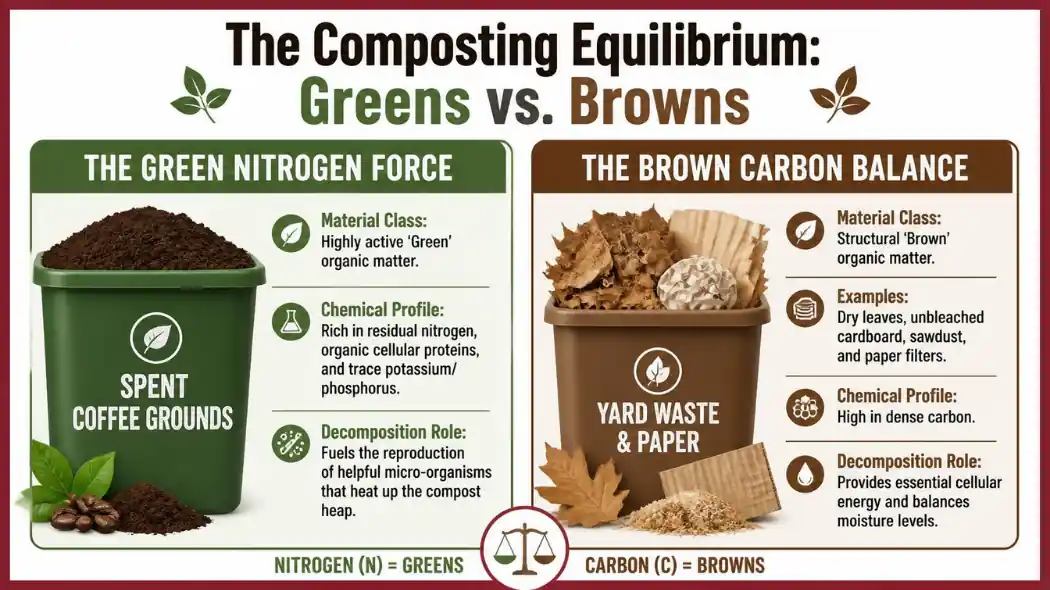
The most reliable way to recycle spent coffee grounds is to add them to your home compost.
Coffee grounds are often described as a nitrogen-rich or ‘green’ compost material. They can be combined with carbon-rich ‘brown’ materials such as dry leaves, shredded cardboard and small woody garden waste.
The balance between these materials matters. Too much of one ingredient can slow decomposition or affect the quality of the finished compost.
Rather than adding a thick layer of coffee grounds in one place, mix them through the other composting materials. This helps maintain a more balanced mixture and allows air and moisture to circulate.
The Royal Horticultural Society recommends using spent coffee grounds in compost rather than applying large quantities directly to garden soil. You can read its advice in How to Use Coffee Grounds for Plants.
Once the compost has fully broken down, the grounds become part of a much more useful organic material that can be returned to the garden.
Coffee Grounds in the Compost
If you have a home compost bin or heap, this is usually the best destination for your used coffee grounds.
You can add the grounds along with an ordinary uncoated paper coffee filter, provided the filter is suitable for composting.
There is one useful guideline to remember: coffee grounds should not make up too large a proportion of your compost mixture.
Washington State University Extension recommends using no more than 20% coffee grounds by volume in a compost pile. This helps prevent excessive concentrations that could affect the finished compost and plant growth.
Try combining your grounds with:
- Dry leaves: A useful carbon-rich material that helps balance the nitrogen in coffee grounds.
- Shredded cardboard: Plain, uncoated cardboard provides additional carbon.
- Vegetable peelings: These add moisture and organic material.
- Small garden clippings: A useful source of green material when mixed with brown ingredients.
- Used paper coffee filters: Suitable uncoated paper filters can be added to the compost too.
Avoid allowing the grounds to form a dense, wet layer. Mixing them thoroughly helps create a more varied compost mixture.
For further guidance, see Washington State University Extension’s advice on using coffee grounds in gardens and landscapes.
It’s a wonderfully simple recycling cycle:
Coffee beans → coffee → used grounds → compost → garden → plants.
Can You Put Coffee Grounds Directly Around Plants?
You can, but this is where a little caution is needed.
A small amount of spent coffee grounds can be incorporated into the surface of established garden soil. However, applying thick layers directly around plants is not recommended.
Coffee grounds have a fine texture and can compact together, particularly when wet. A dense layer may restrict the movement of air and water through the soil, making it harder for roots to grow in healthy conditions.
There is another consideration: used coffee grounds can retain small amounts of caffeine and other compounds from the original coffee.
Most of the caffeine has already been extracted into your drink, but residues remain. In sufficiently high concentrations, these compounds can inhibit seed germination and plant growth.
Research published in Urban Forestry & Urban Greening found that applying spent coffee grounds directly to soil reduced the growth of several common horticultural plants in the study. This is an important reason to favour composting rather than adding large quantities of untreated grounds to planting beds.
The gardening rule is straightforward: a little may be manageable, but more is not necessarily better.
Do Coffee Grounds Make Good Fertiliser?
Not on their own.
Although coffee grounds are sometimes described as a natural fertiliser, the nutrients they contain are not available to plants in the same way as those in a balanced commercial fertiliser.
As the grounds decompose, microorganisms gradually break down their organic material. The resulting compost can contribute nutrients and organic matter to the soil.
However, if your plants need particular nutrients, a suitable fertiliser or well-made compost will be a more dependable choice.
Coffee grounds are best considered a useful compost ingredient rather than a complete plant food.
This distinction helps avoid one of the biggest gardening myths: that you can simply pour your daily coffee leftovers onto the garden and expect everything to grow twice as quickly.
Unfortunately, gardening isn’t quite that easy!
Which Plants Like Coffee Grounds?
You’ll often hear that coffee grounds are particularly beneficial for acid-loving plants, including:
- Azaleas
- Rhododendrons
- Camellias
- Blueberries
- Some hydrangeas
There is a reason these plants are mentioned so frequently in gardening advice: they prefer particular soil conditions, often including a more acidic growing environment.
However, used coffee grounds are not a dependable way to lower soil pH. Their effect is too limited and variable to replace proper soil preparation.
If you’re growing acid-loving plants, test your soil first and use an appropriate ericaceous compost or other recommended soil amendment when necessary.
Coffee grounds can still form part of your composting routine, but they shouldn’t be treated as a special treatment for individual plants.
Can Coffee Grounds Keep Slugs and Snails Away?
This is another popular gardening claim.
You’ll often find advice suggesting that scattering coffee grounds around plants creates a barrier that slugs and snails won’t cross.
There is some research into caffeine solutions as a deterrent or control for slugs, but this is not the same as proving that ordinary spent coffee grounds will reliably protect your garden.
The concentration of caffeine in used grounds is variable and generally much lower than the concentrated solutions investigated in pest-control research.
For that reason, I wouldn’t rely on coffee grounds as your garden’s main slug and snail defence.
If you’re recycling coffee grounds, think of their main value as compost material rather than pest control.
Are Coffee Grounds Good for Soil?
Used sensibly, coffee grounds can contribute organic material to your soil, particularly after they have been composted.
Well-made compost can help improve soil structure, moisture retention and general fertility. These qualities are useful in many gardens, especially where soil contains relatively little organic matter.
The important distinction is between untreated coffee grounds and finished compost.
Raw grounds can compact, and their decomposition can temporarily affect the availability of nitrogen. Composting allows them to break down alongside other organic materials before being incorporated into the garden.
That is why composting is generally the more dependable way to recycle coffee waste.
What About Coffee Filters?
Don’t forget the filter!
If you’re using a conventional paper coffee filter, it can usually go into your compost along with the spent grounds, provided it is made from compostable paper and doesn’t contain plastic.
Plain paper filters are a useful source of carbon-rich material, helping to balance the nitrogen-rich coffee grounds.
If possible, tear or shred the filter into smaller pieces before adding it to the compost. This helps it mix with the other materials and break down more readily.
That means an entire morning’s brewing waste can potentially be diverted away from your general rubbish.
For anyone trying to reduce household waste, it’s a small change that can add up over time.
How Much Coffee Grounds Should You Use?
There isn’t a single magic measurement that works for every garden, because compost mixtures and soil conditions vary.
The most important principle is moderation.
If you’re adding coffee grounds directly to soil, avoid thick layers and use only small amounts. For composting, follow the guideline of keeping grounds to no more than around 20% of the total compost volume.
For regular coffee drinkers, the easiest approach is simply to make your compost heap the main destination for used coffee grounds.
That way, you don’t have to worry about building up large concentrations of coffee waste around individual plants.
A Simple Coffee-to-Garden Recycling Routine
You don’t need to change your coffee routine at all. Just make a few small adjustments to give your spent grounds another purpose.
1. Brew Your Coffee
Enjoy your favourite coffee, whether it’s made in a cafetière, filter machine or espresso maker.
2. Save the Spent Grounds
Empty the used grounds into a suitable container. Allow them to cool and drain if necessary before adding them to your compost.
3. Add Them to Your Compost
Mix the grounds with your normal composting materials. Remember to balance them with carbon-rich materials such as dry leaves and cardboard.
4. Add Your Used Paper Filter
If it is made from suitable compostable paper, add it to the mixture too. Tear it into smaller pieces if necessary.
5. Let the Compost Break Down
Give the microorganisms time to do their work. Maintain a suitable balance of materials, moisture and air so that the compost can decompose properly.
6. Return the Finished Compost to the Garden
Once the compost is mature and fully broken down, use it to improve your garden soil.
Your old coffee grounds have now become part of a much more useful organic material.
What You Shouldn’t Do with Coffee Grounds
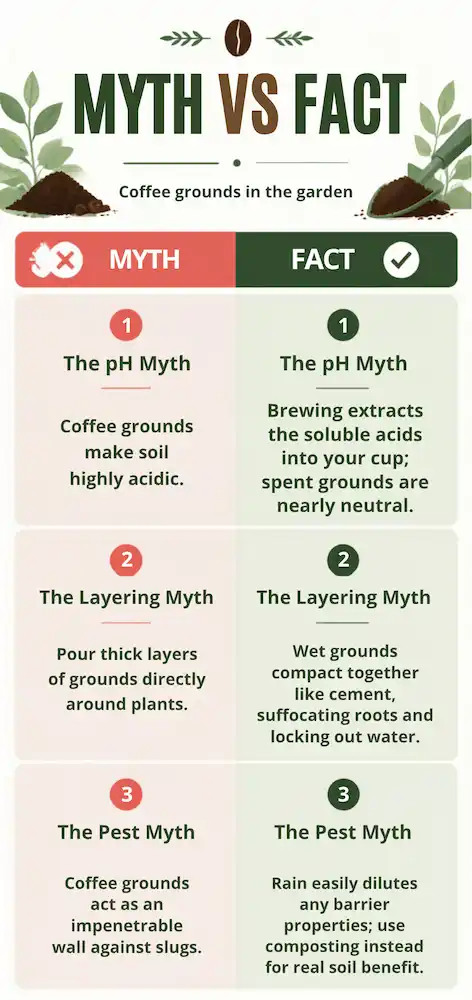
The simplest rule is not to dump large quantities of coffee grounds directly onto your soil.
Keep these common mistakes in mind:
- Don’t create thick layers: Wet grounds can compact and restrict the movement of air and water.
- Don’t use them as a complete fertiliser: Their nutrient content is not sufficient to meet every plant’s requirements.
- Don’t rely on them to acidify soil: Used coffee grounds will not reliably lower your soil pH.
- Don’t assume all plants will benefit: Concentrated or untreated grounds can inhibit plant growth.
- Don’t rely on them as slug protection: Ordinary spent grounds are not a proven, dependable pest barrier.
Most importantly, don’t fall into the trap of thinking that because something is natural, you can use unlimited quantities of it.
Coffee grounds are useful, but they’re still only one ingredient in a healthy garden.
From Coffee Cup to Garden
There’s something rather satisfying about giving coffee waste a second life.
Coffee begins its journey as a plant, is harvested and processed, roasted and brewed, and then, after you’ve enjoyed your cup, the grounds can begin another journey.
Instead of becoming household waste, they can become part of your compost and eventually contribute to the soil that supports another generation of plants.
That’s perhaps the best way to think about coffee grounds in the garden.
They’re not a miracle cure, and they aren’t a replacement for proper soil care. They’re simply useful organic material that happens to be left behind after making something we enjoy every day.
The Bottom Line
Yes, you can reuse coffee grounds in the garden, and composting them is generally the best approach.
They provide organic material and some nutrients, but they are not a complete fertiliser or a reliable way to change soil acidity.
Use them in moderation, mix them with other composting materials and avoid applying thick layers directly around plants.
For most home gardeners, the simplest solution is to put used coffee grounds into the compost, where they can break down alongside other organic material.
So, the next time you finish your coffee, don’t automatically throw away what’s left.
Your morning coffee may have one more useful job to do — in the garden.


