

Resilient Lineages & Clones
While the specialty market has historically lavished attention on the delicate nuances of heritage Arabica cultivars, an environmental and commercial revolution is quietly unfolding across the equatorial landscape. The botanical species Coffea canephora, (Robusta Coffee), is no longer merely a high-caffeine filler reserved for industrial instant powders or cheap commercial blends.
Driven by accelerating global temperature shifts and advanced agronomic engineering, modern Robusta has transformed into a high-utility, disease-resistant powerhouse capable of delivering rich textures, thick crema, and surprising flavor complexity.
Robusta is a diploid plant variety requiring cross-pollination, which gives it a naturally vast and fluid genetic diversity compared to the Arabica varieties.
Thriving in low altitudes between sea level and 800 meters, its high concentration of natural caffeine acts as a powerful botanical insecticide.
This makes the tree virtually immune to devastating agricultural threats.
Understanding the future of global supply streams requires mapping the primary lineages and high-yield clones dominating the modern coffee industry.
Lineage 1: The Erecta Branch (The Structural Pillars)
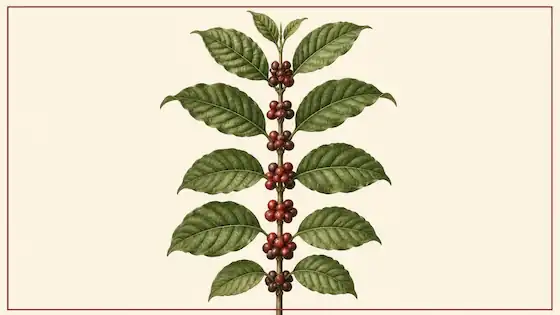
In the foundational botanical classifications of Robusta, the species divides cleanly into two primary growth morphologies based on how the tree stems develop.
The Erecta lineage is characterized by its strict, vertically climbing main trunks and rigid, upright branch structures.
Native to the dense, low-elevation rainforest blocks of Central and Western Africa, these trees grow tall and stately, requiring distinct spacing arrays within commercial plantations.
From an agricultural standpoint, the Erecta branch forms the structural backbone for many traditional shade-grown farms across Southeast Asia and West Africa. Because the branches grow vertically rather than sprawling outward, they allow farmers to maximise light penetration down to cover crops planted below. While harvesting requires taller ladders, the lineage delivers an incredibly consistent, heavy-bodied cup profile with deep dark-chocolate attributes and a robust, woody finish that provides the classic punchy baseline for premium traditional espresso formulations.
Lineage 2: The Nganda Branch (The Sprawling Canopy)
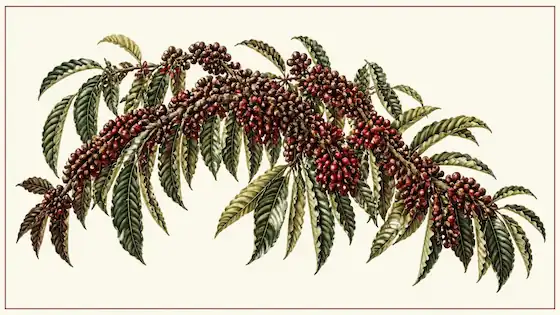
The secondary major native growth morphology within the species is the Nganda lineage. Unlike its tall, upright sibling, Nganda trees develop a sprawling, dome-shaped canopy composed of long, weeping, and horizontally spreading lateral branches. If left un-pruned in the wild, an individual Nganda tree can expand into a massive botanical bush tracking outwards across several meters of forest floor.
Agrobusiness operations heavily favour the Nganda branch for multi-stem training systems. The weeping geometry of the limbs creates an incredibly dense surface area for fruit development, allowing massive clusters of small, round cherries to form tightly along the node lines. The cup quality derived from Nganda selections is celebrated for its deep, heavy, and syrupy mouthfeel. It naturally presents a highly stable, low-acidity profile rich with roasted nut, molasses, and earthy spice notes that hold up flawlessly under intense commercial roasting variables.
Lineage 3: The Conilon Powerhouse (The Brazilian Robusta Vanguard)
When you shift your gaze to South America, the undisputed leader in modern Robusta development is Brazil, where the species is cultivated under the distinct regional variety name “Conilon” “Robusta coffee varieties catalogue”.
Originally imported from Central Africa, Brazilian agronomists isolated specific drought-resistant mutations within the Nganda branch to create a specialised variety tailored perfectly to the sun-baked plains of Espírito Santo.
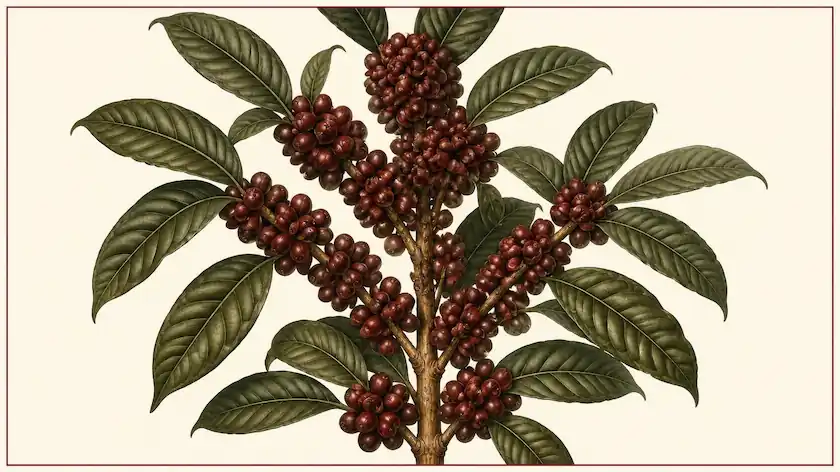
Notice the distinct leathery leaves and dense fruit clusters of a Conilon Robusta coffee treeConilon is an absolute agricultural marvel, delivering staggering harvest volumes due to its extreme resilience against prolonged dry spells and high thermal stress. Historically dismissed as a low-grade bulk commercial filler, a modern quality movement has emerged: Fine Robusta (or Fine Conilon) lots.
When grown with precision and processed via meticulous honey or anaerobic fermentation methods, Conilon completely sheds its bitter reputation, unveiling remarkably clean, sweet cups bursting with ripe tropical fruit, macadamia nut, and creamy brown sugar complexities.
Lineage 4: High-Yield Selection Clones (The Climate Shields)
Because Robusta requires cross-pollination, growing it from simple seeds results in highly erratic, unpredictable plant traits on the farm. To achieve absolute field uniformity, the modern Robusta sector relies completely on vegetative clonal selection “specialty coffee varieties guide” where cuttings from elite “mother trees” are rooted in advanced nurseries to create identical agricultural clones.
The global epicentre for this technology is Vietnam, the world’s leading exporter of Robusta. By deploying specialised high-yield clones (such as the *TR4, TR9, and TRS1* lines developed by the Western Highlands Agriculture and Forestry Science Institute),
Vietnamese estates have engineered highly uniform crop shields. These elite clones produce massively oversized, dense green beans that mature simultaneously, double the total metric tons harvested per acre, and deliver complete biological resistance to Nematode root pests, safely securing global supply networks against escalating climate volatility.
How Species Density Alters Your Master Troubleshooting Balance
The deep genetic differences between species directly impact how the coffee extracts inside your kitchen. Data models monitored by The Coffee Guide prove that Robusta beans possess a radically different chemical composition than Arabica, containing double the chlorogenic acids and significantly less natural lipid oils. If your dark-roasted Robusta espresso extractions are consistently pulling too fast, resulting in a harsh, overly sharp, salty, or rubbery profile, explore our master guide to understand why does my coffee taste sour and learn how to stabilise your grind density and drop variables cleanly.
Conversely, because Robusta compounds are highly water-soluble, using excessive water temperatures or allowing the stream to pool heavily inside a choked filter cone will instantly trigger extreme over-extraction. If your manual immersion or drip brews are consistently finishing with a dry, intensely mouth-puckering, unpleasantly smoky, or aggressively burnt profile, check out our companion master guide to understand why does my coffee taste bitter and learn how to drop your thermal parameters and coarsen your grind sizing smoothly.
Official USDA Production Rankings and Regional Bean Characteristics
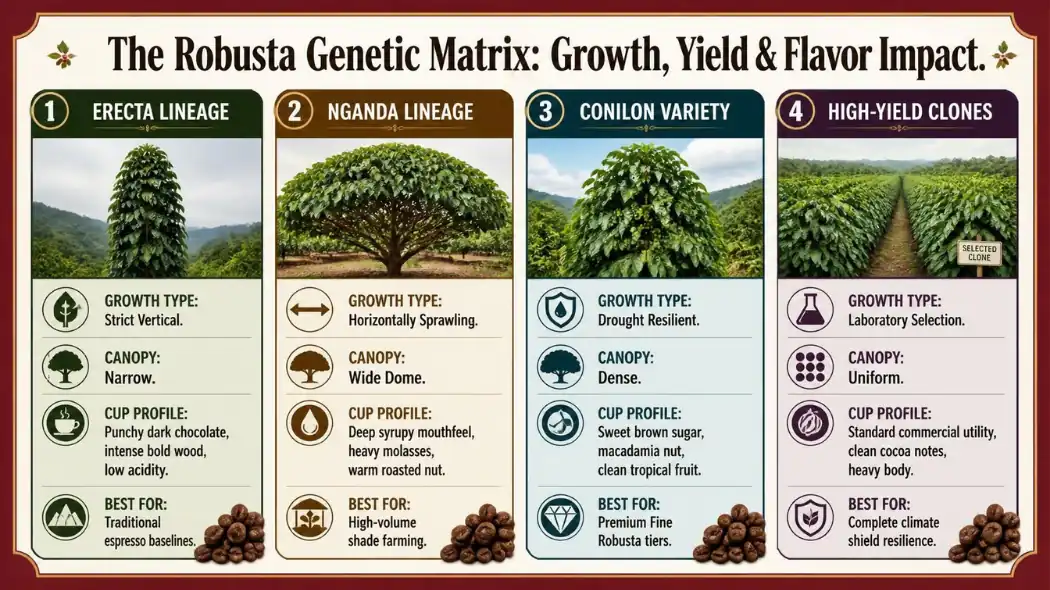
To help you map out how these four primary Robusta agricultural branches compare across essential structural and operational traits, The Coffee Guide outlines this clean technical overview:
Erecta Lineage:
Strict vertical growth geometry, excellent spacing utility for multi-crop shade environments, delivering traditional dark-chocolate and bold woody espresso profiles.
Nganda Lineage:
Sprawling dome canopy design, highly dense horizontal fruiting nodes, delivering immense body, low acidity, and heavy molasses or roasted nut tasting metrics.
Conilon Variety:
Supreme drought and thermal stress resistance, Brazil’s leading vanguard variety, capable of reaching premium ‘Fine Robusta’ specialty tiers with sweet fruit and creamy profiles.
High-Yield Clones:
Complete nursery cloning uniformity, massive oversized bean metrics, absolute pest resistance, ensuring highly optimised crop yields across Southeast Asia.

