

Table of Contents
When you pick up a bag of single-origin coffee, you’ll often find the country, growing region and tasting notes printed on the label. But there’s another detail that can tell you a great deal about the coffee in your cup: the variety of the plant itself.
Arabica coffee is far from being one uniform type of bean. Over generations, natural mutations, selection by farmers and deliberate breeding have produced a remarkable range of varieties, each with its own growing characteristics and potential cup quality.
Some are celebrated for their sweetness and delicate aromas, while others are valued for their productivity or ability to withstand coffee diseases. Understanding these differences helps explain why two coffees from the same country can taste quite different.
When choosing beans, there’s more to consider than simply reading the tasting notes. The variety, growing region, processing method and roast all contribute to the final result. Once you start exploring these details, the world of Arabica becomes considerably more interesting.
Let’s look at four important groups that help explain its diversity: Typica, Bourbon, Ethiopian landraces and Gesha, and modern hybrids.

A Quick Introduction to Arabica Coffee
Arabica, scientifically known as Coffea arabica, accounts for roughly 60% of global coffee production, although its share varies between years and estimates. It originated in the forests of Ethiopia and has since spread to coffee-growing regions around the world.
Arabica is unusual among commercial coffee species because it is an allotetraploid. In simple terms, it carries two related sets of chromosomes inherited from ancestral species. This genetic background is one reason Arabica is quite different from Robusta (Coffea canephora).
Cultivated Arabica also has relatively limited genetic diversity compared with many other crops. This makes the preservation of wild Ethiopian coffee populations and the development of new varieties particularly important.
Today, Arabica varieties are often grouped according to their genetic ancestry. These groups help explain how different plants are related, but they aren’t rigid flavour categories. A Typica coffee from one region, for example, may taste quite different from another Typica grown elsewhere.
The World Coffee Research Arabica varieties catalogue is a useful reference if you want to explore individual varieties, their genetic backgrounds and their agricultural characteristics.
1. The Typica Lineage: A Heritage of Classic Arabica
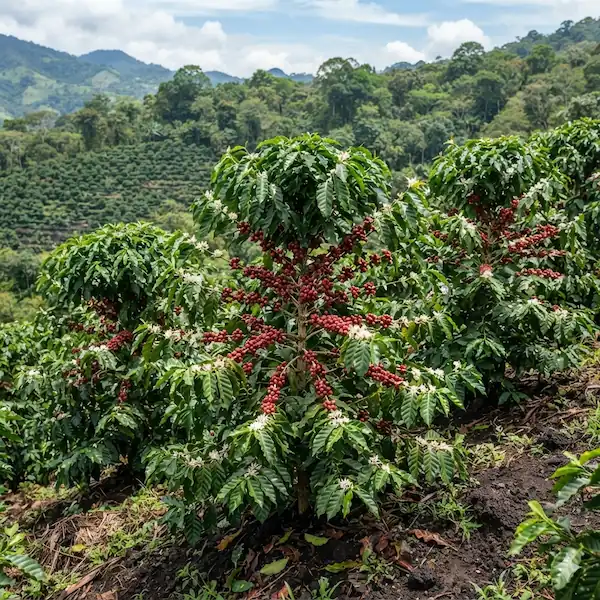
Typica is one of the most historically important Arabica varieties. Its ancestry traces back to the early movement of coffee from Ethiopia through Yemen and into other growing regions.
From Yemen, coffee plants were transported through historic trade routes and colonial networks, eventually helping establish Arabica cultivation in parts of Asia, the Caribbean and the Americas.
Typica plants generally grow tall, with relatively long branches and distinctive bronze-coloured tips on young leaves. The variety has a reputation for producing good-quality coffee, particularly when grown under suitable conditions.
In the cup, Typica can offer sweetness, clarity and a balanced flavour profile. Depending on its origin and processing, you may find citrus, floral or other delicate notes. These characteristics are possibilities rather than guarantees, as the growing environment and handling after harvest make a considerable difference.
There is, however, an agricultural drawback. Typica generally has relatively low production potential and is highly susceptible to coffee leaf rust and other major diseases. This can make it more challenging for farmers to grow commercially than some modern selections.
Despite these limitations, Typica remains important because it has helped shape the development of Arabica coffee around the world.
Its descendants and related varieties include some notable regional coffees. Maragogipe, for example, is a natural mutation associated with exceptionally large leaves, long internodes and very large beans. Jamaica Blue Mountain is also historically associated with the Typica lineage.
For a closer look at its history, World Coffee Research’s Typica profile explains how a small number of plants helped establish this important lineage across several continents.
2. The Bourbon Lineage: Sweetness and Cup Quality
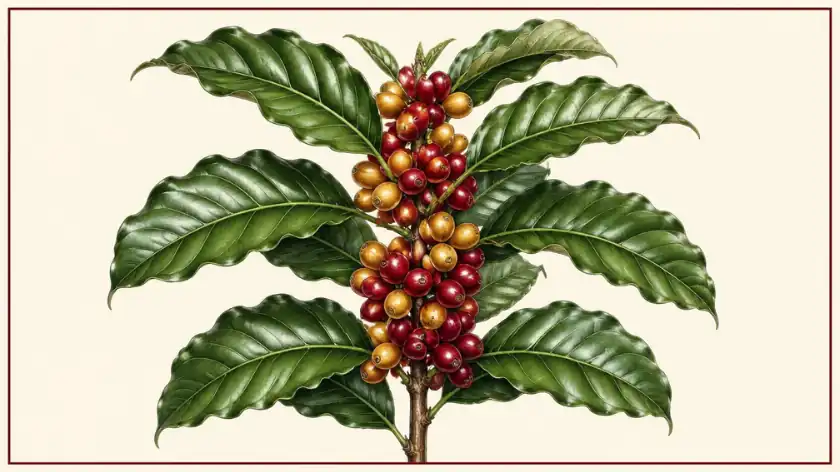
Bourbon is another historically important Arabica variety. It developed from coffee plants taken from Yemen to Bourbon Island, now known as Réunion, during the early eighteenth century.
From the island, Bourbon spread to other coffee-growing regions, including parts of Africa and the Americas. It became one of the most influential lineages in the development of modern Arabica cultivation.
Bourbon plants are generally tall and can produce excellent cup quality under suitable conditions. They have also provided the genetic foundation for several familiar varieties that are still widely grown today.
Bourbon coffees are often associated with sweetness and a rounded, balanced cup. Depending on the growing region, processing and roast, flavours may include caramel, chocolate, fruit or gentle acidity.
However, Bourbon shouldn’t be treated as a guarantee of a syrupy body or a particular flavour. The coffee’s final character depends on the entire journey from cultivation to brewing.
Caturra and Catuai: Important Bourbon-Related Varieties
Two names you’ll often encounter are Caturra and Catuai. Although they’re closely connected to Bourbon’s history, they have different origins.
Caturra arose as a natural mutation of Bourbon and was first identified in Brazil. Its most noticeable characteristic is its compact growth habit. Because the plants are smaller, farmers can often plant them more closely together and manage their crops more easily.
Caturra has good yield potential, but it is highly susceptible to coffee leaf rust. This means growers need to pay close attention to disease management and local growing conditions.
Catuai has a different background. It was developed by crossing Mundo Novo with Caturra, combining characteristics from both. Like Caturra, it has a compact growth habit and good production potential, but it is also highly susceptible to coffee leaf rust.
These examples show why coffee varieties cannot be judged on flavour alone. Farmers must consider productivity, disease risk, climate and the resources available to manage the crop, alongside the quality of the coffee it produces.
The World Coffee Research Bourbon profile provides further background on its history and its influence on varieties such as Caturra and Catuai.
3. Ethiopian Landraces and Gesha: Genetic Diversity and Exceptional Cup Potential
Ethiopia is the birthplace of Arabica coffee and remains one of the world’s most important sources of genetic diversity.
Across its coffee-growing regions, locally adapted populations and traditional varieties have developed over generations. These are often referred to as Ethiopian landraces or heirloom coffees.
The terms are used somewhat differently across the coffee trade, and ‘heirloom’ is frequently a broad label rather than the name of one specific variety.
This diversity is reflected in the cup. Depending on the variety, growing conditions and processing, Ethiopian coffees can display an extraordinary range of flavours, including jasmine, citrus, berries, stone fruit and tea-like characteristics.
It is also one reason Ethiopia is so important to coffee breeding and conservation. Genetic material from Ethiopian coffee has contributed to the development of modern varieties and breeding programmes elsewhere in the world.
Gesha: A Famous Coffee Variety
Gesha, also commonly spelt Geisha, is one of the best-known Arabica varieties in specialty coffee.
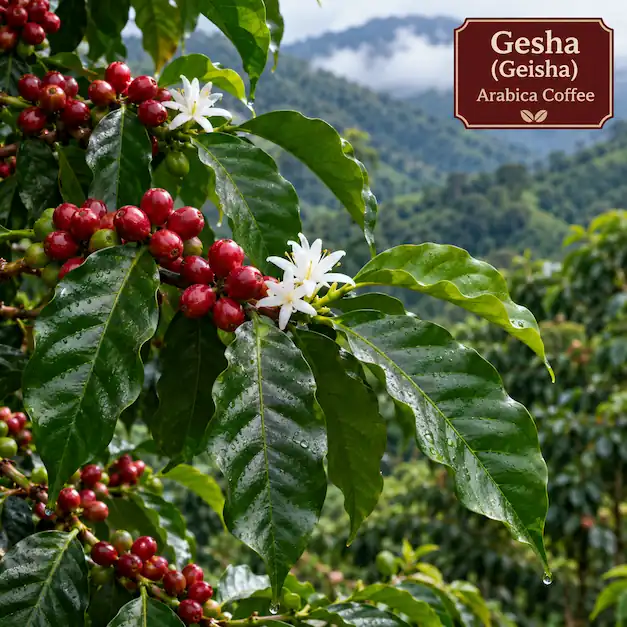
Its origins lie in Ethiopia, where coffee plants were collected near the Gesha region. The variety was subsequently taken to other growing countries, including Kenya and Tanzania, before reaching Central America.
It was in Panama that Gesha gained international attention. Particular plantings in the country’s high-altitude growing regions produced coffees with remarkable floral aromas and delicate, complex flavours.
Depending on the coffee, tasting notes may include jasmine, bergamot, citrus and peach, often accompanied by a light, tea-like body.
Gesha can achieve exceptional cup quality under suitable conditions, particularly at higher elevations. It has also become associated with some very high auction prices, although not every Gesha coffee commands a premium.
Its reputation demonstrates how genetics, growing conditions and careful post-harvest handling can combine to produce a distinctive coffee. It also explains why the variety has become a favourite among roasters and coffee enthusiasts who enjoy exploring more delicate flavour profiles.
One important distinction is that not every coffee sold as Geisha or Gesha necessarily shares the same genetic background. The World Coffee Research catalogue identifies Panamanian Geisha as an Ethiopian landrace and notes its exceptional quality potential at high altitudes.
4. Modern Hybrids: Breeding for Resilience and Quality
Coffee farming faces a range of challenges, including coffee leaf rust, other crop diseases, changing temperatures and irregular rainfall.
Plant breeders have therefore developed varieties that combine useful traits from different genetic backgrounds. The aim is to improve productivity, disease resistance and adaptation to particular growing conditions without losing the cup quality that makes Arabica so appealing.
Some of these varieties are known as introgressed hybrids. They carry genetic material introduced from another coffee species, often Coffea canephora (Robusta), through breeding.
One important source of this breeding work is the Timor Hybrid, a naturally occurring cross between Arabica and Robusta discovered on the island of Timor. Its genetic contribution has been particularly important in the development of coffee leaf rust-resistant varieties.
Catimor and Sarchimor
Catimor and Sarchimor are two important groups of modern Arabica varieties.
Catimor varieties descend from crosses involving Caturra and the Timor Hybrid. They were developed partly to improve resistance to coffee leaf rust while retaining useful production characteristics.
Sarchimor varieties descend from Villa Sarchi and the Timor Hybrid. Like Catimor, they include selections bred for improved disease resistance and agricultural performance.
Both groups contain a number of individual varieties, and their characteristics can differ considerably. Some offer good productivity and resistance to coffee leaf rust, while others have particular requirements relating to altitude, climate or farm management.
It’s therefore important not to assume that every Catimor or Sarchimor has identical resistance, yield or flavour characteristics.
Castillo and the Centroamericano F1 Hybrid
Two further examples help show how modern breeding has developed.
Castillo is a Colombian variety developed through breeding and selection to improve productivity and resistance to coffee leaf rust. It has become an important part of Colombia’s coffee-growing landscape.
Centroamericano H1 is an F1 hybrid created from two genetically distinct parent lines, T5296 and Rume Sudan. It was developed through a breeding programme involving Central American research organisations and CIRAD.
Centroamericano has very high yield potential and can offer very good cup quality under suitable conditions. It also has resistance to coffee leaf rust and is particularly suited to certain higher-altitude growing environments.
Neither variety guarantees a particular result in the cup. Farming practices, climate, ripeness at harvest, processing and roasting all remain important.
Modern hybrids are therefore best understood as part of the wider effort to make coffee cultivation more resilient. Their success depends on matching the right variety to the conditions and needs of the farm.
The World Coffee Research Arabica catalogue provides detailed information on these and other varieties, including their genetic backgrounds, growth habits, yield potential and disease resistance.
How Do Arabica Varieties Compare?
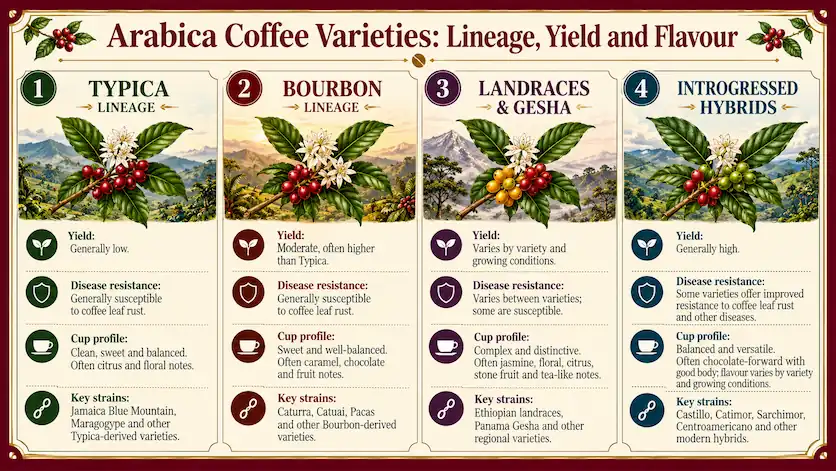
The following comparison brings together the main groups covered in this guide. It is worth remembering that these aren’t all equivalent botanical categories. Some are historical lineages, others are traditional populations, and some are modern breeding selections.
| Variety or group | General characteristics | Main consideration |
|---|---|---|
| Typica | Heritage variety with good cup-quality potential | Low yield potential and susceptibility to major diseases |
| Bourbon | Important historical variety with excellent cup-quality potential | Tall growth and susceptibility to major diseases |
| Ethiopian landraces | Wide genetic diversity and varied flavour potential | Characteristics differ considerably between populations |
| Gesha | Potential for exceptional, floral and complex cups | Quality and value depend on the particular coffee and growing conditions |
| Catimor and Sarchimor | Groups that include varieties bred for disease resistance and productivity | Traits vary between individual varieties |
| Castillo | Colombian selection bred for productivity and rust resistance | Performance depends on growing conditions and farm management |
| Centroamericano H1 | F1 hybrid with high yield and very good cup-quality potential | Requires suitable growing conditions to achieve its potential |
For more detailed information on individual varieties, the World Coffee Research Arabica varieties catalogue is a particularly useful reference. It includes information on genetic background, plant size, yield potential, disease resistance and cup-quality potential.
Does the Arabica Variety Change How Coffee Tastes?
Yes, the variety can influence the flavour potential of a coffee, but it’s only one part of the picture.
Genetics influence the characteristics of the plant and the chemical composition of its fruit and seeds. Growing conditions, including temperature, altitude, soil and water availability, also affect development. After harvesting, processing and roasting introduce further changes before the coffee reaches your cup.
This is why two Arabica coffees can taste completely different even when they share the same variety. A well-grown Bourbon might produce a sweet, balanced cup, while another Bourbon from a different environment could show a different balance of fruit, acidity and body.
The same applies to Gesha. Its reputation for floral complexity is well deserved, but the variety name alone cannot guarantee an exceptional result.
If you’re buying beans, look at the variety alongside the origin, processing method, roast level and tasting notes. Taken together, these details give you a much better starting point for choosing a coffee you’re likely to enjoy.
Bringing It All Together
Arabica coffee is far more diverse than a single name on a bag might suggest.
Typica and Bourbon represent important historical lineages, Ethiopian landraces preserve valuable genetic diversity, and Gesha demonstrates the potential for exceptional cup quality. Modern hybrids show how breeding can help address the practical challenges facing coffee farmers.
The most interesting lesson is that no single variety has everything. Some offer excellent cup-quality potential but are vulnerable to disease or produce relatively small crops. Others are bred for resilience and productivity while also aiming to maintain good flavour.
Next time you buy a bag of Arabica coffee, see whether the variety is listed. If it is, compare it with the origin and processing information and notice how the cup matches the tasting notes. You may find a new favourite, or simply gain a better understanding of why two coffees that look similar can taste so different.
And if your coffee tastes unexpectedly sour or bitter, remember that the variety isn’t necessarily to blame. Brewing technique can have just as much influence on the final result. Our guides to why coffee tastes sour and how to fix it and how to fix bitter coffee can help you troubleshoot your cup.
How Do Arabica Varieties Compare?
| Variety or group | General characteristics | Main consideration |
|---|---|---|
| Typica | Heritage variety with good cup-quality potential | Low yield potential and susceptibility to major diseases |
| Bourbon | Important historical variety with excellent cup-quality potential | Tall growth and susceptibility to major diseases |
| Ethiopian landraces | Wide genetic diversity and varied flavour potential | Characteristics differ considerably between populations |
| Gesha | Potential for exceptional, floral and complex cups | Quality and value depend on the particular coffee and growing conditions |
| Catimor and Sarchimor | Groups that include varieties bred for disease resistance and productivity | Traits vary between individual varieties |
| Castillo and Centroamericano | Modern breeding examples combining agricultural performance with cup-quality potential | Results depend on variety, location and farm management |
For a more detailed comparison of individual varieties, the World Coffee Research Arabica varieties catalogue is a useful reference. It includes information on genetic background, plant size, yield potential, disease resistance and cup-quality potential.
Does the Arabica Variety Change How Coffee Tastes?
Yes, the variety can influence the flavour potential of a coffee, but it is only one part of the picture.
Genetics influence the characteristics of the plant and the chemical composition of its fruit and seeds. Growing conditions, including temperature, altitude, soil and water availability, also affect development. After harvesting, processing and roasting introduce further changes before the coffee reaches your cup.
This is why two Arabica coffees can taste completely different even when they share the same variety. A well-grown Bourbon might produce a sweet, balanced cup, while another Bourbon from a different environment could show a different balance of fruit, acidity and body.
The same applies to Gesha. Its reputation for floral complexity is well deserved, but the variety name alone cannot guarantee an exceptional result.
If you’re buying beans, look at the variety alongside the origin, processing method, roast level and tasting notes. Taken together, these details give you a much better starting point for choosing a coffee you are likely to enjoy.


