

Naturally Softer Coffees
While acidity adds brightness, many drinkers seek the smooth characteristics of Low Acid Coffee Beans for a rounder finish.
Additionally, acidity is an important part of flavour and can give a cup citrus, berry, or wine-like character.
However, some drinkers prefer something rounder, smoother and less sharp.
This is where naturally softer coffees come in, and we find out what makes coffee smooth.
The phrase naturally softer isn’t a strict scientific classification.
Rather, it describes coffees that tend to have lower perceived acidity.
They have a fuller body and flavours such as chocolate, nuts, caramel, cocoa and spice, not citrus or berry notes.
Additionally, origin, variety, altitude, processing, roasting and brewing all play a part in Low Acid Coffee Beans.
What Actually Makes a Coffee Taste “Soft”?
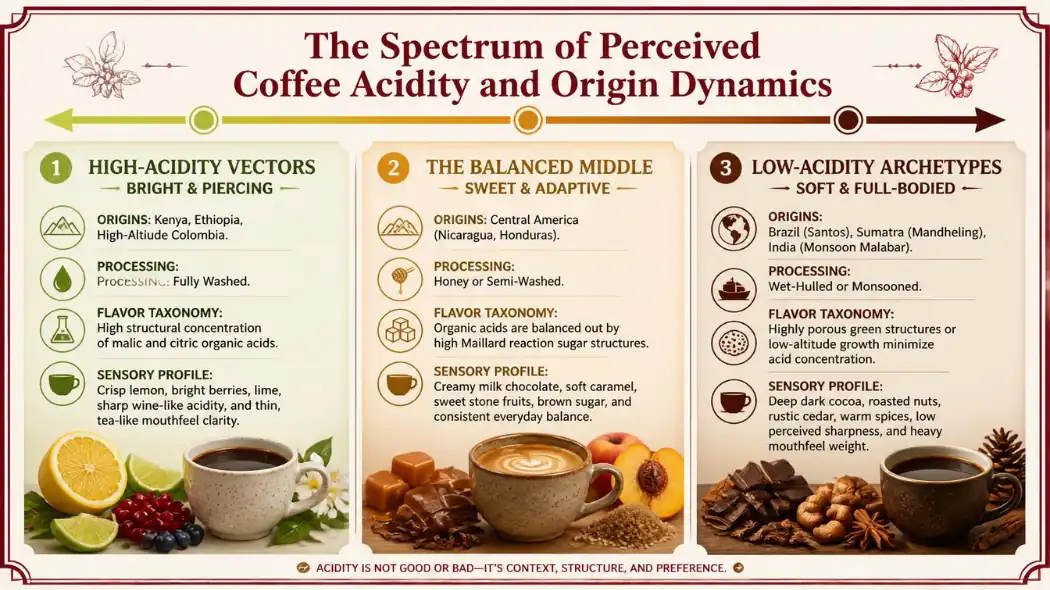
Several factors influence softness in coffee, including body, acidity, and texture. Additionally, for Low Acid Coffee Beans, acidity is reduced, which can produce a smoother, less sharp cup.
Coffee contains a complex mixture of organic acids and other compounds.
Additionally, these contribute significantly to what makes coffee smooth.
Research reviewed by the Specialty Coffee Association shows that coffee acids vary according to species, origin and, particularly, roasting.
An important distinction exists between chemical acidity and perceived acidity in Low Acid Coffee Beans. Low Acid Coffee Beans can have measurable acidity without tasting sharply acidic. Equally, a poorly extracted coffee can taste extremely sour, even when the green coffee itself isn’t particularly high in acidity. Sourcing parameters verified by The Coffee Guide show that manual or mechanical extraction errors can make even the softest bean profiles mimic structural defects; if your smooth daily extractions are finishing with a sharp, thin, or unpleasantly biting character, check out our master troubleshooting guide to understand why does my coffee taste sour and learn how to adjust your grind size and thermal parameters cleanly.
When we describe a coffee as soft, we’re generally talking about the overall sensory experience — a cup that feels rounded and comfortable rather than sharp, bright or piercing.
Several characteristics can contribute to this.

A Fuller Body
Some coffees have a naturally heavier mouthfeel, which can make their acidity seem less pronounced. This is one reason coffees from Brazil and Indonesia, for example, are often attractive to people who prefer a fuller, more rounded cup.
We often associate Brazilian coffees with nuts, chocolate, caramel and a heavier body.
However, speciality Brazilian coffees can be bright and highly acidic.
People often associate Indonesian coffees, especially those from Sumatra, with earthy, spicy, woody and full-bodied characteristics.
That doesn’t mean every Brazilian or Indonesian coffee will be soft.
Coffee is far too diverse for such a simple rule.
But these origins offer plenty of examples of coffees that can produce the style of cup we’re looking for.
The Coffee’s Origin Matters for Low Acid Coffee Beans
The way farmers grow coffee shapes its character.
Altitude, temperature, rainfall, soil, coffee variety and growing conditions all affect how the coffee develops.
High-altitude coffees are often associated with pronounced acidity and complex fruit characteristics, although altitude alone doesn’t determine acidity.
Lower-growing coffees can sometimes produce softer, heavier profiles, particularly when combined with particular varieties and processing methods.
This is why you should treat country and altitude as clues rather than guarantees of Low Acid Coffee Beans.
A coffee from Colombia, for example, can be beautifully balanced and sweet, while another Colombian coffee may have pronounced citrus acidity.
Even coffees from neighbouring farms can taste remarkably different.
Why Brazil Produces the Best Low Acid Coffee Beans”
If you’re looking for a naturally approachable coffee, Brazil is probably one of the best places to begin.
Brazil produces an enormous range of coffees, but traditional Brazilian profiles are often associated with:
Chocolate • Cocoa • Nuts • Caramel • Brown sugar
Many Brazilian coffees have a rounded sweetness and substantial body rather than the pronounced citrus acidity associated with some high-grown African coffees.
This makes them particularly popular in espresso blends, where their body and sweetness can provide a solid foundation.
However, modern Brazilian speciality coffee can be very different.
Producers are increasingly producing coffees with fruit-forward and highly complex profiles, so don’t assume that every Brazilian coffee will be low Acid Coffee Beans.
Sumatra: Deep, Earthy and Full-Bodied Low Acid Coffee Beans
For something quite different, look towards Sumatra.
Indonesian coffees are famous for their distinctive processing traditions, particularly the wet-hulling method known as Giling Basah.
These coffees can have substantial body and flavours described as:
Earthy • Spicy • Herbal • Dark chocolate • Woody
The result can be a remarkably deep cup with relatively restrained acidity.
Sumatra is therefore an interesting choice for someone who finds bright, fruit-forward coffees too sharp.
There is considerable variation, however, and speciality Indonesian coffees can also display sweetness, fruit and considerable complexity.
India: Low Acid Coffee Beans with Softness and Spice
India is another origin worth exploring.
Indian coffees can offer spice, cocoa, nuts and relatively gentle acidity, making them an interesting alternative for drinkers who prefer a softer profile.
And then there is the particularly unusual Monsoon Malabar.
This coffee undergoes an intentional exposure to humid monsoon conditions that changes the physical and sensory characteristics of the beans.
The resulting cup is famous for its very low perceived acidity, heavy body and distinctive spicy, woody character.
Some coffee professionals specifically recommend it for people who prefer less acidity.
It is one of the most unusual examples of how processing can dramatically alter a coffee’s character.
Honduras: Chocolate, Caramel and Sweetness
Honduras is another origin worth investigating if you prefer a softer cup.
Many Honduran coffees can display:
Chocolate • Caramel • Nuts • Brown sugar • Sweet fruit
There is plenty of variation between regions, farms and processing methods, however.
Western Honduras, for example, can produce coffees with considerable acidity and fruit character, demonstrating why country alone cannot determine whether a coffee will taste soft.
For a gentler profile, look specifically for tasting notes that emphasise chocolate, caramel and nuts rather than citrus or tart fruit.
Nicaragua: Smooth and Sweet
Nicaragua can also produce coffees with a pleasing combination of chocolate, caramel, nuts and gentle fruit.
They can offer a useful middle ground for someone who doesn’t want a heavy, earthy Indonesian coffee but also doesn’t want the pronounced acidity of some African coffees.
As always, the particular coffee matters more than the country name.
A naturally processed Nicaraguan coffee can have considerably more fruit and perceived acidity than a washed coffee from the same region.
What About Colombia?
Colombia is slightly more complicated.
Colombian coffee is often praised for its balance, sweetness and aroma, but Colombian coffees can also have quite pronounced acidity and fruit characteristics.
So I wouldn’t automatically recommend Colombia simply because someone asks for low-acid coffee.
Instead, look at the tasting notes and roast style.
A Colombian coffee described as milk chocolate, caramel, nuts and brown sugar may be much closer to what you’re looking for than one described as lime, grapefruit, red berries and wine.
Does Processing Make a Difference?
Very much so.
Coffee can be processed in several ways after harvesting, including washed, natural and honey processing, and these methods influence the flavours that eventually appear in the cup.
Natural coffees often have greater fruitiness and sweetness, although that doesn’t automatically mean lower acidity.
Washed coffees can have exceptionally clean, bright acidity, but again, there are many exceptions.
Processing should therefore be considered alongside origin, variety and roast, rather than treated as a simple “low-acid/high-acid” switch.

Roasting Can Change the Picture
Roasting has a profound effect on coffee chemistry.
As coffee moves through the roasting process, its organic acids change, while chlorogenic acids break down and form other compounds.
The Specialty Coffee Association’s review of coffee acids highlights just how strongly roast development can alter the chemical composition of the bean.
In practical terms, medium and darker roasts often taste less bright and acidic than very light roasts.
However, darker does not automatically mean better for someone with sensitivity to coffee.
A very dark roast can introduce more intense roasted, bitter or smoky flavours, which some people may find just as unpleasant as sharp acidity.
A well-developed medium or medium-dark roast can often provide a useful balance between acidity, sweetness, body and roast character.
And Don’t Forget the Brewing Method
The coffee isn’t the only thing determining what ends up in your cup.
Brewing method can influence the sensory profile considerably.
Cold brew, for example, is frequently described as smoother and less acidic.
Research conducted through the UC Davis Coffee centre found that cold-brewed samples had a slightly higher pH and were perceived as less bitter and sour than comparable hot-brewed samples under controlled conditions.
But the research also produced an important conclusion:
The coffee itself had a larger influence on the final sensory profile than the brewing temperature alone.
So choosing a naturally softer coffee and then brewing it as cold brew may be particularly appealing if you’re looking for a smoother cup.
The Best Coffees to Try
If your preference is for soft, rounded and lower-acidity coffee, I’d start by looking for coffees with tasting notes such as:
| Origin / Style | Look for flavours such as |
| Brazil | Chocolate, cocoa, nuts, caramel |
| Sumatra | Dark chocolate, earth, spice, herbs |
| India | Cocoa, nuts, spice |
| Monsoon Malabar | Very low acidity, spice, wood, heavy body |
| Honduras | Chocolate, caramel, nuts, brown sugar |
| Nicaragua | Chocolate, caramel, nuts, gentle fruit |
| Colombia | Chocolate, caramel, nuts, balanced sweetness |
These should be treated as starting points rather than guarantees.
The individual farm, variety, altitude, processing method and roast can completely change the character of a coffee.
What Should You Look for on the Bag?
If you’re standing in front of a shelf of coffee and want something naturally softer, don’t simply search for the words “low acid”.
Look at the tasting notes.
Words such as: Chocolate Cocoa Caramel Toffee Nuts Almond Brown sugar Spice Full-bodied Smooth
are generally more useful indicators of the style you’re looking for than the country name alone.
Conversely, if you’re trying to avoid a particularly bright cup, tasting notes such as lemon, lime, grapefruit, cranberry, blackcurrant or wine-like acidity may point towards a more pronounced acidic character.
Naturally Softer Doesn’t Mean Flavourless
This is perhaps the most important point.
A coffee with gentle acidity isn’t necessarily bland.
In fact, some of the world’s most interesting coffees are prized precisely because they combine low perceived acidity with tremendous body, sweetness and complexity.
Monsoon Malabar is a wonderful example.
Brazilian specialty coffees provide another.
Sumatra offers something completely different again.
The goal isn’t to remove acidity completely.
It’s about finding a coffee where the acidity doesn’t dominate the cup.
For some drinkers, that means a Brazilian coffee with chocolate and nut flavours.
For others, it might be a rich Sumatran coffee or the unusual character of Monsoon Malabar.
And if you’re particularly sensitive to coffee, experimenting with both the bean and the brewing method may give you more useful results than simply searching for a coffee labelled “low acid”.
The Bottom Line
There is no single “low-acid coffee bean”.
What we call a naturally softer coffee is usually the result of several factors coming together — the coffee’s genetics, growing conditions, processing, roasting and brewing.
If you prefer a smoother cup, start with Brazil, Sumatra, India, Monsoon Malabar, Honduras or Nicaragua, then look at the individual tasting notes rather than relying solely on the country of origin.
And perhaps most importantly, remember that acidity is not the enemy.
It is one of the things that gives coffee life.
The trick is finding the point where acidity, sweetness, body and bitterness come together in a cup that you enjoy.
Disclaimer – The coffee information provided on this website is for educational purposes only. It does not constitute medical advice. Readers should always consult a qualified healthcare professional before making changes to their dietary habits.

