

Table of Contents
Have you ever travelled with a favourite bag of coffee beans, only to find that your usual brew tastes completely different when you make it somewhere else? You use the same grinder, the same coffee-to-water ratio and the same brewing temperature, yet the cup tastes noticeably different. One possible reason is the water itself. Hard water vs soft water in coffee is an important subject because the mineral content of brewing water can influence flavour, extraction and the long-term condition of your equipment.
Water may look identical from one tap to another, but its mineral composition can vary considerably. In areas where water passes through limestone or chalk, it can pick up calcium and magnesium. Elsewhere, the supply may contain much lower concentrations of these minerals.
However, there is more to coffee water than simply choosing between hard and soft. The balance between mineral hardness and alkalinity is particularly important. Understanding the difference can help you produce a more balanced cup and protect your espresso machine from unnecessary scale.

What Is Hard Water, and How Does It Affect Coffee?
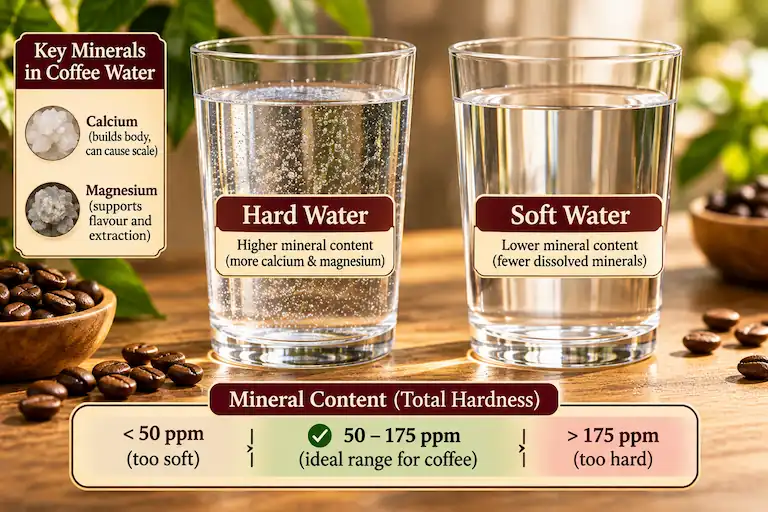
Hard water contains higher concentrations of dissolved minerals, principally calcium and magnesium. These minerals enter the water naturally as it moves through geological formations, including limestone, chalk and other mineral-rich rocks.
Water hardness is commonly expressed as milligrams per litre (mg/L), or parts per million (ppm), calculated as calcium carbonate equivalent. This does not mean that all the hardness is present as dissolved calcium carbonate: it is a standard way of expressing the combined contribution of calcium and magnesium.
Both minerals matter in coffee brewing, but their effects are more complex than the simple idea that one extracts fruity flavours and the other creates body.
Magnesium: An important mineral in brewing water
Magnesium ions can interact with compounds found in coffee, including organic acids and other flavour-related molecules. Earlier chemical modelling by researchers suggested that magnesium could bind more strongly than calcium to certain coffee compounds, potentially influencing extraction.
However, later experimental research has made the picture less straightforward. A 2024 study found that, at concentrations normally found in drinking water, magnesium and calcium produced only limited changes in the measured organic-acid content of coffee. The researchers suggested that some differences in perceived flavour may arise from interactions within the brewed drink itself, rather than simply from more acids being extracted.
This means magnesium remains an important part of brewing-water composition, but it should not be described as a guaranteed way to pull more fruitiness or sweetness from a coffee. PubMed+1
Calcium: Hardness, balance and limescale
Calcium also contributes to total water hardness and plays a role in the mineral balance of brewing water. It is not accurate to say that calcium selectively extracts heavy, earthy or bitter compounds from coffee.
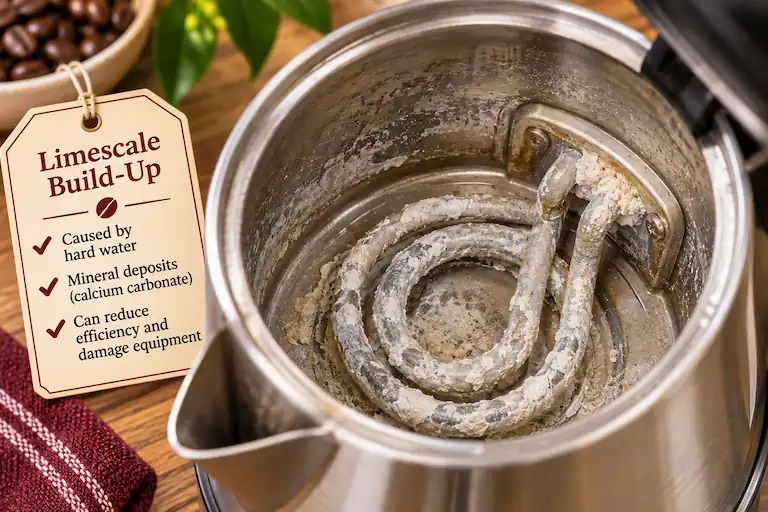
Its most familiar practical consequence is its contribution to limescale. When water containing calcium and bicarbonate is heated, chemical changes can encourage calcium carbonate deposits to form on heating elements, boiler surfaces and internal pipework.
Over time, scale can reduce heating efficiency, restrict water flow and increase maintenance requirements. This is particularly important for espresso machines, where water is repeatedly heated inside boilers and other components.
The aim is not to remove every trace of calcium. It is to keep hardness at a suitable level while also controlling alkalinity.
The Problem with Overly Soft Water
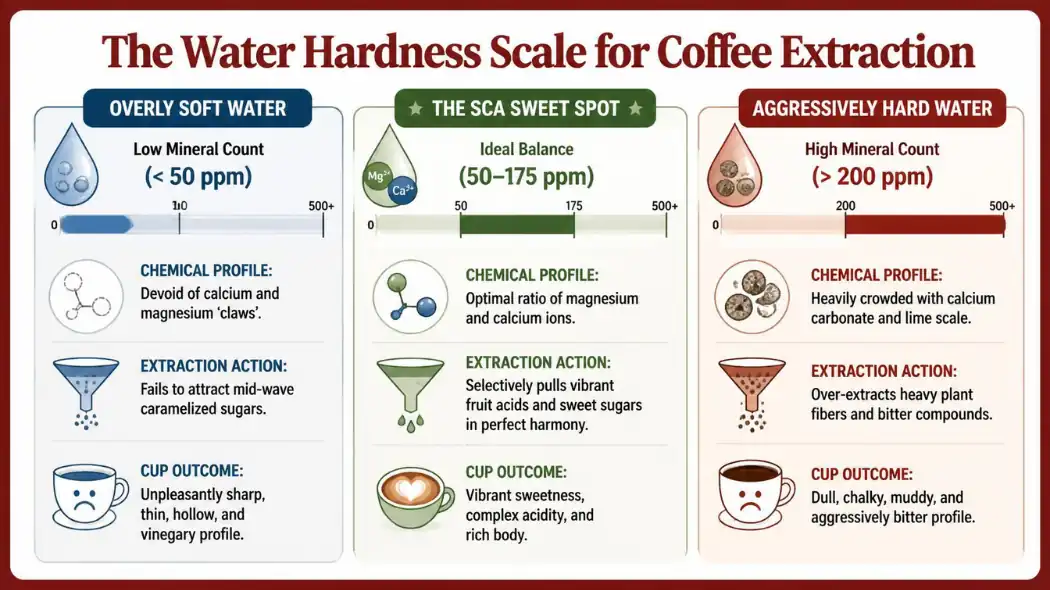
If very hard water can contribute to scale and an unbalanced brew, it might seem sensible to remove as many minerals as possible. Unfortunately, completely mineral-free water is not the ideal answer.
Water with extremely low mineral content can behave differently during brewing and may produce a cup that lacks the balance and character you expect. However, it is misleading to claim that soft water automatically causes under-extraction or that it washes out fruit acids while failing to dissolve caramelised sugars.
Coffee extraction depends on several interacting variables, including grind size, water temperature, contact time, brew ratio and water chemistry. Mineral content is one part of that picture, not a single control that determines the result.
There is also an important distinction between naturally soft water and water treated by a conventional household salt-based softener. These systems generally exchange calcium and magnesium ions for sodium ions. Although this reduces hardness and can help control scale, the resulting sodium-rich water is not necessarily suitable for coffee brewing or espresso machines.
Very low-mineral water, including distilled or reverse-osmosis water without remineralisation, is not automatically a good choice either. Many brewing-water recipes add selected minerals back to create a more suitable balance.
Hard Water vs Soft Water in Coffee: Why Alkalinity Matters
Hardness is only half the story. To understand why some water makes coffee taste dull, muted or less lively, you also need to understand alkalinity.
Alkalinity describes water’s ability to neutralise acids. In most drinking water, bicarbonate is the main contributor. During brewing, bicarbonate can buffer some of the acids present in coffee, reducing the sharpness and brightness perceived in the finished cup.
This is why two water supplies with similar hardness can produce noticeably different coffee. One may have a relatively balanced mineral composition, while the other has much higher alkalinity and can make the brew taste flatter.
A 2026 sensory study found that increasing bicarbonate had a pronounced effect on coffee flavour, reducing perceived acidity, fruitiness and complexity while increasing roasted and bitter notes. In that study, hardness alone produced no marked flavour changes across the tested samples. This is a useful reminder that hardness and alkalinity should not be treated as interchangeable measurements. PubMed Central (PMC)
If your coffee tastes harsh, dry or bitter, water may be one factor worth investigating, but it is not the only possible cause. Our guide explains the other common reasons for why coffee tastes bitter.
Likewise, if your brew is sharply sour or lacks balance, take a look at why coffee tastes sour.
What Is the Ideal Water Hardness for Coffee?

The Specialty Coffee Association (SCA) provides water-quality guidance intended to support good coffee brewing. Its commonly referenced parameters include:
- Calcium hardness: 50–175 ppm, expressed as calcium carbonate equivalent.
- Alkalinity: 40–70 ppm, expressed as calcium carbonate equivalent.
- pH: 6–8.
These are useful reference ranges rather than a guarantee that every coffee will taste best at exactly the same mineral composition. Brewing method, coffee variety, roast level and personal preference all influence the final result. Espresso equipment manufacturers may also specify their own water requirements, so always check the recommendations for your machine. coffeegeek.com+1
One important point: a basic TDS meter cannot tell you the exact calcium, magnesium or bicarbonate content of your water. It measures overall dissolved solids, not the individual minerals responsible for hardness and alkalinity. A dedicated water test is needed to understand those values.
How Can You Improve Your Coffee Water?
You do not necessarily need an expensive filtration system to improve your brewing water. The best approach depends on your local supply and the equipment you use.
A few practical options include:
- Filter jugs: Some household filter cartridges reduce chlorine and may also contain ion-exchange resins that alter water hardness. Check the cartridge specification, as not all filter jugs reduce calcium and magnesium.
- Specialist coffee-water filters: These are designed to manage mineral content and can be useful for espresso machines, where scale control is particularly important.
- Reverse osmosis systems: RO removes a large proportion of dissolved substances. The resulting water is often remineralised before brewing because very low-mineral water is not an ideal finished product for most coffee applications.
- Water testing: A simple hardness test can provide a useful starting point, while more detailed testing can help identify alkalinity and individual mineral levels.
For a closer look at the equipment and methods available, read our guide to coffee water filtration.
Finding the Right Balance
The difference between hard and soft water is not simply a choice between good and bad. Coffee needs water with a suitable mineral balance, and both excessive hardness and very low mineral content can create problems.
Calcium and magnesium contribute to total hardness, while bicarbonate influences alkalinity and the way acidity is perceived. Together, these characteristics help determine how your brewing water behaves.
Once you understand what is coming out of your tap, you can make more informed decisions about filtration, remineralisation and espresso-machine maintenance. The reward is greater consistency, a better-balanced cup and equipment that is less likely to suffer from avoidable scale build-up.


