

Table of Contents
When we’re trying to improve a cup of coffee, it’s easy to concentrate on the obvious things. We buy better beans, experiment with grind sizes, invest in a decent grinder and carefully adjust our brewing times. Yet there’s one ingredient that often gets overlooked: the water, tap water quality.
It might seem like a small detail, but water makes up around 98% of a typical filter coffee and roughly 90% of an espresso. That means the quality and mineral composition of the water going into your coffee can have a considerable influence on the finished drink.
Even excellent speciality beans can taste flat, harsh or unbalanced when brewed with unsuitable water. The problem isn’t necessarily your technique or the coffee itself. Sometimes, the answer is coming straight from the kitchen tap.

Why Is Ordinary Tap Water Not Always Ideal for Coffee Extraction?
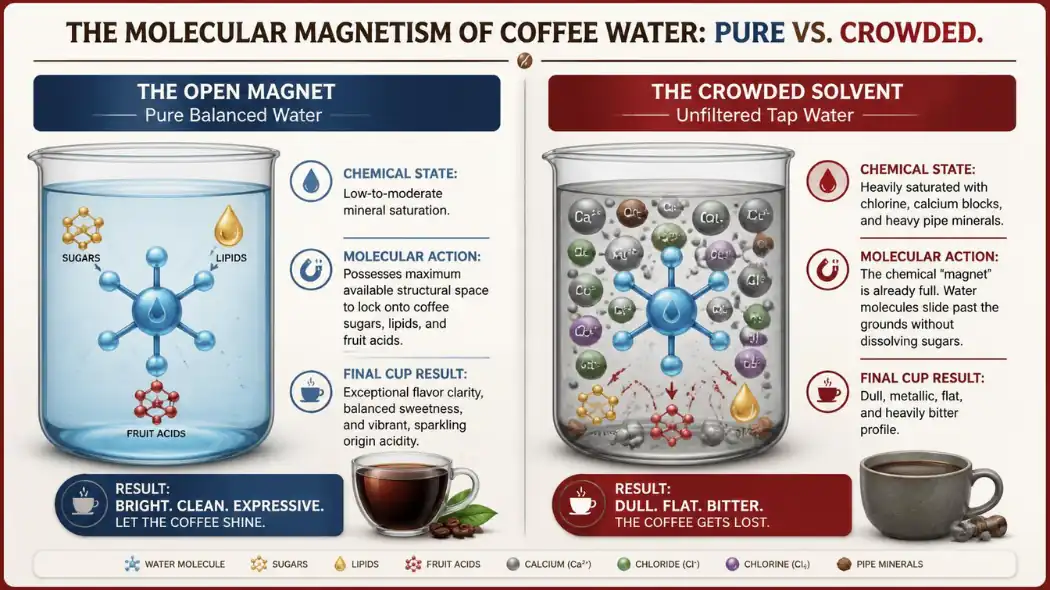
Water is often called the universal solvent because it can dissolve a remarkable range of substances. During brewing, it passes through the ground coffee and extracts soluble compounds responsible for its flavour, aroma and body.
However, water is not chemically identical everywhere. As it moves through the ground, it picks up naturally occurring minerals such as calcium and magnesium. Water companies may also treat it to make it safe to drink, while household plumbing can influence its final taste.
These differences matter because coffee extraction depends partly on the minerals dissolved in the water.
Calcium and magnesium help influence how certain coffee compounds dissolve. Bicarbonates, meanwhile, affect alkalinity and the water’s ability to buffer acidity. In other words, water composition can change how bright, sweet or balanced a coffee tastes.
This is why there is no single perfect tap water supply for every coffee. The aim is to find water with a suitable mineral balance, rather than water that is completely stripped of minerals.
The Specialty Coffee Association’s brewing water guidance provides useful reference ranges for characteristics such as hardness, alkalinity, pH and odour. These are helpful starting points for anyone interested in taking their home brewing a little further.
The Hidden Impact of Chlorine and Old Pipes
One of the most noticeable problems with some tap water is chlorine. Water suppliers use chlorine as a disinfectant to protect drinking water as it travels through the public supply network. This is an important public health measure, but some people can detect its taste or smell.
When water has a noticeable chlorine or medicinal character, it can interfere with the delicate aromas we want to enjoy in a freshly brewed coffee. A cup that should reveal floral, fruity or chocolate notes may instead have an unpleasant background taste.
The UK’s Drinking Water Inspectorate explains that chlorine is used to maintain the hygiene of public water supplies, and that an activated-carbon jug filter can help reduce noticeable chlorine taste and smell.
Household plumbing can also affect water quality. Copper, iron and other materials in pipes, fittings or tanks may contribute metallic or bitter flavours, particularly where water has been standing for a long time.
If your tap water suddenly develops an unusual taste or smell, don’t simply assume that it is a coffee problem. Try another cold tap and contact your water supplier if the change persists or is particularly strong.
For further guidance, the Drinking Water Inspectorate’s advice on taste and odour in drinking water is a useful place to start.
How Water Quality Affects Your Coffee’s Flavour
Water composition can influence extraction, but it is important not to confuse mineral balance with a simple rule that harder water always makes bitter coffee or softer water always makes sour coffee.
The relationship is more subtle.
Hard water and mineral content
Hard water generally contains higher concentrations of dissolved calcium and magnesium. These minerals can influence extraction and flavour, while the bicarbonate content affects how acidity is perceived.
Water with excessive alkalinity can soften the brighter acidic characteristics of a coffee, making a lively, fruit-forward cup seem flatter or less expressive.
Very soft or low-mineral water
Water with very little mineral content may produce a different extraction profile and can make coffee taste unbalanced. However, low mineral content does not automatically mean over-extraction. The result depends on the coffee, brewing method, temperature, grind size and other water characteristics.
Chlorine and unwanted tastes
Unlike mineral balance, chlorine-related tastes are often easier to recognise. If your water has a noticeable swimming-pool, medicinal or chemical character, those flavours can carry through into your coffee.
If you’re struggling to identify whether your coffee is bitter or sour, it is worth reading our guides to why coffee tastes bitter and why coffee tastes sour. Remember that water is only one possible cause; grind size, brewing time and temperature all play their part too.
The Simple Ways to Improve Your Brewing Water
You don’t need specialist laboratory equipment to start improving the water you use at home. A few straightforward changes can make a noticeable difference.
1. Try an activated-carbon filter jug
A filter jug with an activated-carbon cartridge can reduce chlorine taste and smell, as well as certain other substances, depending on the filter design. It is a sensible first step if your tap water has an unpleasant taste.
Always follow the manufacturer’s instructions and replace cartridges at the recommended intervals. A neglected filter is unlikely to improve your water.
2. Compare your tap water with bottled water
A useful experiment is to brew the same coffee twice: once with your usual tap water and once with a bottled natural mineral water.
Volvic is often used by home brewers as a comparison water because its mineral composition can suit certain brewing recipes. However, bottled water varies considerably, and no single brand is automatically ideal for every coffee.
Check the mineral information on the label rather than choosing purely by brand name. Compare the results in the cup and see which brings out the sweetness and character you prefer.
3. Consider water made specifically for coffee
For those who enjoy experimenting, specialist mineral sachets such as Third Wave Water can be added to distilled or reverse-osmosis water. They provide a controlled mineral composition, allowing you to adjust your brewing water more consistently.
This is a more involved approach, but it can be useful if you want to understand how different mineral levels influence extraction.
4. Start with fresh, cold tap water
Even without buying a filter, use freshly drawn cold water from the kitchen tap rather than water that has been sitting in a kettle for a long time. If the water has been standing in household pipes overnight, let it run until it is fresh and cool.
This is a simple habit that helps ensure you’re starting with clean, fresh water each time you brew.
A Better Cup Starts with Better Tap Water Quality
It’s easy to spend time and money improving your coffee equipment while overlooking the ingredient that makes up most of the drink. Yet tap water quality can influence extraction, acidity, sweetness and the overall clarity of your cup.
Start by tasting your water on its own. If it has a noticeable chlorine or metallic flavour, try a suitable filter and compare the result. If you want to go further, experiment with bottled mineral water or a coffee-specific mineral recipe.
You may discover that the beans you’ve been trying to improve didn’t need a new grinder or a different brewing technique at all. They simply needed better water.
In our next guide, Hard Water vs Soft Water: The Chemistry of Calcium and Magnesium in Espresso Extraction, we’ll look more closely at how water hardness and mineral composition influence the way coffee extracts.
I


