

Table of Contents
From Filter Pitchers to Reverse Osmosis
Water is one of the most important ingredients in a cup of coffee, yet it is often the one receiving the least attention. We carefully select our beans, adjust our grind size and experiment with brewing temperatures, but the water itself can have an equally important influence on the final result.
Understanding coffee water filtration is therefore an important step towards improving your home brewing.
Ordinary tap water may contain chlorine, dissolved minerals and other substances that affect its taste, while excessive water hardness can contribute to limescale build-up inside coffee machines. At the other extreme, water that has had almost all its minerals removed may not provide the balance needed for a satisfying extraction.
Fortunately, you don’t need an industrial filtration plant to improve your brewing water. From simple carbon-filter pitchers to specialist ion-exchange cartridges and reverse osmosis systems, there are several ways to manage your water quality.
The key is understanding what each system actually removes, what it leaves behind and whether it suits the water supplied to your home.

1. Carbon Filter Pitchers: The Entry-Level Option
For many home coffee drinkers, a filtered water jug is the easiest starting point.
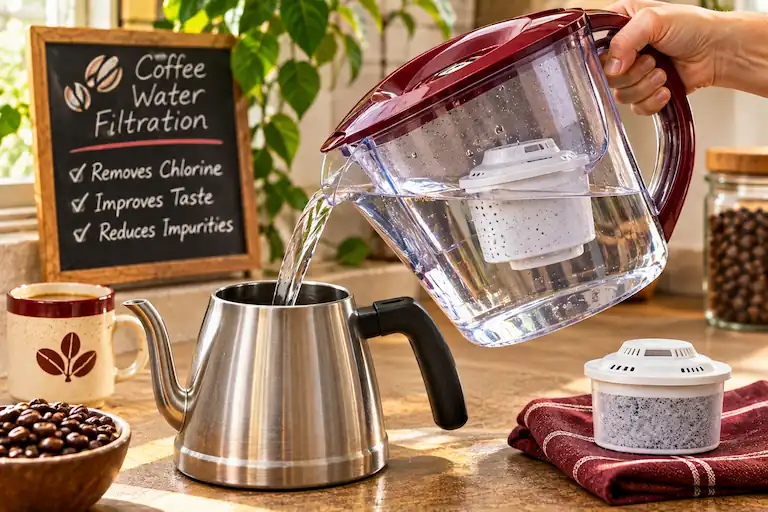
Products such as BRITA water filter pitchers use replaceable cartridges containing activated carbon, often combined with ion-exchange resin.
How Does Activated Carbon Work?
Activated carbon has an enormous internal surface area containing millions of tiny pores. As water passes through the material, certain unwanted substances are adsorbed onto its surface.
This process is particularly useful for reducing chlorine and other substances that can affect the taste and smell of tap water.
Removing unwanted chlorine odours can help prevent them from interfering with the delicate aromas of freshly brewed coffee.
Does a Carbon Filter Remove Water Hardness?
This is where the type of cartridge becomes important.
A simple activated-carbon filter is primarily designed to improve taste and odour. It does not necessarily remove calcium and magnesium, the minerals responsible for water hardness.
However, many domestic filter cartridges combine activated carbon with ion-exchange resin. These cartridges can reduce some of the carbonate hardness responsible for limescale formation.
For example, BRITA’s MAXTRA PRO cartridges use a combination of activated carbon and ion-exchange resin, although the precise performance depends on which cartridge is selected.
If you’re considering a filter jug, check the manufacturer’s specifications rather than assuming that every cartridge offers the same treatment.
You can find further information in BRITA’s guide to its filter cartridges.
Best suited to: Home coffee drinkers who want to improve the taste and odour of their tap water, with certain cartridges also providing some reduction in limescale.
2. Specialised Ion-Exchange Filters: Controlling Mineral Hardness
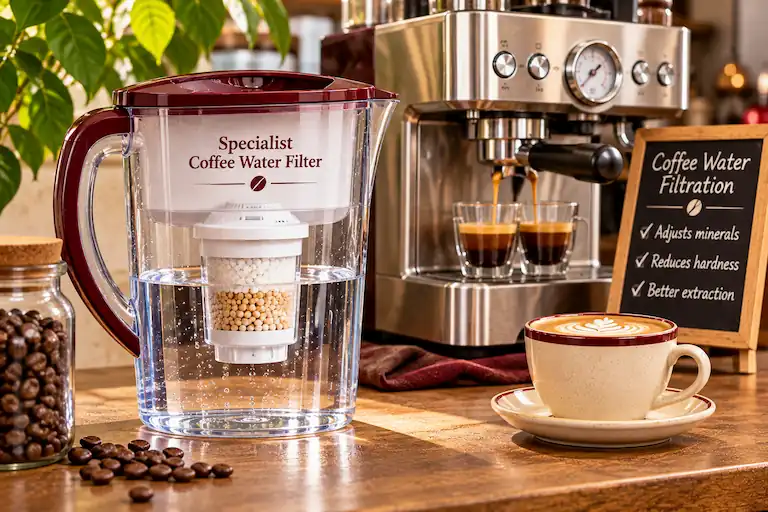
If your local water supply is particularly hard, a standard activated-carbon filter may not provide enough protection for your coffee equipment.
This is where ion-exchange filtration becomes useful.
Ion-exchange systems contain small resin beads that exchange selected dissolved ions as water passes through them. Depending on the resin and cartridge design, this can reduce calcium and magnesium or replace certain minerals with other ions.
How Does Ion Exchange Work?
Calcium and magnesium are the principal minerals responsible for water hardness.
In a conventional softening process, an ion-exchange resin can capture these minerals and release sodium ions in their place. This reduces hardness and helps prevent limescale formation.
However, not all coffee filtration systems work in exactly the same way.
Some specialist coffee-water cartridges use a different approach, replacing calcium with magnesium rather than simply removing hardness.
This can be particularly interesting for coffee preparation because magnesium contributes to the mineral composition of brewing water and influences how coffee compounds are extracted.
Specialist Coffee Water Filters
Two examples worth exploring are:
- Peak Water: Developed specifically for coffee enthusiasts, with adjustable filtration designed to help users manage the mineral content of their brewing water.
- BWT Water Filters: Offers filtration technologies that include magnesium mineralisation, where calcium ions are exchanged for magnesium ions.
The exact performance depends on the cartridge, incoming water composition and operating conditions.
It’s also worth remembering that reducing hardness is not the same as creating ideal brewing water. Alkalinity, which helps control acidity, is another important factor.
Best suited to: Home baristas dealing with hard water who want greater control over mineral composition and better protection against limescale.
3. Reverse Osmosis Systems: A More Precise Starting Point
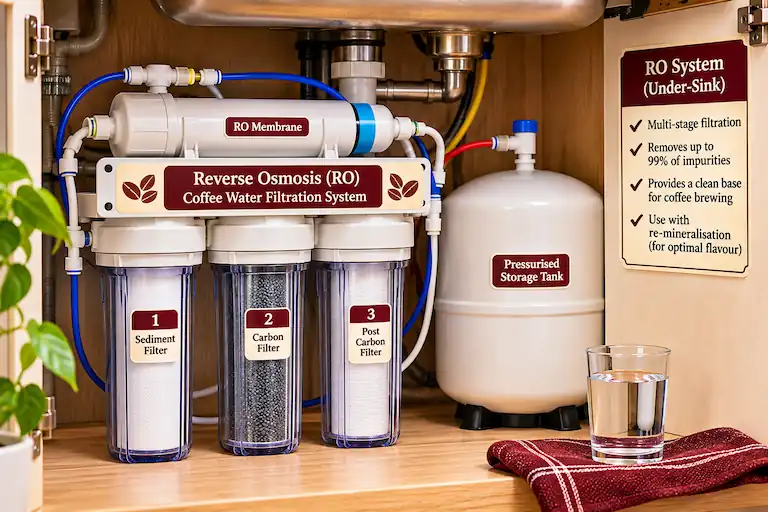
For coffee enthusiasts who want greater control over their brewing water, reverse osmosis (RO) offers a more comprehensive filtration approach.
Unlike a simple carbon filter or conventional ion-exchange cartridge, an RO system uses pressure to push water through a semi-permeable membrane.
The membrane allows water molecules to pass through while rejecting a large proportion of dissolved salts, minerals and other contaminants.
How Does Reverse Osmosis Work?
An RO system typically uses several filtration stages.
- Pre-filtration: Sediment and certain substances are removed before the water reaches the membrane.
- Carbon filtration: Activated carbon helps reduce chlorine and other substances that could affect the membrane or water quality.
- Reverse osmosis membrane: Water passes through the semi-permeable membrane, which rejects much of the dissolved mineral content.
- Post-treatment: Depending on the installation, additional carbon filtration or mineral adjustment may take place.
The resulting water has a much lower dissolved-solids content than the original tap water.
However, reverse osmosis does not automatically produce sterile water, nor does it guarantee a perfect brewing composition.
Why Does RO Water Need Remineralisation?
Water with almost all its minerals removed is not necessarily ideal for brewing coffee.
Calcium and magnesium contribute to the mineral balance that influences extraction, while alkalinity helps moderate the acidity of the finished drink.
Using almost mineral-free water without adjustment can produce an unbalanced brewing result.
For this reason, coffee enthusiasts often remineralise RO water before brewing.
This can be achieved using:
- Third Wave Water: Mineral sachets designed to be added to purified water to create a brewing-water recipe.
- Remineralisation cartridges: These add selected minerals back into the water as it passes through a treatment system.
- Measured mineral concentrates: These allow experienced users to prepare their own water recipes using carefully controlled quantities.
The advantage of reverse osmosis is that it provides a more consistent starting point for mineral adjustment, although the equipment requires installation, maintenance and periodic membrane replacement.
RO systems also produce wastewater during operation, so their efficiency and suitability should be considered before purchasing.
Best suited to: Enthusiasts, specialist home baristas and commercial operations that want greater control over the mineral composition of their brewing water.
How to Choose the Right Coffee Water Filtration System
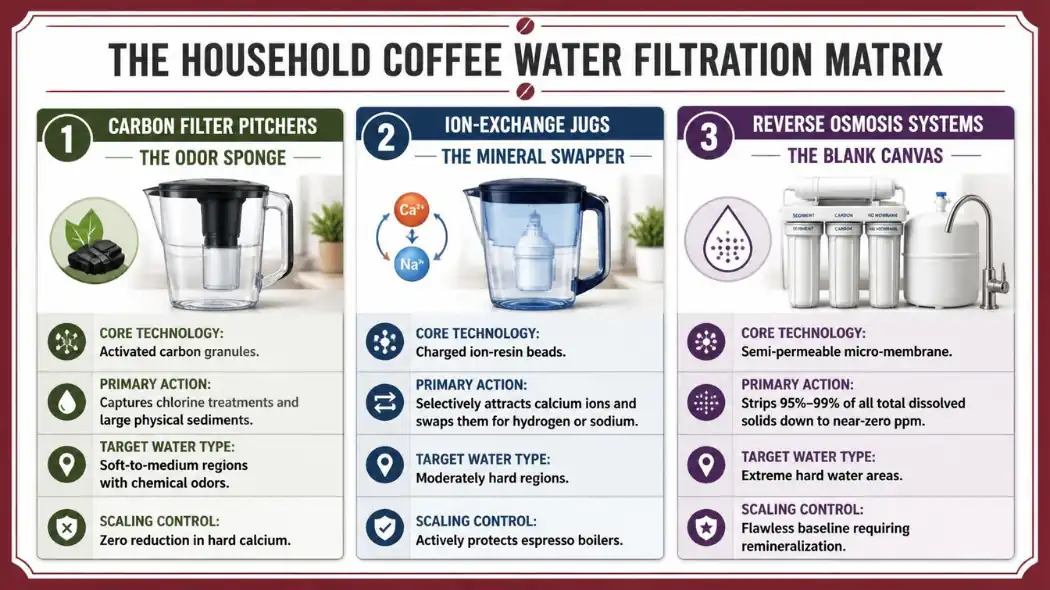
Choosing a suitable filtration system starts with understanding the water entering your home.
There is little point purchasing an expensive reverse osmosis system if your existing water is already suitable for brewing. Equally, a basic carbon-only filter may not solve the problem if your main concern is excessive hardness.
Before investing, consider the following:
1. Understand Your Local Water Supply
Start by checking the water quality information supplied by your local water company.
In the UK, many suppliers publish water hardness information based on postcode or supply area.
You can also use a domestic water hardness test kit to establish whether your water is soft, moderately hard or very hard.
2. Identify the Main Problem
Are you trying to remove chlorine odours, reduce limescale or gain greater control over mineral composition?
Each problem calls for a different approach.
- Chlorine taste or odour: An activated-carbon filter may be sufficient.
- Excessive limescale: Choose a cartridge or treatment system specifically designed to reduce hardness.
- Greater mineral control: Consider specialist ion-exchange filtration or reverse osmosis with remineralisation.
3. Consider Maintenance and Running Costs
Every filtration system requires maintenance.
Filter cartridges have a limited capacity, and their useful life depends on the incoming water quality and the volume treated.
Reverse osmosis systems require additional attention, including membrane maintenance, pre-filter replacement and management of the wastewater produced.
Remember to include replacement filters and ongoing maintenance when comparing the overall cost.
A Quick Reference Guide to Household Coffee Water Filtration
| Filtration system | Main purpose | Advantages | Limitations |
|---|---|---|---|
| Activated carbon | Reduces chlorine and taste-affecting substances | Affordable, simple and convenient | Does not normally reduce hardness on its own |
| Carbon and ion-exchange jug | Improves taste and reduces some hardness | Easy to use and relatively inexpensive | Performance varies by cartridge and water supply |
| Specialist coffee filter | Adjusts mineral composition | Greater control over brewing water | Requires regular cartridge replacement |
| Reverse osmosis | Removes a large proportion of dissolved substances | Provides a consistent starting point for water adjustment | Higher installation cost, maintenance and wastewater |
| RO with remineralisation | Produces water with a controlled mineral composition | Greater precision and repeatability | Requires careful adjustment and ongoing monitoring |
What Makes Good Water for Brewing Coffee?
Filtration is only part of the story. The real objective is to produce water with a suitable mineral composition for coffee extraction.
The Specialty Coffee Association (SCA) publishes brewing-water guidelines covering characteristics such as hardness, alkalinity, pH and chlorine.
Its commonly referenced guidance includes:
- Total dissolved solids (TDS): A target around 150 mg/L, with an acceptable range of approximately 75–250 mg/L.
- Calcium hardness: A target of around 68 mg/L expressed as calcium carbonate, within an acceptable range of 50–175 mg/L.
- Total alkalinity: A target around 40 mg/L expressed as calcium carbonate.
- pH: A target of approximately 7, with an acceptable range of 6–8.
- Chlorine: None detectable.
These figures provide a useful reference rather than a compulsory recipe for every coffee. Different beans, roast levels and brewing methods may respond differently to variations in water composition.
It is also important not to confuse TDS with hardness. A TDS meter measures the total concentration of dissolved substances, but it does not tell you exactly how much calcium, magnesium or alkalinity your water contains.
For more detailed information, consult the Specialty Coffee Association’s brewing-water standards.
How Poor Water Quality Can Affect Your Coffee
Water composition influences how coffee compounds dissolve during brewing. If the mineral balance is unsuitable, you may find it more difficult to achieve the flavour you’re expecting, even when your beans and brewing technique are good.
When Water Produces a Harsh or Bitter Cup
Excessive alkalinity can neutralise some of the acids naturally present in coffee, making the finished drink taste flatter and less vibrant.
High mineral concentrations can also contribute to limescale deposits inside kettles and espresso machines, potentially affecting their performance over time.
If your coffee is consistently harsh or unpleasantly bitter, read our guide to why coffee tastes bitter.
When Water Produces a Thin or Sour Cup
Water with an unsuitable mineral composition may contribute to an unbalanced extraction, although sourness is not automatically caused by a lack of minerals.
Coffee that tastes sharply acidic, thin or underdeveloped can also result from grind size, brewing temperature, contact time or the coffee’s roast profile.
Our guide to why coffee tastes sour explores these possibilities in more detail.
Bringing Your Coffee Water Filtration Choices Together
Choosing the right filtration system doesn’t have to be complicated.
For many households, a good-quality filter jug is a sensible first step, particularly when the main problem is chlorine taste or moderate limescale.
If your water is particularly hard, a specialist ion-exchange cartridge may provide a more suitable solution.
For those who want to take water preparation further, reverse osmosis offers a way to create a consistent starting point before adding the minerals needed for brewing.
The important thing is to understand your incoming water rather than buying equipment simply because it promises the most advanced filtration.
After all, coffee is mostly water. Giving that ingredient the same attention as your beans, grinder and brewing equipment can make a noticeable difference to the cup you enjoy.
For more insight into Water Filtration pop over to out dedicated post Hard Water vs Soft Water in Coffee


