

Table of Contents
Does grind size matter when brewing coffee? Absolutely. In fact, it is one of the most important variables you can control when preparing your favourite cup.

It might seem that grinding a coffee bean is simply a matter of making it smaller, but the size of those particles has a considerable influence on how water interacts with the coffee. Get the grind right and your brew can be sweet, balanced and full of flavour. Get it wrong and you may end up with a cup that tastes sour, bitter, weak or strangely flat.
Whether you use an espresso machine, a French press or a simple pour-over dripper, understanding why grind size matters will help you make better brewing decisions and get more from your coffee beans.

Why Does Grind Size Matter?
The simplest way to understand the relationship between grind size and coffee flavour is to look at surface area.
A whole coffee bean exposes relatively little of its internal structure to water. Once it is ground into smaller particles, much more surface area becomes available for water to interact with.
Research into ground coffee particle size and distribution has demonstrated how the size of the particles influences extraction and the characteristics of the finished beverage Read the research paper
A fine grind creates smaller particles with a greater combined surface area. This generally allows soluble compounds to become accessible more quickly.
A coarse grind produces larger particles, reducing the exposed surface area relative to the amount of coffee. Water usually needs more time to penetrate these particles and extract their soluble compounds.
This is why grind size needs to be matched to the brewing method. Espresso, for example, normally requires a fine grind because water is pushed through a compacted bed of coffee under pressure over a relatively short period.
A French press works very differently. The coffee grounds remain immersed in water for several minutes, so a coarser grind is commonly used.
The important relationship is between particle size, contact time and water movement. Changing the grind alters how quickly extraction takes place, but it does not work in isolation from the other brewing variables.
Fine Doesn’t Automatically Mean Better
It is tempting to assume that finer coffee must produce a stronger or better cup because more surface area is exposed to the water.
But coffee extraction is about balance, not simply extracting as much as possible.
If your grind is too fine for the brewing method, extraction may become difficult to control. In percolation methods such as espresso and pour-over, excessive fines can also restrict water flow, potentially causing uneven extraction.
If the grind is too coarse, the water may not extract enough soluble material within the available brewing time. The result can taste thin, sharp or underdeveloped.
Neither outcome is guaranteed by grind size alone. Water temperature, coffee dose, brewing time, water quality and grinder consistency all play a part.
This is why grind size is so closely connected to two familiar brewing complaints: sour coffee and bitter coffee. Adjusting the grind can help, but it is important to consider the whole brewing process before deciding what needs changing.
Your Brewing Method Determines the Starting Point
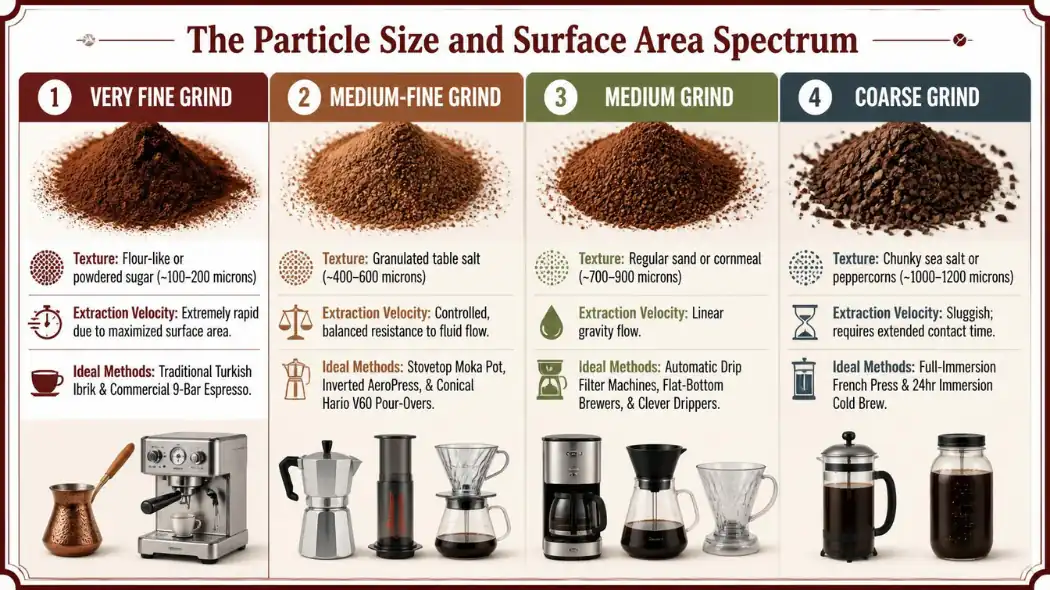
There isn’t one perfect grind size for every coffee maker. Instead, think of grind size as a scale running from very fine to very coarse, with different brewing methods occupying different positions along it.
The following guide gives you a useful starting point:
| Brewing method | Typical starting grind | What to look for |
|---|---|---|
| Espresso | Fine | Controlled flow through a compacted coffee bed |
| Moka Pot | Fine to medium-fine | Steady brewing without excessive resistance |
| AeroPress | Fine to medium-coarse | Depends on recipe, steeping time and filter |
| Pour-over / V60 | Medium-fine | Consistent flow through the filter |
| Automatic drip | Medium | Balanced flow and contact time |
| Chemex | Medium to medium-coarse | Suitable flow through its thicker paper filter |
| Clever Dripper | Medium | Balanced immersion and drawdown |
| French Press | Medium-coarse to coarse | Comfortable immersion and manageable sediment |
| Cold Brew | Medium-coarse to coarse | Suitable extraction over a long steep |
These are starting points rather than rigid rules. Different grinders, coffees, recipes and brewing techniques can all require adjustments.
Even within pour-over brewing, for example, one recipe may use a medium-fine grind while another works better with something slightly coarser. The thickness of the filter, pouring technique and total brew time all influence the result.
It is also worth remembering that grind settings are not standardised between manufacturers. A setting of 10 on one grinder may produce a completely different particle size from the same number on another.
The best approach is to begin with a sensible setting for your brewer, taste the result and make small adjustments.
What Happens If Your Grind Is Wrong?
One of the easiest ways to identify a possible grind problem is to pay attention to the flavour of your coffee.
If Your Coffee Tastes Sour, Sharp or Thin
Your grind may be too coarse, particularly if the brewing water is passing through the coffee too quickly.
Try moving slightly finer. This increases the exposed surface area and can help soluble compounds become accessible within the available brewing time.
However, sourness is not always caused by a coarse grind. Water temperature, brewing ratio, contact time and the natural acidity of the coffee can also influence the result.
For more help identifying the cause, read our guide to why coffee tastes sour.
If Your Coffee Tastes Bitter, Harsh or Dry
Your grind may be too fine for your brewing method. In a filter brewer, excessive fines can slow the flow of water and contribute to uneven extraction. In espresso, the increased resistance can make the shot run too slowly.
Try moving slightly coarser and see whether the flavour becomes more balanced.
However, bitterness and dryness can also come from roast development, water chemistry, brewing temperature and other factors. A grind adjustment is a useful first test, not an automatic cure.
Our guide to why coffee tastes bitter explores the other common causes.
If Your Coffee Tastes Weak
A weak-tasting cup does not necessarily mean your grind is too coarse. Before changing the grinder, check your coffee-to-water ratio.
Using too little coffee for the amount of water can produce a weak brew, even when the grind size is appropriate.
Also consider whether your coffee is freshly roasted and stored correctly. Freshness and the condition of the beans can influence the result.
The most useful habit is to change one variable at a time. That way, you can identify what actually improves the cup.
The Grinder Matters Too
There is another part of the equation that is often overlooked: the quality and consistency of your grinder.
Two grinders can be set to what appears to be the same grind size but produce quite different results.
A good burr grinder generally offers greater control over particle-size distribution. A less consistent grinder may produce a wider mixture of large fragments and very fine particles.
This matters because particles of different sizes do not extract at the same rate. Smaller particles expose more surface area and generally release soluble compounds more quickly, while larger particles take longer.
In addition, excessive fines can restrict water movement through a coffee bed, particularly in espresso and pour-over brewing.
The result is that a grinder’s consistency can influence extraction just as much as the setting you choose.
For a closer look at how grinder design affects particle size, read our companion guide, The Science Behind the Perfect Coffee Grind.
How to Adjust Your Grind Size: A Simple Practical Guide
Once you understand the basics, adjusting your grinder becomes much easier. You don’t need to make dramatic changes or follow complicated calculations.
Try this simple approach:
- Start with the recommended grind: Use a sensible starting point for your brewing method.
- Brew your coffee as usual: Keep your dose, water quantity and temperature consistent.
- Taste the result: Look for sourness, bitterness, excessive strength, weakness or an unbalanced flavour.
- Make a small adjustment: Move a little finer or coarser depending on the result.
- Brew again: Keep the other variables unchanged so you can judge the difference.
- Record what works: A simple note of the grinder setting and brewing recipe can save time next time.
For espresso, pay attention to how quickly the shot flows as well as how it tastes. For filter coffee, notice whether the water drains too quickly or takes an unusually long time.
Over time, you will develop a better understanding of how your grinder behaves with different beans and brewing methods.
So, Does Grind Size Really Matter?
Yes — enormously.
But the secret isn’t finding one magical grind setting and using it forever. Grind size is a starting point for controlling extraction, and the best setting depends on your coffee, grinder and brewing method.
Match the grind to your brewer, then make small adjustments according to how the coffee tastes. If the brew seems under-extracted, try going a little finer. If it is overly intense or the water flow is restricted, try going a little coarser.
Remember that every coffee is different. The same grind setting that produces a beautiful cup from one bag of beans may need adjusting when you change the origin, processing method, roast or even the age of the coffee.
That’s part of the enjoyment of brewing.
Your grinder isn’t simply preparing the coffee — it’s helping determine what eventually ends up in your cup.
Disclaimer – The coffee information provided on this website is for educational purposes only. It does not constitute medical advice. Readers should always consult a qualified healthcare professional before making changes to their dietary habits.


