

Table of Contents

Naturally Softer Coffees
While acidity brings brightness and complexity to coffee, not everyone enjoys a sharply acidic cup. Many coffee drinkers prefer the smoother characteristics of low acid coffee beans, looking for a rounder finish, fuller body and flavours such as chocolate, nuts, caramel and spice.
Acidity is an important part of coffee’s character. It can introduce citrus, berry and wine-like notes, adding freshness and depth. However, some people find these brighter characteristics too sharp and would rather enjoy something softer and more mellow.
This is where naturally softer coffees come in.
The phrase naturally softer isn’t a strict scientific classification. Instead, it describes coffees that tend to have lower perceived acidity and a more rounded sensory profile.
Finding the right coffee involves looking beyond the country of origin. Variety, altitude, growing conditions, processing, roasting and brewing all contribute to the character of the finished cup.
Let’s explore what makes coffee taste smoother, which origins are worth considering and how to find low-acid coffee beans that suit your palate.
What Actually Makes a Coffee Taste Soft?
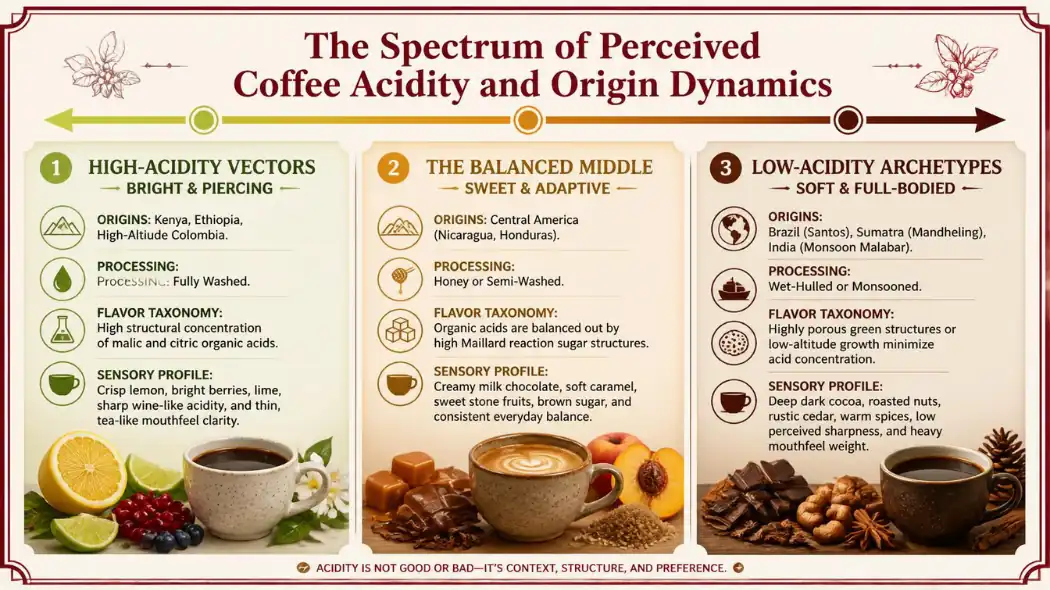
Several characteristics influence how we experience coffee, including acidity, sweetness, bitterness, body and mouthfeel.
Coffee contains a complex mixture of organic acids and other compounds. These contribute to its flavour and sensory character, but the relationship between chemical composition and perceived acidity is not straightforward.
It is important to distinguish between chemical acidity and perceived acidity.
Chemical acidity can be investigated through measurements such as pH and titratable acidity. Perceived acidity describes the sensation we experience when tasting the coffee. The two are related, but they are not interchangeable.
A coffee can contain measurable acids without tasting sharply sour. Equally, an incorrectly extracted coffee can taste unpleasantly sour, even when the beans themselves are not particularly bright.
Research published in the Journal of Food Science and Technology and reviewed by the Specialty Coffee Association demonstrates how complicated coffee acidity can be. Different acids behave differently during roasting, and their individual contributions to flavour are not always easy to predict.
You can explore the research in the Specialty Coffee Association’s review, Acids in Coffee: A Review of Sensory Measurements and Meta-Analysis of Chemical Composition.
If a coffee you normally enjoy suddenly tastes sharp, thin or unpleasantly sour, the problem may be extraction rather than the beans. Our guide explains why your coffee tastes sour and how to fix it, including how grind size and brewing conditions can affect the final cup.
When we describe a coffee as soft, we’re generally talking about the overall sensory experience: a cup that feels rounded and comfortable rather than sharp, piercing or excessively bright.

A Fuller Body
Some coffees have a heavier mouthfeel, which can make their acidity seem less prominent within the overall flavour.
This is one reason coffees from Brazil and Indonesia, particularly Sumatra, are often attractive to people who prefer a fuller, more rounded cup.
We commonly associate Brazilian coffees with nuts, chocolate, caramel and a substantial body.
However, Brazilian coffee is not automatically low in acidity. Some speciality lots are exceptionally bright, sweet and fruit-forward.
Indonesian coffees, especially those from Sumatra, are often associated with earthy, spicy, herbal and full-bodied characteristics.
That doesn’t mean every Brazilian or Indonesian coffee will taste soft. Coffee is far too diverse for such a simple rule. However, both origins offer plenty of examples worth exploring if you prefer a deeper, more rounded cup.
The Coffee’s Origin Matters
The way coffee is grown helps shape its character long before the beans reach the roastery.
Altitude, temperature, rainfall, soil, coffee variety and local growing conditions all influence how the coffee develops.
High-altitude coffees are often associated with pronounced acidity and complex fruit characteristics. However, altitude alone does not determine acidity, and there are plenty of exceptions.
Lower-growing coffees can sometimes produce softer, heavier flavour profiles, particularly when combined with suitable varieties and processing methods.
This is why country and altitude should be treated as useful clues rather than guarantees when searching for low-acid coffee beans.
A coffee from Colombia, for example, might be beautifully balanced and sweet, while another Colombian coffee could have pronounced citrus acidity. Even coffees from neighbouring farms can taste remarkably different.
Why Brazil Is a Good Starting Point for Low-Acid Coffee Beans
If you’re looking for a naturally approachable coffee, Brazil is probably one of the best places to begin.
Brazil produces an enormous range of coffees, but traditional Brazilian profiles are often associated with:
- Chocolate
- Cocoa
- Nuts
- Caramel
- Brown sugar
Many Brazilian coffees have rounded sweetness and substantial body rather than the pronounced citrus character associated with some brighter coffee profiles.
This makes them particularly popular in espresso blends, where their body and sweetness can provide a solid foundation.
However, modern Brazilian speciality coffee can be very different. Producers are increasingly creating fruit-forward and highly complex coffees, so don’t assume every Brazilian coffee will be low in perceived acidity.
For a softer cup, look for tasting notes that emphasise chocolate, nuts and caramel.
Sumatra: Deep, Earthy and Full-Bodied Coffee
For something quite different, look towards Sumatra.
Indonesian coffees are famous for their distinctive processing traditions, particularly the wet-hulling method known as Giling Basah.
Wet-hulling is a traditional Indonesian process in which parchment is removed from the coffee while the beans still have a relatively high moisture content. This gives the beans their distinctive appearance and contributes to the characteristic profile associated with many Sumatran coffees.
These coffees can have substantial body and flavours described as:
- Earthy
- Spicy
- Herbal
- Dark chocolate
- Woody
The result can be a remarkably deep cup with relatively restrained perceived acidity.
Sumatra is therefore an interesting choice for someone who finds bright, fruit-forward coffees too sharp. There is considerable variation, however, and speciality Indonesian coffees can also display sweetness, fruit and considerable complexity.
India: Low-Acid Coffee Beans with Softness and Spice
India is another origin worth exploring.
Indian coffees can offer spice, cocoa, nuts and relatively gentle acidity, making them an interesting alternative for drinkers who prefer a softer profile.
And then there is the particularly unusual Monsoon Malabar.
This coffee undergoes an intentional exposure to humid monsoon conditions after harvesting. During this process, the beans absorb moisture and undergo physical and chemical changes that alter their appearance and sensory characteristics.
The resulting cup is famous for its very low perceived acidity, heavy body and distinctive spicy, woody character.
Monsoon Malabar is one of the most unusual examples of how post-harvest treatment can dramatically alter a coffee’s character. If you’re looking for a particularly mellow and full-bodied coffee, it is well worth trying.
Honduras: Chocolate, Caramel and Sweetness
Honduras is another origin worth investigating if you prefer a softer cup.
Many Honduran coffees can display:
- Chocolate
- Caramel
- Nuts
- Brown sugar
- Sweet fruit
There is plenty of variation between regions, farms and processing methods, however.
Western Honduras, for example, can produce coffees with considerable acidity and fruit character, demonstrating why country alone cannot determine whether a coffee will taste soft.
For a gentler profile, look specifically for tasting notes that emphasise chocolate, caramel and nuts rather than citrus or tart fruit.
Nicaragua: Smooth and Sweet
Nicaragua can also produce coffees with a pleasing combination of chocolate, caramel, nuts and gentle fruit.
They can offer a useful middle ground for someone who doesn’t want a particularly heavy, earthy Indonesian coffee but also prefers to avoid the more pronounced acidity found in some brighter coffee profiles.
As always, the individual coffee matters more than the country name.
A naturally processed Nicaraguan coffee can have considerably more fruit and perceived acidity than a washed coffee from the same region. Look at the tasting notes rather than relying on origin alone.
What About Colombia?
Colombia is slightly more complicated.
Colombian coffee is often praised for its balance, sweetness and aroma, but Colombian coffees can also have quite pronounced acidity and fruit characteristics.
I wouldn’t automatically recommend Colombia simply because someone asks for low-acid coffee. Instead, look at the tasting notes and roast style.
A Colombian coffee described as milk chocolate, caramel, nuts and brown sugar may be much closer to what you’re looking for than one described as lime, grapefruit, red berries and wine-like acidity.
Does Processing Make a Difference?
Very much so.
After harvesting, coffee cherries undergo processing to remove the fruit and prepare the beans for drying. The three widely recognised approaches are washed, natural and honey processing.
Each method influences the flavours that eventually appear in the cup.
Natural processing involves drying the coffee cherry with the fruit still surrounding the bean. These coffees often develop pronounced fruitiness and sweetness, although that doesn’t automatically mean lower acidity.
Washed processing removes the fruit before the beans are dried. Washed coffees can have exceptionally clean, bright acidity, but the finished profile depends on much more than the processing method alone.
Honey processing removes some or most of the fruit before drying, while allowing a layer of mucilage to remain attached to the bean. Depending on the method and drying conditions, these coffees can offer a balance of sweetness, body and fruit character.
Processing should therefore be considered alongside origin, variety and roast, rather than treated as a simple low-acid or high-acid switch.
Roasting Can Change the Picture

Roasting has a profound effect on coffee chemistry.
As coffee moves through the roasting process, its organic acid composition changes. Some acids decrease, others increase, and chlorogenic acids break down into other compounds, including substances that contribute to bitterness.
The Specialty Coffee Association’s review of coffee acids explains that different acids respond differently to roast development. There is no simple rule that every acid decreases as the roast gets darker.
In practical terms, medium and darker roasts often taste less bright than very light roasts. This is one reason a medium or medium-dark roast can be a useful starting point if you prefer a rounded cup.
However, darker does not automatically mean better.
A very dark roast can introduce intense roasted, bitter or smoky flavours, which some people may find just as unpleasant as sharp acidity.
A well-developed medium or medium-dark roast can often provide a useful balance between acidity, sweetness, body and roast character.
Don’t Forget the Brewing Method
The coffee isn’t the only thing determining what ends up in your cup.
Brewing method can influence the sensory profile considerably.
Cold brew, for example, is frequently described as smoother and less sour than hot-brewed coffee.
Research conducted by scientists associated with the UC Davis Coffee Center compared cold-brewed and hot-brewed coffees under controlled conditions. The study found that the cold-brewed samples were perceived as less sour and less bitter, although the results also showed that the coffee itself had a greater influence on the final sensory profile than brewing temperature alone.
You can read the published study, Sensory Analysis of Full Immersion Coffee: Cold Brew Is More Floral, and Less Bitter, Sour, and Rubbery Than Hot Brew.
This is an important distinction. Cold brew isn’t necessarily free from acids, nor will every cold-brewed coffee taste less acidic. The bean selection and the way the drink is prepared still matter.
Choosing a naturally softer coffee and then preparing it as cold brew may be particularly appealing if you’re looking for a smoother cup.
The Best Coffees to Try
If your preference is for soft, rounded and lower-acidity coffee, the following origins and styles are useful starting points.
| Origin or style | Flavours worth looking for |
|---|---|
| Brazil | Chocolate, cocoa, nuts and caramel |
| Sumatra | Dark chocolate, earth, spice and herbs |
| India | Cocoa, nuts and spice |
| Monsoon Malabar | Very low perceived acidity, spice, wood and heavy body |
| Honduras | Chocolate, caramel, nuts and brown sugar |
| Nicaragua | Chocolate, caramel, nuts and gentle fruit |
| Colombia | Chocolate, caramel, nuts and balanced sweetness |
These should be treated as starting points rather than guarantees.
The individual farm, variety, altitude, processing method and roast can completely change the character of a coffee.
What Should You Look for on the Bag?
If you’re standing in front of a shelf of coffee and want something naturally softer, don’t simply search for the words low acid.
Look at the tasting notes.
Words such as these can help you identify the style you’re looking for:
Chocolate • Cocoa • Caramel • Toffee • Nuts • Almond • Brown Sugar • Spice • Full-bodied • Smooth
They are generally more useful indicators of the flavour profile than the country name alone.
Conversely, if you’re trying to avoid a particularly bright cup, tasting notes such as lemon, lime, grapefruit, cranberry, blackcurrant or wine-like acidity may point towards a more pronounced acidic character.
Remember, tasting notes describe the sensory character of the coffee. They are not a laboratory measurement of its acidity.
Naturally Softer Doesn’t Mean Flavourless
This is perhaps the most important point.
A coffee with gentle acidity isn’t necessarily bland.
In fact, some of the world’s most interesting coffees are prized precisely because they combine lower perceived acidity with tremendous body, sweetness and complexity.
Monsoon Malabar is a wonderful example. Brazilian speciality coffees provide another. Sumatra offers something completely different again.
The goal isn’t to remove acidity completely. It’s about finding a coffee where the acidity doesn’t dominate the cup.
For some drinkers, that means a Brazilian coffee with chocolate and nut flavours. For others, it might be a rich Sumatran coffee or the unusual character of Monsoon Malabar.
And if you’re particularly sensitive to coffee, experimenting with both the beans and the brewing method may give you more useful results than simply searching for a coffee labelled low acid.
The Bottom Line
There is no single low-acid coffee bean.
What we call a naturally softer coffee is usually the result of several factors coming together: the coffee’s genetics, growing conditions, processing, roasting and brewing.
If you prefer a smoother cup, start by exploring Brazil, Sumatra, India, Monsoon Malabar, Honduras or Nicaragua. Then look at the individual tasting notes rather than relying solely on the country of origin.
And perhaps most importantly, remember that acidity is not the enemy. It is one of the things that gives coffee life.
The trick is finding the point where acidity, sweetness, body and bitterness come together in a cup that you enjoy.
Disclaimer – The coffee information provided on this website is for educational purposes only. It does not constitute medical advice. Readers should always consult a qualified healthcare professional before making changes to their dietary habits.


