

Table of Contents
Acidity is one of the things that makes good coffee so interesting. It can give a cup a lively citrus edge, a refreshing berry-like character or a crisp finish that keeps you coming back for another sip. But there’s a difference between pleasant brightness and you saying to yourself “why does my coffee taste sour” making you pull a face.
If your coffee tastes sharp, thin or almost lemon-like in a way that isn’t enjoyable, under-extraction is one of the first things worth investigating. It happens when the brewing process doesn’t extract enough of the coffee’s soluble compounds to create a balanced flavour. The result can taste sharp, hollow and lacking in sweetness.
There are other possible causes, too. Your grind may be too coarse, your water may be too cool, or the brewing time may be too short. Even the coffee itself can influence how much acidity you taste.
The good news is that you don’t need to replace your coffee maker or start experimenting with complicated recipes. A few small adjustments can often make a noticeable difference.
Here’s how to work out what’s happening and get your coffee tasting the way it should.

Why Does My Coffee Taste Sour? The Most Common Causes
When a cup tastes unpleasantly sour, it’s tempting to blame the beans. Sometimes the coffee itself is naturally bright, but very often the problem lies in how it has been brewed.
| The sour symptom | Possible cause | Why it happens | What to try |
|---|---|---|---|
| Sharp, acidic and thin | Grind too coarse | Water passes through larger particles too quickly, limiting extraction | Grind a little finer |
| Sour and underdeveloped | Water too cool | Lower temperatures can slow the extraction process | Try water around 90–96°C |
| Sharp taste with a quick brew | Short contact time | Water has insufficient time to extract the coffee evenly | Increase brewing time slightly |
| Weak and watery | Too much water for the coffee dose | The finished drink may be too dilute | Adjust your coffee-to-water ratio |
| Sour despite careful brewing | Coffee naturally has high acidity | Some origins and processing styles produce bright, fruity profiles | Check the coffee’s tasting notes and roast level |
These are starting points rather than absolute rules. Different brewing methods behave differently, so make one adjustment at a time and taste the result before changing anything else.
Understanding the Difference: Sour vs. Bright Acidity
In my years managing busy café bars and training retail baristas, helping people distinguish between unpleasant sourness and desirable acidity was a regular conversation.
A coffee that tastes bright, fruity and pleasantly crisp isn’t necessarily under-extracted. In fact, high-altitude single-origin coffees, including many washed Ethiopian lots, are appreciated for their lively citrus, floral and berry characteristics.
The difference is balance.
Think of the difference between a squeeze of fresh lime over a well-prepared dish and biting straight into an unpeeled lemon. One adds a refreshing sharpness that works with the other flavours; the other can be overwhelming.
Coffee acidity works in much the same way. A well-brewed coffee can have plenty of acidity while still tasting sweet, rounded and enjoyable. When the balance is missing, that same brightness can become sharp and unpleasant.
It’s also worth remembering that coffee acidity isn’t simply a measure of how acidic a drink is on the pH scale. What we experience as sourness is influenced by several different acids and other flavour compounds, as well as the coffee’s sweetness, body and overall balance.
So don’t automatically assume that a naturally bright coffee needs correcting. Sometimes you’re tasting exactly what the grower, processor and roaster intended.
The Most Common Brewing Problems Behind Sour Coffee
1. Your Coffee Grind Is Too Coarse
This is one of the first things I’d check.
When coffee is ground too coarsely, the particles have less exposed surface area for water to work on. In many filter brewing methods, this also allows water to pass through the coffee bed more quickly.
The result can be an under-extracted brew with a sharp, thin flavour.
How to fix it: Adjust your grinder a little finer. Make small changes rather than moving several settings at once. Brew another cup using the same dose and water temperature, then compare the flavour.
If the sourness begins to soften and more sweetness comes through, you’re moving in the right direction.
2. Your Brewing Water Is Too Cool
Water temperature has a direct influence on how quickly coffee compounds are extracted.
If your water is too cool, the brewing process may not extract enough flavour within the time available. This can leave the finished cup tasting underdeveloped, particularly when combined with a coarse grind or short brewing time.
For many hot filter brewing methods, a useful starting range is around 90–96°C.
How to fix it: Use a thermometer or temperature-controlled kettle if possible. If you’re using a standard kettle, allow it to reach a full boil before pouring, rather than leaving it to cool for several minutes.
The Specialty Coffee Association’s brewing best-practice guidance provides further information on brewing temperature, grind size, water and contact time.
3. Your Brewing Time Is Too Short
Coffee needs sufficient contact with water for a balanced extraction. If the water passes through too quickly, or an immersion brew is poured away too early, the result may taste sharp and incomplete.
This is particularly noticeable with pour-over methods, where pouring technique, grind size and the depth of the coffee bed all influence how long water remains in contact with the grounds.
How to fix it: Try extending the brewing time slightly. With a pour-over, use a more controlled pouring pattern. With a French press, allow a little longer for the grounds to steep before plunging.
Avoid making a dramatic change. A small increase in contact time may be all that’s needed.
4. Your Coffee-to-Water Ratio Is Out of Balance
A coffee-to-water ratio determines how concentrated your finished drink will be. If you use too much water for the amount of coffee, the result may taste weak, thin and lacking in sweetness.
However, it’s important to understand the difference between strength and extraction. Adding more coffee can make a drink stronger, but it doesn’t automatically correct an under-extraction problem.
For filter coffee, a starting recipe around 1:15 to 1:17 (one gram of coffee to 15–17 grams of water) is a useful range to experiment with.
How to fix it: Use a digital kitchen scale to measure both coffee and water. Keep the ratio consistent while you adjust your grind and brewing time. This makes it much easier to identify which change is actually improving the cup.
A Simple Troubleshooting Guide
The easiest way to understand what’s happening during brewing is to look at the relationship between under-extraction, balanced extraction and over-extraction.
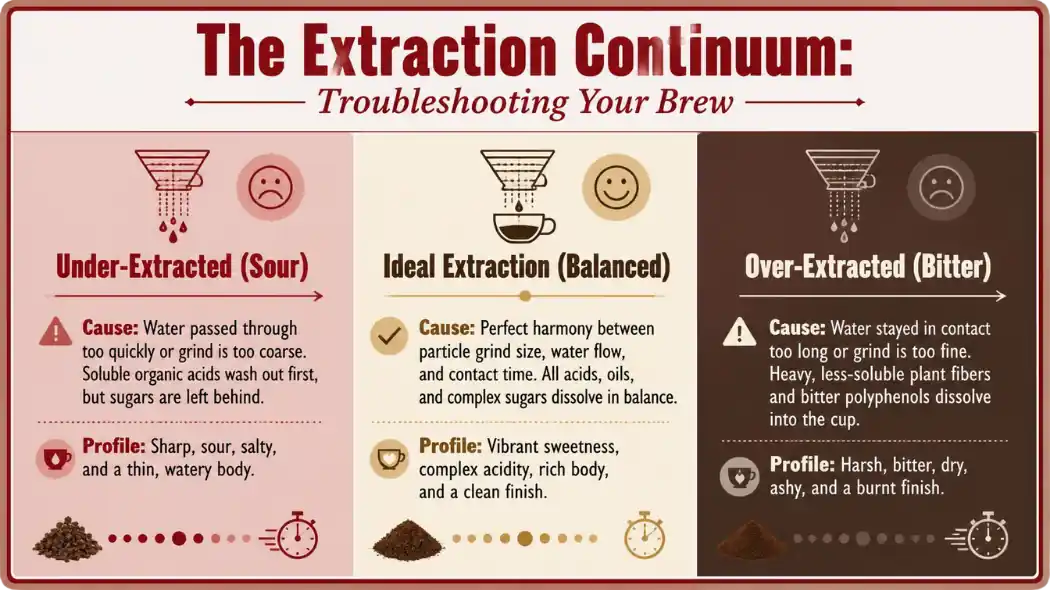
The important thing to remember is that sourness and bitterness are useful clues, but they aren’t perfect measurements of extraction. A coffee can have naturally bright acidity, and a poorly balanced brew can sometimes taste both sour and bitter.
Use the flavour as a guide, then check your brewing variables before deciding what to change.
Quick-Reference Action Plan
If your morning coffee is turning out sour, work through these adjustments one at a time.
- Sour and sharp? Try adjusting your grinder a couple of clicks towards a finer setting.
- Still tasting underdeveloped? Check your water temperature and aim for around 90–96°C for hot filter brewing.
- Brewing too quickly? Slow your pouring technique or extend your immersion time slightly.
- Tastes thin as well as sour? Check your coffee-to-water ratio and measure your ingredients accurately.
- Still tastes unusually sharp? Consider whether the beans themselves have a naturally bright flavour profile.
One final point: don’t change five things at once. If you alter your grind size, water temperature, brewing time and coffee dose together, you’ll never know which adjustment actually made the difference.
Our experience at The Coffee Guide is that small, controlled changes make troubleshooting much easier. Push the extraction too far in the opposite direction and you may replace an unpleasantly sour cup with one that tastes harsh, dry or bitter.
If that happens, head over to our companion guide, Why Does My Coffee Taste Bitter?, where we look at the causes of bitterness and how to bring your brewing back into balance.
For readers interested in the relationship between water chemistry and the flavour of coffee, the Specialty Coffee Association also has a useful article on Water and Coffee Acidity.
The Bottom Line
An unpleasantly sour cup is often a sign that your coffee hasn’t been extracted in a balanced way, but it doesn’t automatically mean something has gone wrong. Some coffees are naturally bright and lively, and that acidity is part of what makes them special.
If the flavour is sharp, thin or unpleasant, start with the basics. Try a slightly finer grind, check your water temperature and give the brewing process a little more time. Keep your coffee dose and water ratio consistent while you experiment.
Most importantly, trust your palate. The aim isn’t to remove every trace of acidity from your coffee. It’s to find the balance where the natural brightness, sweetness and body all work together to make a genuinely enjoyable cup.
Disclaimer – The coffee information provided on this website is for educational purposes only. It does not constitute medical advice. Readers should always consult a qualified healthcare professional before making changes to their dietary habits.


