

Table of Contents
Discover how coffee cherries are transformed into clean, carefully prepared green beans through one of the world’s most widely used processing methods.
Washed coffee processing: understanding the wet process
Washed coffee processing, also known as the wet process, is one of the most established methods used to prepare coffee after harvesting. Unlike natural processing, where the whole cherry is dried around the seed, the washed method removes the outer skin and pulp early in the process, followed by fermentation, washing and drying.
The aim is to remove the remaining mucilage before the beans are dried, allowing producers to manage the process in a controlled and consistent way.
This method is particularly valued for producing coffees with clearly defined flavours, lively acidity and a clean finish. It is widely used throughout Central and South America, East Africa and other coffee-growing regions, although its suitability depends on access to water, equipment and appropriate processing facilities.
To understand why washed coffee tastes the way it does, it helps to follow the journey from the freshly picked cherry to the finished green bean.
What is washed coffee processing and how does it work?
In washed coffee processing, the outer skin and pulp of the ripe coffee cherry are mechanically removed shortly after harvesting. The seeds, still protected by their parchment layer and covered in a sticky substance called mucilage, then undergo fermentation to help break down the remaining material.
Once the mucilage has been sufficiently loosened, the beans are washed with water before being dried.
Unlike natural processing, where the coffee remains inside the whole fruit during drying, washed processing separates the seed from most of the cherry’s fruit much earlier.
This changes the conditions under which fermentation and drying take place, influencing the chemical development and eventual flavour of the coffee.
Washed processing is often associated with clean, transparent cup profiles, where characteristics linked to the variety and growing environment can be more clearly expressed.
However, it isn’t simply a matter of removing the fruit to reveal the coffee’s natural flavour. Fermentation, drying, harvesting and storage all play important roles in determining the quality of the finished bean.

What are the six stages of washed coffee processing?
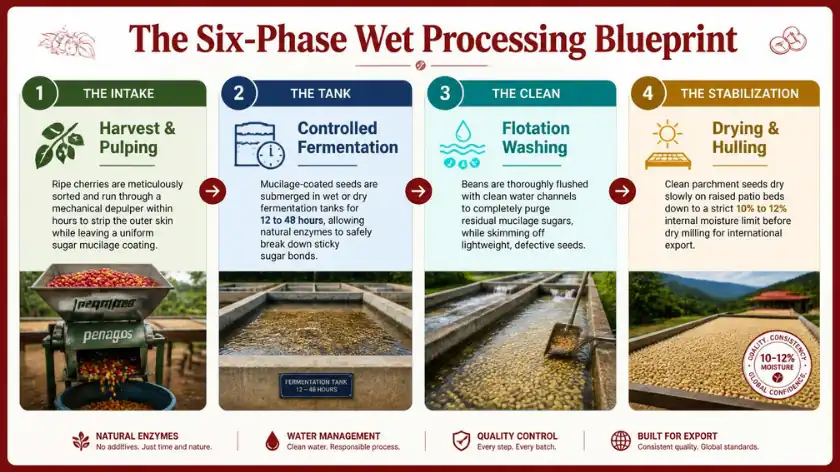
Although individual farms and processing mills may use slightly different equipment and procedures, washed coffee production generally follows six main stages.
1. Harvest selection – choosing ripe coffee cherries
Everything begins with the harvest.
Coffee cherries do not necessarily ripen at the same time, even on the same branch. Producers therefore need to select ripe cherries carefully, removing unripe, overripe, damaged or defective fruit wherever possible.
This initial selection is important because the condition of the cherries influences the quality of everything that follows.
Unripe cherries can contribute unwanted grassy or underdeveloped flavours, while overripe or damaged fruit may introduce undesirable fermentation characteristics.
Some farms carry out additional sorting using flotation tanks or water channels. Ripe, healthy cherries generally have greater density and are more likely to sink, while certain defective or dried cherries float and can be removed.
Good selection provides the processing stages with a more consistent starting point.
2. Mechanical pulping – removing the outer fruit
Once the cherries have been sorted, they are passed through a mechanical depulping machine.
The equipment separates the outer skin and much of the fleshy pulp from the coffee seeds. The beans emerge still enclosed in their parchment layer, with a sticky coating of mucilage remaining on the surface.
The timing is important. Pulping usually takes place relatively soon after harvesting to reduce the risk of uncontrolled fermentation developing while the cherries are waiting to be processed.
The depulping equipment must also be adjusted correctly. Poorly calibrated machinery can damage the beans or allow unwanted amounts of unpulped fruit to pass through.
At this point, the coffee is ready for fermentation.
3. Controlled fermentation – breaking down the mucilage
This is one of the most important stages of washed coffee processing.
After pulping, the parchment-covered beans still have a layer of sticky mucilage attached. This material contains pectin-rich substances that make it difficult to remove through simple rinsing.
The beans are placed into fermentation tanks, where naturally occurring microorganisms and enzymes help break down the mucilage.
Fermentation can take place in tanks with water or under relatively dry conditions. The exact procedure depends on the mill and the producer’s preferred technique.
A period of 12–48 hours is often quoted as a general guide for traditional fermentation, although actual times can be shorter or considerably longer depending on temperature, coffee condition and the processing system.
Several factors influence the process:
- Temperature: Warmer conditions generally accelerate microbial activity, while cooler conditions can slow fermentation.
- Time: The producer must allow sufficient time for mucilage breakdown without allowing unwanted fermentation characteristics to develop.
- Microorganisms: Naturally occurring yeasts and bacteria contribute to changes within the mucilage.
- Coffee condition: Cherry maturity and the amount of mucilage remaining can influence fermentation behaviour.
The aim is to achieve sufficient mucilage breakdown so that the beans can be washed cleanly.
Fermentation is not simply a waiting period. It requires observation and experience, as poorly managed conditions can lead to inconsistent results and undesirable flavours.
4. Washing and sorting – removing the remaining mucilage
Once fermentation has reached the desired stage, the beans are washed to remove the loosened mucilage.
Water channels, washing tanks or mechanical equipment may be used to separate the remaining material from the parchment-covered beans.
Some mills also use this stage to carry out additional flotation and sorting. Lightweight beans and certain defective material can be separated from the denser, better-quality coffee.
The result is a batch of clean, parchment-covered beans ready for drying.
Water quality and cleanliness are important throughout this stage. Poorly managed washing facilities can introduce contamination or undermine the quality achieved during fermentation.
5. Drying and moisture stabilisation – preparing the parchment coffee
Following washing, the beans still contain a considerable amount of moisture and must be dried carefully.
Drying can take place using:
- Raised drying beds.
- Sun-drying patios.
- Covered drying structures.
- Mechanical dryers.
- A combination of natural and mechanical drying.
The aim is to reduce moisture gradually and evenly until the coffee reaches a suitable level for safe storage.
For export preparation, green coffee is commonly dried to approximately 10–12% moisture, although acceptable specifications vary according to storage conditions and commercial requirements.
Drying too quickly or unevenly can affect quality, while insufficient drying can encourage mould and deterioration during storage.
Producers regularly turn the beans to encourage even airflow and reduce the likelihood of uneven moisture distribution.
Once drying is complete, the parchment coffee is generally rested or stored under suitable conditions before milling.
6. Dry milling – removing the parchment and preparing green coffee
The final stage is dry milling.
Unlike the earlier stages, which deal with the fresh or wet coffee, dry milling takes place after the parchment-covered beans have been dried and stabilised.
The parchment is mechanically removed using a hulling machine, revealing the familiar green coffee bean underneath.
The beans can then pass through further preparation stages, including:
- Screen grading: Separating beans according to size.
- Density sorting: Removing lighter or defective beans.
- Colour sorting: Identifying beans with visible discolouration or defects.
- Final inspection: Checking the coffee before it is packed for transport.
Once grading and quality checks are complete, the green coffee is ready for storage, export and eventually roasting.
What does washed processed coffee taste like?
Washed coffees are often appreciated for their clarity and precision. Because the outer fruit is removed early in the process, the fermentation and drying stages take place under different conditions from those found in natural processing.
The resulting cup is frequently associated with clearly defined flavours, lively acidity and a clean finish.
Common characteristics include:
- Acidity: Often bright and clearly expressed, sometimes resembling citrus or green apple.
- Body: Frequently light to medium, although this varies with variety and growing conditions.
- Sweetness: Generally balanced rather than heavily fruit-driven.
- Aroma: Can include floral, citrus and delicate fruit characteristics.
- Clarity: Individual flavour notes may be easier to distinguish.
Typical tasting notes include:
- Lemon and orange.
- Green apple.
- Stone fruit.
- Jasmine and other delicate florals.
- Black tea and lighter herbal notes.
These are common associations rather than guaranteed results. A washed coffee from one origin may taste very different from another, even when both have been processed using the same method.
Variety, altitude, climate, soil, harvesting, fermentation and roasting all contribute to the final cup.
What are the environmental challenges of washed coffee processing?
Although washed processing can produce excellent coffee, it comes with practical and environmental challenges.
One of the most important is its use of water.
Water consumption
Traditional washed processing can require considerable quantities of clean water for pulping, fermentation, washing and equipment cleaning.
The amount used varies considerably between farms and mills. Modern equipment and improved processing systems can reduce consumption, while some producers reuse water where appropriate.
In regions where water is scarce, this can influence whether washed processing is a practical option.
Wastewater management
After fermentation and washing, the water contains organic material from the coffee pulp and mucilage.
If discharged untreated into rivers or streams, this wastewater can increase the organic load and encourage oxygen depletion as microorganisms break down the material. This can damage aquatic environments.
Responsible mills therefore need suitable wastewater treatment systems, settling facilities or other methods of managing processing water before it is released.
Managing fermentation and drying risks
Washed processing also requires careful control of fermentation and drying.
Poorly managed fermentation can produce unwanted flavours, while uneven or insufficient drying can increase the risk of mould and storage deterioration.
These problems are not inevitable, but they demonstrate why experience, equipment and quality control are so important.
If your home-brewed washed coffees are tasting unexpectedly sharp or sour, it is worth remembering that processing is only one part of the equation. Brewing temperature, grind size and extraction time can all influence the result. Our guide explains why coffee tastes sour and how to correct it.
Why is washed coffee processing so widely used?
Washed processing has become an important part of the global coffee industry because it offers producers a well-established way of preparing coffee with clearly defined characteristics.
When properly managed, it can deliver consistency, clean flavour profiles and a good opportunity to express the qualities associated with a particular origin and variety.
However, it requires suitable facilities, access to water and careful management of fermentation, drying and wastewater.
It is not automatically superior to natural or honey processing. Each method has its own advantages and challenges, and the right choice depends on the producer’s circumstances and the coffee they want to create.
Understanding washed coffee processing gives us a better appreciation of the work that takes place between harvesting and roasting. The next time you enjoy a bright, floral or citrus-led coffee, there may be a carefully managed wet-processing journey behind every sip.


