

Table of Contents
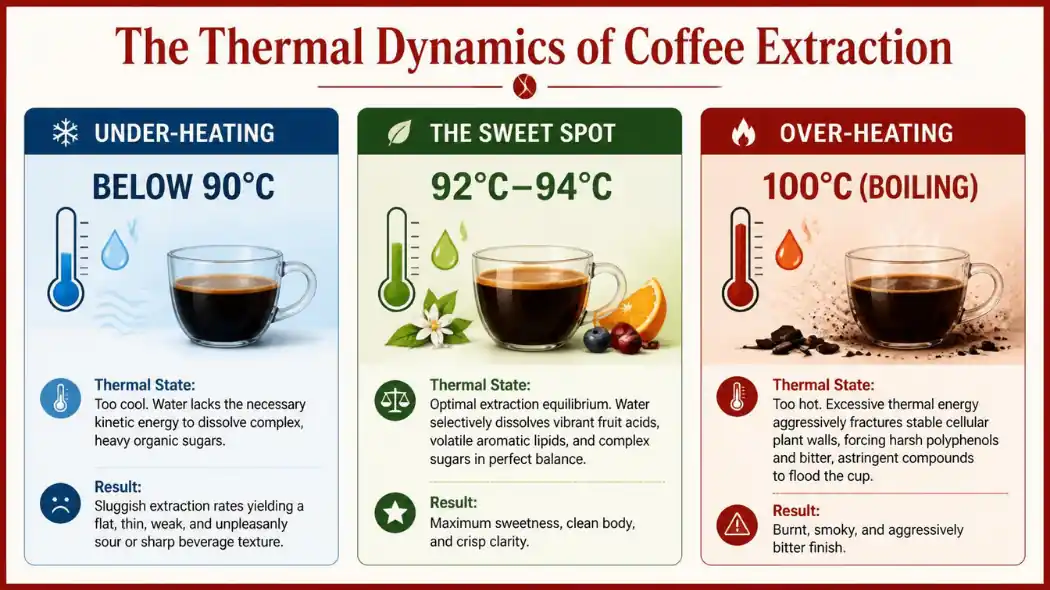
It seems logical enough: if hot water extracts flavour from coffee, surely boiling water must do an even better job? Not necessarily. Water temperature for coffee is one of the variables that can make a noticeable difference to your finished cup. Use water that’s too cool and extraction may be slow or incomplete. Use water that’s excessively hot for your particular coffee and brewing method, and you may find the result harsher than you’d like.
So, should you pour boiling water straight from the kettle onto your coffee grounds? For most everyday filter brewing, it’s better to let the kettle settle first.

No – Let the Kettle Settle First
Let’s look at why temperature matters, what the recommended brewing range actually is, and how to get it right without buying a cupboard full of specialist equipment.
Freshly boiled water reaches approximately 100°C at sea level. That’s hotter than the usual recommended brewing temperature for many filter coffee methods.
The Specialty Coffee Association’s brewing guidance recommends water at the point of contact with the coffee of approximately 94°C, with a tolerance of around 2°C. Its home-brewer standard also specifies a brewing temperature range of 90–96°C.
That doesn’t mean boiling water will automatically ruin every cup. Brewing temperature is only one part of extraction, and different beans, roasts and brewing methods can respond differently.
However, allowing freshly boiled water to cool slightly gives you a useful starting point for a more controlled brew.
Why Is Boiling Water a Problem?
Coffee brewing is all about extraction: the process through which water dissolves and carries flavour compounds from the ground beans into your cup.
Temperature influences how quickly this happens. Hotter water generally increases the rate at which soluble compounds are extracted, while cooler water slows the process down.
The important point is that extraction needs to be balanced. You want to bring out the coffee’s sweetness, acidity, aroma and body without creating a cup that tastes harsh or unpleasant.
If your water temperature is too high for the particular coffee and brewing recipe, it may contribute to an overly intense or unbalanced result. However, bitterness isn’t caused by temperature alone. Grind size, brewing time, agitation, roast development and water quality all play their part.
In my years running a coffee shop and managing catering events, I always trained our team to pay attention to brewing temperature. It was one of those small details that could make a noticeable difference to consistency, particularly when preparing coffee for a busy service.
It’s also worth paying attention to the roast. Darker roasted coffees can sometimes taste more bitter or heavy, so experimenting with a slightly lower brewing temperature may help produce a more rounded cup. Lighter roasts often benefit from the higher end of the recommended range.
If your coffee regularly tastes harsh, dry or unpleasantly bitter, our companion guide explains why your coffee tastes bitter and how to fix it.
For a closer look at the science, a published study in the journal Scientific Reports examined how brewing temperature affects the sensory qualities of drip coffee. Interestingly, when brew strength and extraction were controlled, the researchers found no appreciable sensory difference between the temperatures they tested. You can read the research into coffee brewing temperature and flavour for yourself.
So What is the Ideal Water Temperature for Coffee?
For most hot filter brewing, a good starting point is between 90°C and 96°C, with approximately 92–94°C being a useful target.
[Keep existing infographic here: The Thermal Dynamics of Coffee Extraction – Under-heating, Optimal Temperature and Boiling Water]
You don’t necessarily need a temperature-controlled kettle or a commercial thermometer to get close to this range. There are a couple of simple ways to manage the temperature at home.
The Simple Kettle Method
Bring your kettle to the boil, switch it off and allow the water to stand briefly before pouring.
A rest of around 30–60 seconds is a convenient starting point, although the actual temperature drop depends on the kettle, the amount of water inside it and the surrounding temperature.
If you want to be more precise, a kitchen thermometer will tell you exactly where your water is before it reaches the coffee.
Adjust the Temperature to Suit Your Beans
The recommended range isn’t a rigid rule that every coffee must follow. Think of it as a starting point from which you can make small adjustments.
- Light roasts: Try the higher end of the range, around 94–96°C. This can help extract the flavours from more densely roasted beans.
- Medium roasts: Start around 92–94°C and adjust according to taste.
- Dark roasts: Experiment towards the lower end, around 90–92°C, if the finished cup tastes overly bitter or heavy.
These are practical starting suggestions rather than fixed scientific rules. Your grinder, brewing equipment and preferred recipe will also influence the result.
The Specialty Coffee Association’s brewing best practices provide further guidance on temperature, grind size, contact time and coffee-to-water ratio.
The Golden Rule for Home Brewing
If there’s one thing to take away from this guide, it’s that hotter isn’t automatically better.
For most filter coffee, allow freshly boiled water to cool a little before pouring. Start around 92–94°C, keep your other brewing variables consistent and make small adjustments until you find the flavour you enjoy.
You don’t need expensive equipment to make better coffee. A little attention to water temperature, combined with a consistent grind and brewing method, can make all the difference.
And remember, the aim isn’t simply to avoid boiling water. It’s to find the temperature that brings out the best in the coffee you’re brewing.


