

Table of Contents
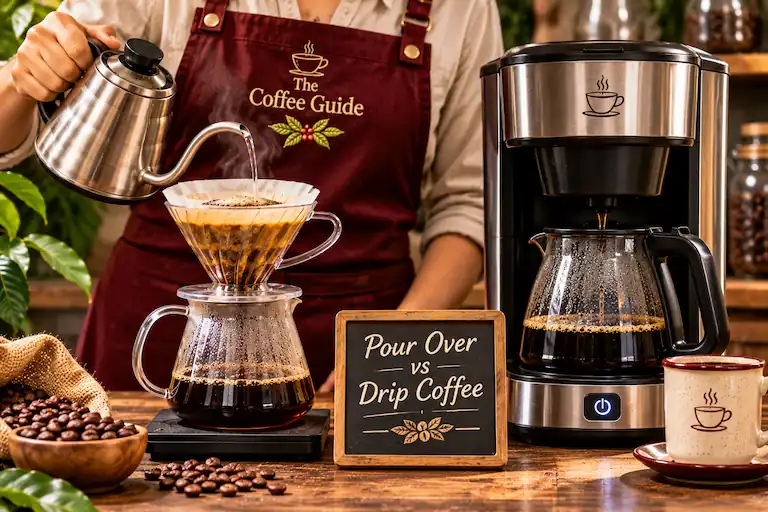
Two of the most popular filter coffee brewing methods are pour-over and automatic drip coffee. At first glance, they appear almost identical. Both use gravity to draw hot water through a bed of ground coffee, and both commonly use paper filters to produce a clean, sediment-free cup. However, although the underlying principles are similar, the brewing experience is quite different. The main distinction between pour over vs drip coffee is the degree of control you have over the brewing process. Manual pour-over allows you to influence water distribution, pouring speed and timing, while an automatic drip machine handles these tasks for you.
Both methods can produce excellent coffee, but understanding their differences will help you decide which one best suits your taste, equipment and daily routine.

Where Did Pour-Over and Drip Coffee Originate?
The history of filter coffee is closely associated with a German inventor whose simple kitchen experiment changed the way the world brewed coffee.
The Invention of the Paper Coffee Filter
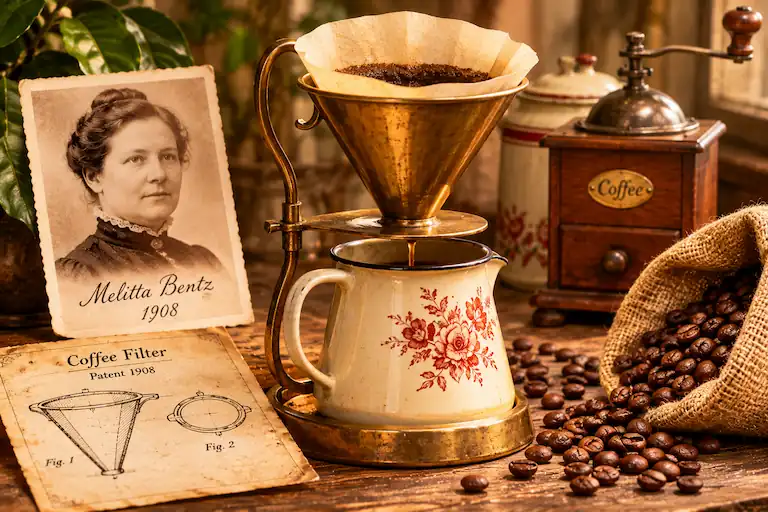
In 1908, Melitta Bentz, a coffee enthusiast from Dresden, Germany, became frustrated with the bitter taste and coffee grounds left behind by traditional brewing methods.
Her solution was remarkably simple. She perforated a brass pot and lined it with blotting paper taken from her son’s school exercise book.
The result was the first Melitta paper coffee filter, allowing hot water to pass through the grounds while retaining much of the unwanted sediment.
Her invention was registered with the German Imperial Patent Office in June 1908, and the Melitta company was established later that year.
This development helped establish the foundations of modern paper-filter coffee brewing, although manual filtration itself had existed in various forms before Bentz’s invention.
The Arrival of the Electric Drip Coffee Maker
The next significant development came during the 1950s with the introduction of the Wigomat, associated with German inventor Gottlob Widmann.
Dating from 1954, it is widely credited as one of the earliest electric drip filter coffee machines. By automating water heating and delivery, it brought greater convenience to a brewing method that had traditionally required manual attention.
The technology continued to develop, particularly during the 1970s, when automatic drip coffee makers became increasingly popular in American households.
Today, machines such as the Moccamaster demonstrate how modern engineering can combine automated brewing with carefully controlled water temperature and distribution.
What Is the Mechanical Difference Between Pour-Over and Drip Filtration?
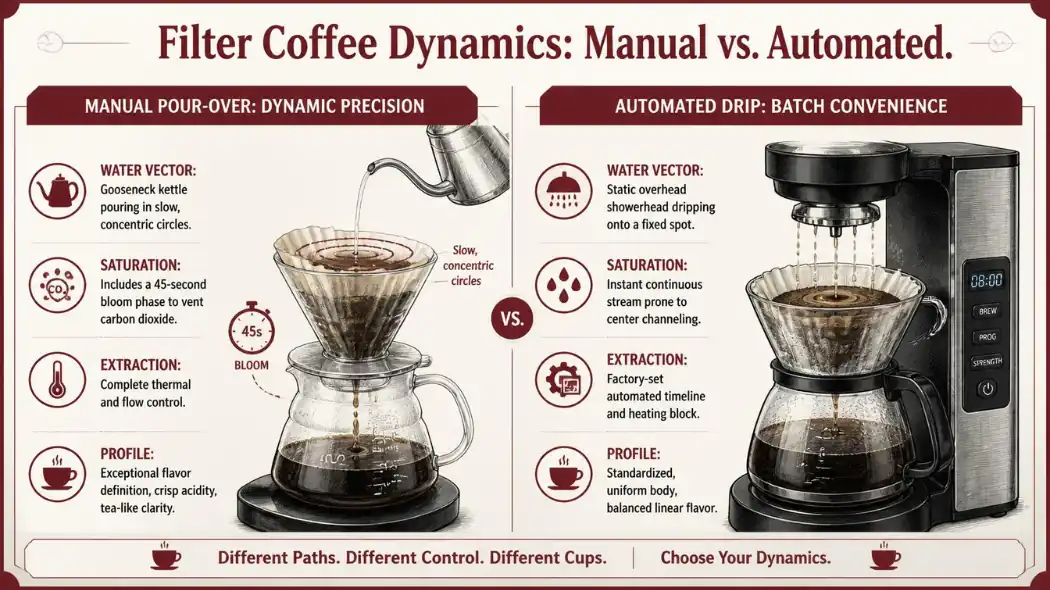
Both methods rely on gravity extraction, but the way water reaches the coffee bed is different.
Manual Pour-Over Methods
With manual pour-over brewing, the barista controls the delivery of hot water using a gooseneck kettle.
Water is poured in a controlled pattern, often using circular movements, allowing the brewer to influence how the coffee bed becomes saturated.
This gives you the opportunity to adjust:
- Pouring speed and volume
- Water distribution across the grounds
- The length of the bloom phase
- The number of pouring stages
- Total brewing time
Popular equipment includes the Hario V60, Chemex and Kalita Wave. Each has its own filter shape, drainage characteristics and brewing behaviour.
The advantage is flexibility. The challenge is consistency: achieving the same result requires practice and attention.
Automated Drip Filter Machines
An automatic drip machine performs most of the brewing process for you.

Water is heated internally and delivered through a shower head positioned above the filter basket. It passes through the coffee grounds and paper filter before collecting in a carafe.
The machine controls the heating and water delivery cycle, allowing you to prepare several cups with very little involvement.
The quality of the result depends heavily on the machine’s design. Better brewers offer consistent water temperature, effective shower-head coverage and carefully managed brewing cycles.
Although you cannot adjust every pour by hand, a well-designed machine can produce remarkably consistent results.
Pour Over vs Drip Coffee: Technical Comparison
The following comparison highlights the main differences between the two brewing methods.
| Extraction metric | Manual pour-over | Automatic drip filter |
|---|---|---|
| Water delivery | Controlled by hand using a kettle | Automated through a shower head |
| Temperature control | Adjustable through kettle settings | Managed by the machine |
| Water distribution | Influenced by pouring technique | Depends on shower-head design |
| Channeling risk | Possible if pouring is uneven | Possible if distribution is uneven |
| Brewing time | Usually around 2½–4 minutes, depending on recipe | Varies with machine and batch size |
| Flavour profile | Can offer excellent clarity and definition | Can produce clean, balanced coffee |
| User involvement | High; requires attention and technique | Low; largely automatic |
| Brewing capacity | Usually one or a few cups | Often several cups per cycle |
| Convenience | More hands-on | Excellent for everyday convenience |
| Consistency | Depends on the brewer’s technique | Depends on machine quality and recipe |
Neither method automatically guarantees a better extraction. A carefully prepared pour-over can be exceptional, but a good automatic brewer can achieve equally impressive results.
Why Does Manual Pour-Over Brewing Offer Greater Control Over Flavour?
One of the main attractions of manual pour-over is the ability to influence the extraction process as it happens.
Using a gooseneck kettle, you can control where the water lands, how quickly it flows and how much agitation is introduced into the coffee bed.
This can be particularly useful when working with delicate single-origin coffees, where small adjustments to the brewing recipe may reveal different aspects of the flavour.
The Importance of Filter Shape
Different drippers influence how water moves through the coffee bed.
A conical dripper such as the Hario V60 has a pointed base and spiral ridges along its internal walls. Its design encourages water to travel towards a single drainage opening.
The Chemex uses a thicker paper filter, which retains more oils and fine particles, often producing a particularly clean cup.
The Kalita Wave uses a flatter-bottomed filter with several drainage holes, offering a different approach to water flow and extraction.
These design differences do not automatically make one brewer superior to another, but they provide useful opportunities to experiment with flavour and brewing technique.
The Role of the Coffee Bloom
During the initial pour, hot water releases carbon dioxide trapped within freshly roasted coffee grounds.
This process, known as the bloom, causes the coffee bed to swell and bubble as gas escapes.
Allowing approximately 30–45 seconds for this stage is a common starting point. It helps wet the grounds before the main extraction begins.
However, a bloom does not eliminate channeling or guarantee perfectly even extraction. Good pouring technique and suitable grind size remain important throughout the brewing process.
What Are the Limitations of Automatic Drip Coffee Machines?
Automatic drip machines are convenient, but their performance depends on the quality of their design.
Two important factors are water distribution and temperature stability.
Water Distribution and Shower-Head Design
The shower head is responsible for spreading hot water across the coffee bed.
Basic machines may distribute water unevenly, leaving some areas of the grounds more thoroughly saturated than others.
When this happens, water can follow the easiest available pathways through the coffee bed, creating uneven extraction.
Higher-quality machines often use wider or more carefully designed shower heads to improve coverage and saturation.
However, this is not a problem with every automatic brewer. Well-engineered machines can distribute water very effectively.
Temperature Stability
Water temperature influences how quickly soluble compounds are extracted from coffee grounds.
If the water is too cool, the resulting cup may taste underdeveloped. Excessively high temperatures can also produce an unbalanced result.
A good automatic brewer should maintain a suitable brewing temperature throughout its cycle.
The important distinction is that temperature control varies between machines. A budget appliance may struggle to maintain consistent conditions, while a specialist batch brewer can offer excellent control.
The Problem with Leaving Coffee on a Hot Plate
Another common issue is leaving brewed coffee sitting on a heated hot plate for too long.
Although the brewing process has finished, continued exposure to heat can gradually alter the coffee’s flavour, making it taste stale, flat or unpleasantly cooked.
A thermal carafe is a useful alternative because it helps maintain serving temperature without continuous direct heating.
For more advice, read our guide to why coffee tastes bitter and how to correct it.
How to Choose the Right Filtration Method for Your Routine
Choosing between pour-over and automatic drip coffee comes down to your personal preferences and how you enjoy making coffee.
Choose Manual Pour-Over If:
- You enjoy the hands-on process of brewing.
- You want greater control over water delivery and extraction.
- You enjoy experimenting with different grind sizes and pouring techniques.
- You regularly explore light and medium-roasted single-origin coffees.
- You appreciate the slower, more deliberate side of coffee preparation.
Choose an Automatic Drip Machine If:
- You regularly prepare coffee for several people.
- Convenience is important during a busy morning.
- You prefer a brewing method that requires minimal attention.
- You want to prepare a larger batch in one cycle.
- You value consistency without having to control every stage manually.
Final Verdict: Pour Over vs Drip Coffee – Which Is Better?
When comparing pour over vs drip coffee, there is no universal winner. Both methods use gravity filtration, but they offer different levels of involvement and control.
Manual pour-over appeals to coffee enthusiasts who enjoy experimenting with water flow, grind size and brewing time. It offers a rewarding way to explore the subtle characteristics of different coffee origins.
Automatic drip machines, meanwhile, provide convenience and the ability to prepare several cups at once. A well-designed machine can deliver excellent flavour without requiring the brewer to stand over the kettle.
Ultimately, the best method is the one that fits your routine and produces the cup of coffee you enjoy most.
Whether you prefer the hands-on ritual of a Hario V60 or the convenience of an automatic drip machine, both deserve their place in the world of filter coffee.


