

Table of Contents
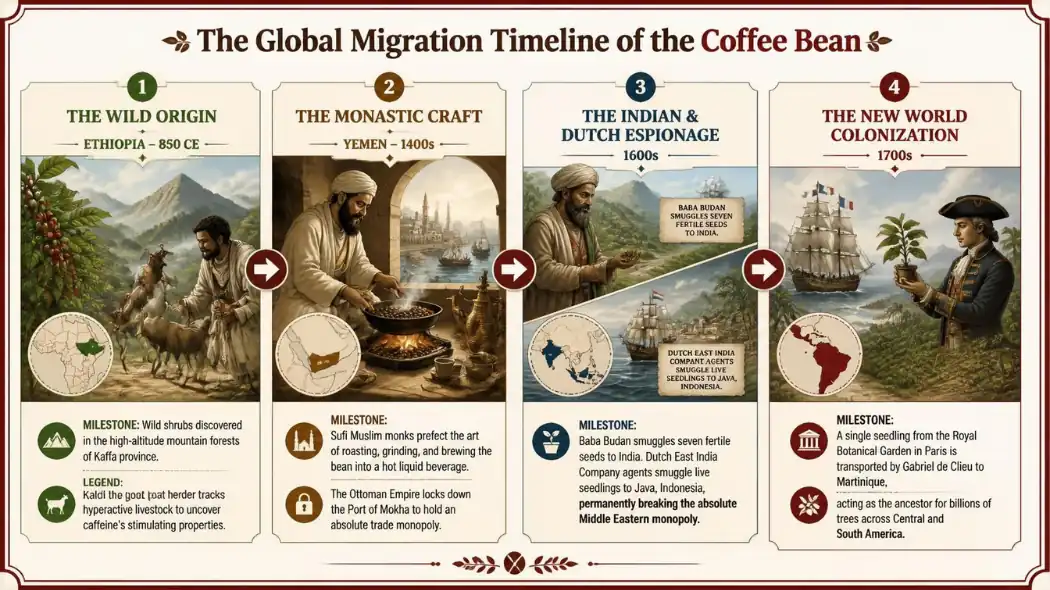
The Global Journey of Coffee emerges from the forests of East Africa to the plantations of the Americas is one of the most remarkable stories in agricultural history. What began as a wild plant native to a relatively small region of Africa eventually became one of the world’s most important traded commodities, transforming economies, cultures and everyday life across continents.
Today, coffee is grown in more than 70 countries, supporting millions of farmers and supplying a global industry enjoyed by people in almost every corner of the world. Yet its international success was far from inevitable. It depended on centuries of trade, migration, botanical experimentation and, in some cases, extraordinary acts of determination.
Understanding the global journey of coffee means following the movement of the plant itself, from its African origins through Arabia and Asia before reaching the Caribbean and South America.

Ethiopia: Where the Coffee Journey Began
The botanical origins of Arabica coffee (Coffea arabica) lie in the highland forests of southwestern Ethiopia. Here, coffee trees developed naturally within a rich forest environment long before the beverage became an international commodity.
The precise circumstances surrounding the earliest human use of coffee remain uncertain. One of the best-known explanations is the legend of Kaldi, an Ethiopian goat herder who supposedly noticed his animals becoming unusually energetic after eating ripe red cherries.
According to the story, Kaldi sampled the fruit and experienced the same stimulating effects. He then shared his discovery with monks at a nearby monastery, where the cherries were eventually roasted and prepared as a drink.
Although the Kaldi story is deeply embedded in coffee folklore, there is no contemporary historical evidence confirming the events. The legend should therefore be enjoyed as part of coffee’s cultural heritage rather than treated as a documented account of its discovery.
What is clearer is that coffee’s natural range and genetic origins are closely associated with Ethiopia, making the country an essential starting point in its history.
Yemen: The Birthplace of Coffee as a Brewed Beverage
Coffee’s next important destination was across the Red Sea in Yemen.
During the fifteenth century, coffee became established as a roasted and brewed beverage within Yemeni religious communities. Sufi mystics valued its stimulating properties because it helped them remain alert during lengthy evening prayers and devotional gatherings.
Coffee gradually moved beyond religious settings and became part of everyday social life. Its popularity spread throughout the Arabian Peninsula and into major trading centres across the Islamic world.
The Yemeni port of Mocha became particularly important. Situated on the Red Sea, it developed into a major centre for the export of coffee, connecting Arabian growing regions with merchants and markets overseas.
The name Mocha subsequently became closely associated with coffee itself, particularly beans exported through the port.
For centuries, Yemen occupied a central position in the international coffee trade. Its growing regions, commercial networks and established reputation made it an important supplier to an expanding market.
Baba Budan: The Famous Seven Seeds Taken to India
One of the most celebrated stories in the Global Journey of Coffee is the international expansion concerning a Sufi pilgrim named Baba Budan.
According to traditional accounts, Baba Budan visited Mecca during the seventeenth century and became fascinated by coffee. At the time, Yemen was keen to protect its valuable position in the international trade, and restrictions were reportedly placed on the export of viable coffee seeds.
The story claims that Baba Budan concealed seven fertile coffee seeds against his body before returning to India.
He is traditionally credited with planting them in the Chandragiri Hills of southern India, in what is now Karnataka.
The exact details of the journey and the seven seeds have not been independently established through contemporary records. Nevertheless, Baba Budan remains an important figure in Indian coffee heritage.
The surrounding hills became associated with his name, and the region eventually developed into an important centre of coffee cultivation.
Commercial coffee production in India expanded considerably during the nineteenth century, particularly under British colonial rule.
The Dutch Expansion: From Yemen to Java
The next major development came through the trading activities of the Dutch East India Company.
Dutch merchants recognised the enormous commercial potential of coffee and sought to establish cultivation beyond the traditional Arabian growing regions.
An early attempt to establish coffee plants in Java in 1696 was unsuccessful. A later introduction in 1699 proved more successful, allowing cultivation to develop on the Indonesian island.
Java’s tropical climate, volcanic soils and suitable growing conditions helped coffee production flourish.
By the early eighteenth century, Java had become an important commercial supplier to European markets.
The island’s association with coffee became so strong that its name eventually entered everyday language as a familiar alternative word for coffee.
Dutch expansion also helped establish coffee plants in other parts of Southeast Asia, strengthening the development of a wider international growing industry.
France and Gabriel de Clieu: Coffee Crosses the Atlantic
Coffee’s arrival in the Caribbean marked another decisive stage in its global expansion.
A famous historical account concerns Gabriel Mathieu de Clieu, a French naval officer traditionally credited with transporting a coffee seedling from France to Martinique around 1723.
The story describes how de Clieu obtained a young coffee plant from the royal botanical collection in Paris and carried it aboard his ship.
During the Atlantic crossing, the seedling reportedly endured difficult conditions, including rough weather and limited supplies of fresh water. De Clieu is said to have protected the plant and shared his own drinking water to keep it alive.
Although later retellings have added dramatic details, coffee cultivation did become established in Martinique during this period.
From the Caribbean, coffee spread into neighbouring islands and mainland territories, eventually helping establish the foundations of the coffee industries of Central and South America.
The introduction of coffee to the Americas was a turning point. It allowed European colonial powers to develop large-scale plantation production far beyond the original Arabian growing regions.
Brazil: The Rise of a Coffee-Producing Giant
The Global Journey of Coffee reached Brazil in the early eighteenth century. Its introduction is traditionally associated with Francisco de Melo Palheta, who travelled to French Guiana in 1727 and is credited with bringing coffee planting material into Portuguese-controlled Brazil.
The crop initially developed in northern Brazil before gradually spreading into other regions.
Brazil possessed several advantages that encouraged its expansion. Extensive agricultural land, favourable growing conditions, developing transport infrastructure and access to international markets helped coffee production increase dramatically.
By the nineteenth century, Brazil had become one of the world’s leading coffee suppliers.
Its growing influence transformed international coffee markets and helped establish South America as the dominant centre of global production.
However, this expansion came at a considerable human cost. Brazil’s plantation economy relied heavily on enslaved African people and their descendants. The growth of the coffee industry cannot be separated from the history of slavery, colonial exploitation and unequal land ownership.
Recognising this history is essential to understanding how coffee became such a powerful global commodity.
How Coffee Became a Worldwide Crop
As coffee cultivation spread through colonial trading networks, it gradually reached new territories across Africa, Asia, the Caribbean and the Americas.
The original movement of Arabica coffee from Ethiopia and Yemen eventually developed into a much broader agricultural industry, involving different growing regions, varieties and production systems.
Today, commercial coffee cultivation is concentrated within the tropical region surrounding the Equator, commonly known as the Coffee Belt.
This broad geographical area stretches between the Tropics of Cancer and Capricorn, although suitable growing conditions vary considerably according to elevation, rainfall, temperature and local climate.
Two species dominate international production:
Arabica (Coffea arabica)
Arabica is particularly valued for its diverse flavour characteristics, aromatic complexity and potential for high-quality speciality coffee. It generally grows best at higher elevations and is more sensitive to environmental stresses than Robusta.
Robusta (Coffea canephora)
Robusta is generally more resilient in warmer growing conditions and is widely cultivated at lower elevations. Its beans typically contain more caffeine than Arabica and are often associated with stronger, more intense flavour characteristics.
Liberica and coffee varieties traditionally known as Excelsa also contribute to the wider diversity of the coffee industry.
The Global Journey of Coffee Continues
The journey from Ethiopia’s highland forests to today’s international coffee industry has taken centuries.
Trade, religious traditions, migration, colonial expansion and agricultural innovation all played important roles in moving coffee around the world. The plant that once grew naturally within a relatively limited geographical area now supports an enormous network of farmers, processors, exporters, roasters and retailers.
Yet coffee’s history is not simply a story of commercial success. It also reflects the movement of people, the exchange of cultures and the economic inequalities that shaped international agriculture.
From the Ethiopian forests to the growing regions of Brazil, Colombia, Vietnam and beyond, every coffee-producing country contributes another chapter to this remarkable global journey and in the history of the coffee bean.
And with increasing attention being given to sustainability, traceability and genetic diversity, the story of coffee continues to evolve.
The next time you enjoy a cup of coffee, remember that its journey may have begun thousands of miles away, carried through centuries of history before reaching your cup.


