

Table of Contents
Understanding coffee extraction is one of the most useful steps towards making better coffee at home. Once you understand how water draws flavour from ground coffee, you gain much greater control over the sweetness, acidity, body and balance of your daily brew.
When you make coffee, you are doing much more than pouring hot water over crushed beans. You are carrying out a process known as solid-liquid extraction. Water acts as a solvent, passing through or mixing with the ground coffee and dissolving a wide range of compounds that contribute to the drink’s flavour and aroma.
A roasted coffee bean contains hundreds of chemical compounds, but not all of them dissolve in water. Some contribute to the taste and aroma of your cup, while much of the bean’s structural material remains behind in the spent grounds. The art of brewing is learning how to extract enough of the desirable compounds to create a balanced and enjoyable drink.


What Is Coffee Extraction in Simple Terms?
In simple terms, coffee extraction is the process of transferring soluble compounds from ground coffee into water during brewing.
As water comes into contact with the grounds, it dissolves and carries away substances including organic acids, caffeine, carbohydrates, aromatic compounds and products formed during roasting. These compounds contribute to the different characteristics we recognise in coffee, from fruity acidity and sweetness to bitterness and body.
Not everything in a coffee bean is soluble. Much of its structure consists of plant material, including cellulose and other fibres, which remain in the grounds rather than dissolving into your cup.
Your aim is not to extract as much as physically possible. Instead, you want to achieve a balance that suits the coffee and your personal taste.
Coffee brewing commonly uses a measurement called extraction yield. This describes the percentage of the original dry coffee dose that has dissolved into the finished drink. An extraction yield of around 18–22% is often used as a traditional reference range for filter coffee and espresso, but it is not a universal rule for the perfect cup. Different coffees, roast levels and brewing methods can produce enjoyable results outside that range.
It is also worth distinguishing extraction yield from coffee strength. Extraction yield tells you how much material has been removed from the grounds; strength describes how concentrated the finished drink is. They are related, but they are not the same thing.
The Three Stages of Coffee Extraction: Acids, Sweetness and Bitterness

Water does not dissolve every coffee compound at the same rate. Some substances dissolve relatively quickly, while others take longer to become prominent in the brew. This gives us a useful way of understanding extraction through three overlapping stages.Think of these as a simplified flavour model rather than three completely separate chemical waves. In a real brew, many compounds are extracted at the same time.
1. The Early Stage – Acidity and Aromatic Compounds
As water first meets the ground coffee, readily soluble compounds begin to dissolve. These include various organic acids and other flavour and aroma compounds.
They help create the bright, lively characteristics found in many coffees, including citrus, berry and other fruit-like notes. When the brew is stopped too early, these flavours can become disproportionately prominent, leaving the coffee tasting sharp, thin or sour.
2. The Middle Stage – Sweetness and Balance
As extraction continues, a wider range of soluble compounds enters the brew. The resulting combination can create a fuller and more rounded flavour, helping balance the acidity.
This is where a coffee may reveal notes that we describe as caramel, chocolate, biscuit or ripe fruit. These descriptions represent our perception of a complex mixture of compounds, rather than one particular sugar being responsible for each flavour.
A well-balanced brew brings together acidity, sweetness, aroma and body without allowing one characteristic to dominate.
3. The Later Stage – Bitterness and Astringency
As brewing continues, additional compounds are extracted, including substances that can contribute bitterness, dryness and astringency.
These characteristics are not automatically unpleasant. A little bitterness can provide structure and depth, particularly in darker roasts. However, when the overall extraction becomes excessive or uneven, the cup may taste harsh, woody, drying or unpleasantly bitter.
The important point is that extraction is cumulative: the flavour of your finished coffee reflects the combination of compounds dissolved throughout the brewing process.
How Coffee Extraction Affects the Taste of Your Cup
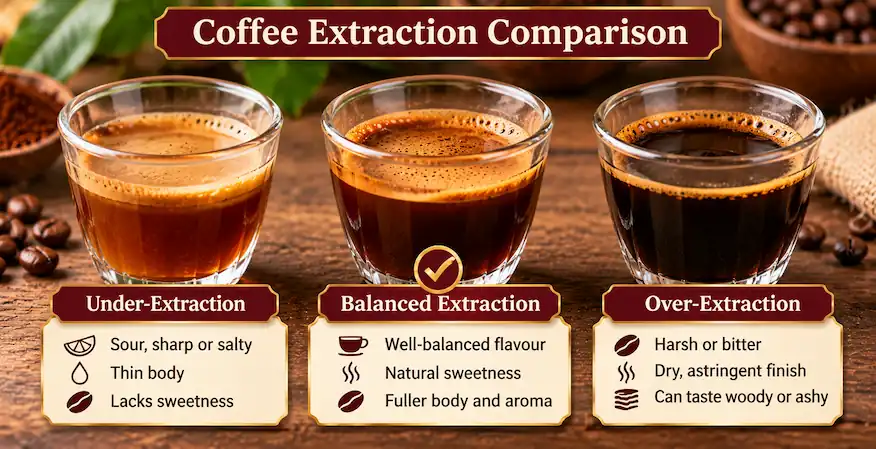
Understanding the relationship between extraction and flavour makes it much easier to diagnose problems with your home brew.
Under-extraction – When Your Coffee Tastes Sour
Under-extraction occurs when too little of the coffee’s soluble material has been transferred into the drink. The result can be sharp, sour, salty or watery, with insufficient sweetness and body to balance the flavour.
Common causes include:
- A grind that is too coarse for the brewing method.
- Water that is too cool for the chosen recipe.
- Insufficient contact time between water and coffee.
- Uneven water distribution, leaving parts of the coffee bed poorly extracted.
If your coffee regularly tastes sharp or thin, take a look at our troubleshooting guide to discover why your coffee tastes sour and how to fix it.
Over-extraction – When Your Coffee Tastes Bitter
Over-extraction describes a brew in which too much soluble material has been removed for a pleasant balance. It can produce harsh bitterness, a drying mouthfeel and lingering, unpleasant flavours.
Possible causes include:
- A grind that is too fine for the brewing method.
- Excessive contact time.
- High brewing temperatures combined with other aggressive extraction conditions.
- Excessive agitation or uneven brewing that creates inconsistent extraction.
If bitterness is spoiling your morning cup, our guide explains why coffee tastes bitter and how to correct it.
It is worth remembering that sourness and bitterness are not always proof of under- or over-extraction. Roast level, bean quality, water chemistry and brewing strength can also influence what you taste.
The Five Variables You Can Control at Home
You don’t need a professional espresso machine or laboratory equipment to improve your extraction. A few simple adjustments can make a noticeable difference.
1. Grind Size
Grind size controls the surface area exposed to the water. Finer grounds provide more surface area and generally allow faster extraction, while coarser grounds slow the process down.
The correct setting depends on your brewing method. Espresso requires a much finer grind than French Press, for example.
The science behind brewing is more complex than simply choosing a grind setting, as research into coffee extraction and brewing uniformity demonstrates how water moves through a coffee bed and influences the finished cup.
2. Water Temperature
Temperature affects how readily many coffee compounds dissolve. Hotter water generally speeds up extraction, while cooler water slows it down.
For many hot filter brewing methods, a starting temperature around 92–96°C works well. However, the ideal temperature depends on the coffee, roast and recipe. It is not necessary to use the same temperature for every brewing method.
3. Brewing Time
The longer water remains in contact with the coffee grounds, the more opportunity there is for soluble material to dissolve.
A short contact time can leave a brew under-extracted, while an unnecessarily long one can produce an unbalanced result. The ideal time varies considerably between espresso, pour-over, French Press and other methods.
4. Agitation
Agitation means disturbing the coffee bed by stirring, swirling or pouring water in a particular way.
Gentle agitation can help wet the grounds evenly and improve consistency. Too much disturbance, however, may create an uneven coffee bed or encourage excessive extraction in some areas.
5. Coffee-to-Water Ratio
The amount of coffee you use in relation to your water determines how concentrated the finished drink will be.
Using more coffee does not automatically mean you have extracted more from each ground particle. It generally produces a stronger brew, while the extraction yield depends on how much soluble material has been removed from the grounds.
A simple way to begin is to weigh both your coffee and water rather than relying on scoops and guesswork. Once you have a repeatable recipe, you can adjust the ratio to suit your taste.
Bringing Coffee Extraction Together
Coffee extraction is the foundation of every brewing method, whether you use a V60, Chemex, French Press, AeroPress, Moka Pot or espresso machine.
The equipment may differ, but the underlying principle remains the same: water dissolves soluble compounds from the ground coffee, and the way you control that process shapes the flavour in your cup.
Start with a consistent recipe, make small adjustments and taste the results. If the coffee is too sharp, consider whether it needs a little more extraction. If it is harsh or drying, try reducing the extraction or improving the evenness of your brew.
There is no single setting that produces the perfect cup for everyone. The real skill is learning how grind size, temperature, time, agitation and coffee-to-water ratio work together.
Once you understand what coffee extraction is, you are no longer simply following a brewing recipe. You are learning how to shape the flavour of your own coffee.


