

When we discuss the art of brewing exceptional specialty coffee, our attention almost always zeroes in on the hardware. We obsess over purchasing premium single-origin beans, investing in high-end burr grinders, and balancing our extraction timelines down to the second.
However, we routinely ignore the single largest component sitting inside our mugs.
A standard cup of brewed filter coffee is physically 98% water, while a traditional shot of espresso is roughly 90% water.
That means if the water solvent flowing out of your kitchen tap tastes dull, chemically, or heavily metallic, your final beverage will mirror those exact traits—regardless of how expensive your coffee beans were.
Treating water as a neutral, invisible background liquid is the ultimate barrier preventing home baristas from achieving cafe-quality sweetness.
Why is Ordinary Tap Water Bad for Coffee Extraction?
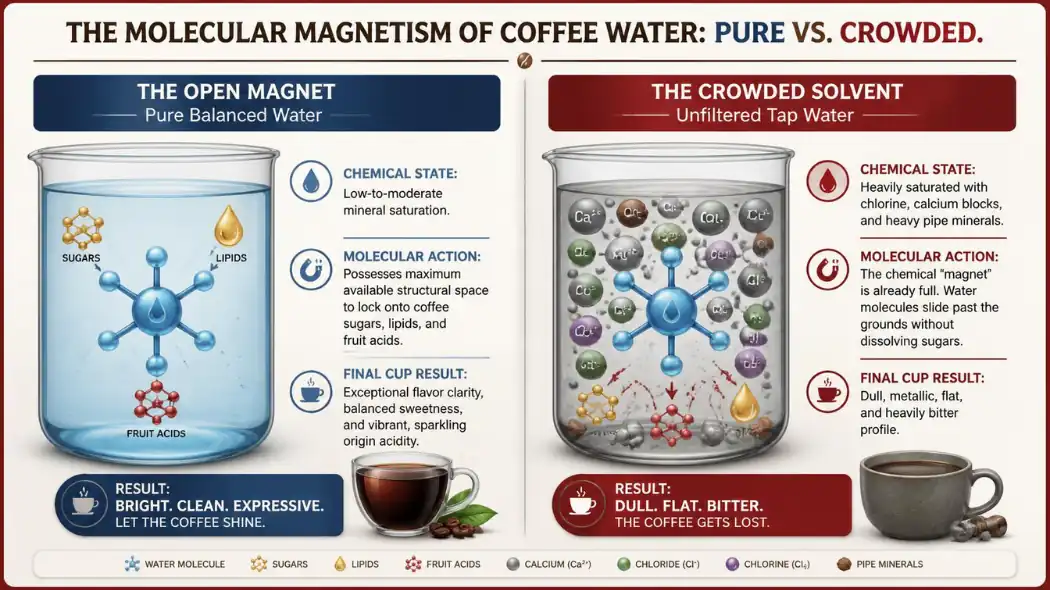
In organic chemistry, water is known as the “universal solvent.”
It behaves like a microscopic magnet, utilising its natural molecular charge to actively attract, dissolve, and pull out soluble flavor compounds locked inside the cell matrix of your ground coffee beans.
The problem with ordinary tap water is that it isn’t pure. As municipal water travels through environmental limestone shelves and city pipe networks, it becomes heavily saturated with dissolved minerals, chlorine treatments, and trace organic elements.
When you boil water that is already crowded with these background chemicals, its molecular “magnetic pull” is severely compromised.
The water simply lacks the available structural capacity to dissolve the sweet carbohydrates and aromatic lipids inside your coffee grounds, leaving the best flavours trapped inside the spent coffee puck.
The Hidden Impact of Chlorine and Old Pipes
Municipal water treatment facilities deliberately add chlorine to domestic networks to keep drinking water safe from biological contaminants. While this is fantastic for public health, chlorine is an absolute disaster for delicate coffee aromatics. Even in microscopic concentrations, heated chlorine chemically binds with the natural organic compounds inside coffee, creating an unpleasantly medicinal, sharp, and bleach-like aftertaste.
Similarly, older household plumbing systems often leach tiny traces of copper, zinc, or iron directly into the flow. These metallic minerals don’t just muddy the clean body of your drink; they aggressively oxidise your coffee’s volatile aromatic oils the exact microsecond the liquid hits your server, flattening out vibrant floral or berry notes into a metallic, stale landscape.
How Water Quality Corrupts Your Master Troubleshooting Balance
The most frustrating part of using unconditioned tap water is that it completely destabilises your ability to diagnose brewing mistakes. Sourcing parameters verified by The Coffee Guide prove that water composition dictates your extraction speed far more aggressively than human technique; if your household extractions are consistently finishing with a flat, muddy, or unpleasantly mouth-drying profile despite using premium beans, check out our master troubleshooting guide to understand why does my coffee taste bitter and learn how to adjust your brewing variables smoothly.
Conversely, if your municipal water supply is completely devoid of mineral content, it will tear through the grounds too violently, leaving you with an unpleasantly sharp, hollow flavor. If your cups are leaning toward this aggressively biting, lemon-like profile, explore our companion guide to understand why does my coffee taste sour and discover how to realign your parameters cleanly.
The 30-Second Layman’s Fix to Reclaim Your Flavor Clarity
You do not need to construct an expensive scientific laboratory in your kitchen to bypass tap water roadblocks. To immediately elevate your flavor clarity today, work through these three simple, progressive household water upgrades:
- The Carbon Filter Pitcher (The Baseline Step): Utilising a standard charcoal filter jug (like a Brita) represents the absolute minimum baseline for home brewing. The active carbon core acts like a physical sponge, capturing up to 90% of aggressive chlorine treatments and heavy pipe sediments to clean up your background sensory noise.
- Bottled Volvic or Spring Water (The Benchmark Test): If you want to instantly see what your favourite bag of beans is truly capable of expressing, purchase a bottle of inexpensive Volvic or natural spring water from the supermarket for your next brew. Speciality baristas worldwide utilise Volvic as an international benchmark because its natural mineral balance sits precisely within the ideal chemical sweet spot for coffee dissolution.
- Remineralized Distilled Water (The Ultimate Craft Masterclass): For absolute perfection, purchase a jug of pure distilled water (which contains zero minerals) and drop in a specialised, pre-formulated coffee mineral sachet (such as Third Wave Water). This completely bypasses your local geography, giving you a clinically perfect solvent that unlocks maximum sweetness and sparkling origin acidity every single time.
In the next Guide to The Impact of Tap Water Quality on The Taste of Coffee we discuss the significance of Hard Water vs Soft Water

