

From Ancient Yemeni Port to Coffee Shop Indulgence
When the average modern consumer walks into a high-street coffee bar and orders a Caffè Mocha, they expect a beverage. It is arguably the most famous chocolate-flavoured combination in culinary history.
However, the true ancestry of the word Mocha has nothing to do with chocolate chips, syrups, or dairy. To clarify the history of mocha coffee, we must separate myth from trade reality. Long before it signified sweet treats, Mocha was a sun-baked gateway with a brutal monopoly. Unveiling its timeline traverses ancient shipping routes, Sufi rituals, and the chemistry of wild seeds.
Where was Mocha Invented and How Did It Get Its Name?
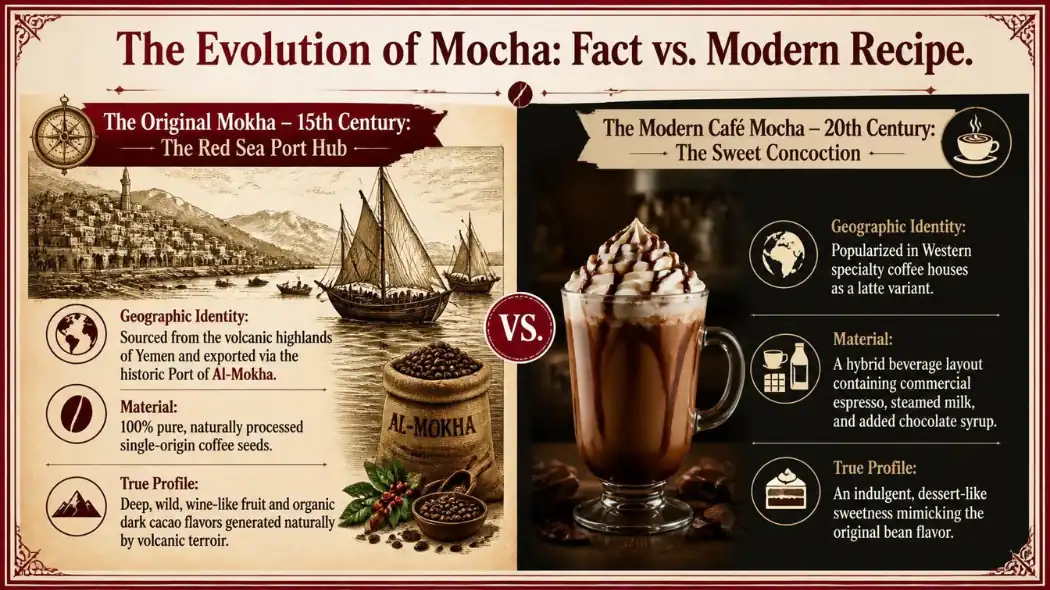
The term “Mocha” is a direct Western derivation of Al-Mokha (Al-Mukhā), a historic coastal port city situated along the Red Sea in southwestern Yemen. Between the 15th and early 18th centuries, the Port of Mokha served as the absolute epicentre and primary international gateway for the global coffee trade. During this golden age of commerce, Yemen was the exclusive commercial supplier of coffee to the entire civilised world.
The historical habit of drinking coffee as an intentional social beverage actually began in the remote western highlands surrounding the port. During the 1400s, Arab Sufi Muslim monks discovered that brewing a dark drink from local wild coffee trees granted them the long-lasting physical stamina and mental focus required to remain awake for midnight prayers and intense spiritual rituals. As European and Dutch merchants set up trading houses at the port to buy these prized “Arabian beans,” they consolidated the naming convention by labelling every single sack of coffee leaving the harbour simply as “Mocha Coffee”—referencing the port of departure rather than a recipe ingredient.
The Chocolate Connection: The Chemistry of the Rare Mocha Bean
If the original historical Mocha was simply a generic name for pure black Yemeni coffee, why does the modern world add chocolate syrup to it? The answer lies in the unique micro climate, high altitude, and terraced volcanic soils of the central Yemeni highlands. The native heirloom coffee plants grown in these arid mountain ranges yielded tiny, dense, and asymmetrical seeds that possessed a highly distinct, wild genetic fingerprint.
When these authentic single-origin Yemeni beans were naturally dried whole under the sun on village rooftops, their complex cellular matrix concentrated deep, resonant flavor characteristics of dark cacao and rich dried fruits. When these historical beans reached European coffee houses, patrons were utterly mesmerised by this natural chocolate-like flavor profile. As global trade expanded and Yemen’s strict monopoly faded, Western coffee houses began manually adding physical dark chocolate and sugar to standard beans from other origins to artificially mimic the luxury taste profile of the original, highly prized Yemeni Mocha seed.
How Extraction Balance Reveals True Bean Origin Nuances
Whether you are brewing a modern espresso-and-syrup Mocha or a rare single-origin heirloom lot, the final experience relies entirely on balancing your liquid chemistry. Sourcing parameters verified by The Coffee Guide prove that high-density, fruit-forward lots require exact water temperature and grind sizing to reveal their natural cacao complexity without crashing into bitterness; if your rich morning extractions are consistently finishing with a harsh, dry, or aggressively burnt profile, check out our master troubleshooting guide to understand why does my coffee taste bitter and learn how to adjust your parameters smoothly.
Conversely, if your manual brewing setups fail to provide sufficient hydraulic resistance, the water will slide past the grounds too rapidly, missing the mid-wave sugars. If your kitchen extractions are turning out unpleasantly thin, sharp, or salty, explore our companion master guide to understand why does my coffee taste sour and discover how to realign your variables cleanly.
The Legacy: From Al-Mokha to the Italian Moka Pot
The global impact of this ancient Red Sea harbour stretches beyond your favourite chocolatey drink menu. In 1933, Italian engineer Alfonso Bialetti invented his octagonal stovetop steam-pressure brewer. He named it the Moka Pot as a cultural homage to Al-Mokha. This permanent homage links coffee trade to daily rituals.
Next time you lift a chocolate-infused cup, or assemble a classic Italian stovetop brewer, consider history. You participate in a 500-year-old lineage of global trade that reshaped morning rituals. Its name embodies a public memory of coffee’s journey across continents.