

Table of Contents
How to Control Heat and Airflow in Home Coffee Roasters
When you move beyond basic household roasting methods and start using dedicated equipment, such as a tabletop drum roaster or a fluid-bed machine, you enter a more controlled stage of home roasting. This is where understanding coffee roast profiling becomes important.
A coffee roast profile is essentially a record of how a roast develops over time. It commonly uses a temperature curve to show how the beans heat up throughout the process, alongside important events such as first crack, airflow adjustments and total development time.
For the home roaster, this information provides a valuable way to understand what is happening inside the machine and how individual adjustments influence the finished coffee.

You don’t need to be an industrial roasting engineer to get started. By learning how heat, airflow and roasting time interact, you can begin to develop a more consistent approach to your batches.
The aim is not simply to achieve a particular colour. It’s to understand how different roasting decisions influence sweetness, acidity, body and the overall flavour of your coffee.

The Core Variable 1: Charge Temperature and the Turning Point
Every roast begins with a starting condition known as the charge temperature.
Charge temperature is the temperature reading of the roasting environment immediately before the green beans are introduced. Depending on the equipment, this may be measured using a drum, environmental or other designated temperature probe.
When the room-temperature green beans enter the preheated roaster, they absorb thermal energy from the surrounding environment. The temperature reading consequently drops, sometimes quite sharply.
This initial fall is followed by a point where the temperature stops declining and begins to rise again. This is known as the Turning Point.
The turning point is an important reference in coffee roast profiling because it marks the transition from the initial temperature decline towards sustained heating.
Why Charge Temperature Matters
Charge temperature influences how much energy is initially available to the beans and how quickly the roast begins developing.
A higher charge temperature may help provide the initial energy needed for a particular coffee and roasting profile. However, too much heat can create problems, including scorching or tipping, particularly if the beans receive excessive direct heat early in the roast.
A lower charge temperature can provide a gentler beginning, but starting too cool may extend the roast unnecessarily or contribute to a flat, underdeveloped result.
There isn’t one ideal charge temperature for every coffee. Bean density, moisture content, batch size, machine design and heat transfer characteristics all influence the appropriate starting point.
For a useful explanation of the terminology, see the Green Coffee Collective glossary entry for charge temperature.
The Core Variable 2: Airflow and Convection Manipulation
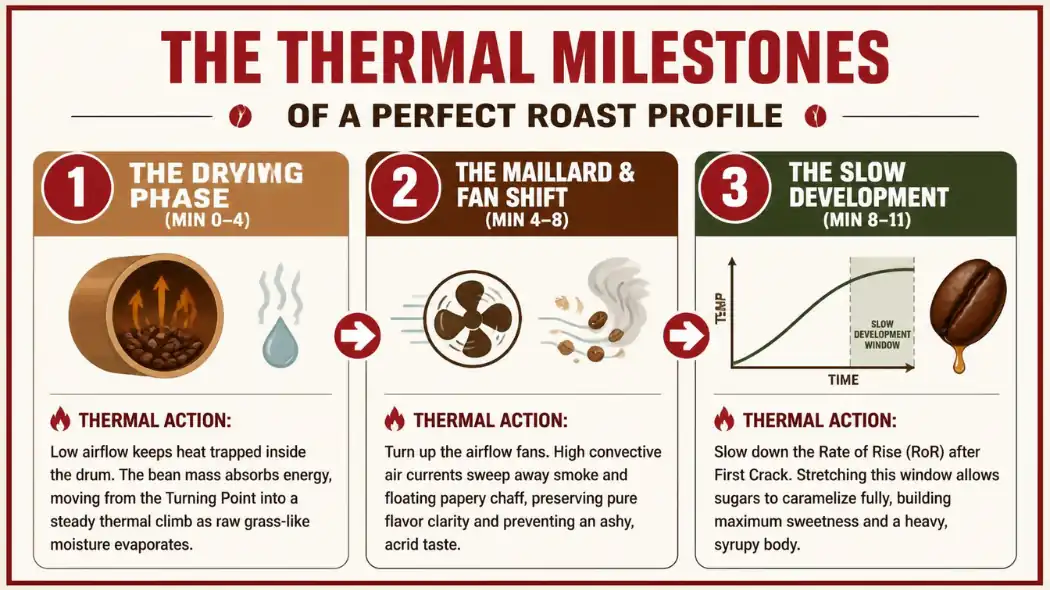
Airflow is one of the most important controls available on many tabletop roasting machines. It influences how heat moves through the roasting chamber, how smoke and chaff are removed, and how consistently the beans are exposed to the roasting environment.
There are two important forms of heat transfer to understand:
- Conduction: Heat transferred through direct contact, such as between the beans and the heated metal surfaces of a drum.
- Convection: Heat transferred through the movement of hot air around and between the beans.
The balance between these processes varies considerably between different roaster designs. A drum roaster, for example, may rely on a combination of conduction and convection, while a fluid-bed machine uses moving hot air as its primary heat-transfer mechanism.
How Airflow Changes During Roasting
Airflow adjustments can influence the roast at different stages, but the correct settings depend on the machine and the profile you’re trying to achieve.
Early roast: Managing heat transfer
During the initial drying phase, airflow affects how quickly heat is transferred to the beans and how moisture is carried away. Reducing airflow too much can restrict circulation and may allow unwanted smoke or chaff to accumulate.
Mid-roast: Managing smoke and chaff
As the beans turn yellow and begin browning, they release more chaff and produce increasing amounts of smoke. Increasing airflow where the machine allows can help remove these by-products and maintain a cleaner roasting environment.
Later roast: Controlling development
As the beans approach first crack and move into the development phase, airflow continues to influence heat transfer and the removal of smoke. Adjustments should be made carefully, because excessive changes can alter the rate at which the roast progresses.
Airflow is not simply a matter of keeping the fan low at the beginning and high at the end. The objective is to understand how your particular machine responds and use airflow to support a controlled, even roast.
The Core Variable 3: Rate of Rise (RoR) and Roast Development
One of the most useful measurements in modern coffee roasting is the Rate of Rise (RoR).

RoR describes how quickly the measured bean temperature is increasing over time. It is commonly expressed in degrees per minute and is calculated from successive temperature readings.
For example, if the bean temperature increases by 10°C over one minute, the Rate of Rise for that interval is approximately 10°C per minute.
RoR is particularly useful because it shows whether the roast is accelerating, slowing down or maintaining a relatively steady rate of temperature development.
Understanding a Declining RoR
A common roasting objective is to achieve a reasonably smooth, declining RoR curve as the roast progresses.
This generally means the temperature continues to rise, but the rate of increase gradually slows.
A declining RoR helps the roaster avoid uncontrolled acceleration towards the end of the roast. However, it should not be treated as an absolute rule or a perfect curve that every coffee must follow.
Sudden drops or increases can indicate that the roast has become difficult to control.
- RoR crash: A sudden and substantial drop in the rate of temperature increase. This can contribute to a stalled or underdeveloped roast.
- RoR flick: A sudden increase in the rate of temperature rise, often occurring later in the roast. It can lead to excessive development if not managed carefully.
The aim is to understand why these changes occur and how your adjustments influence the resulting cup.
First Crack and the Development Phase
One of the most important milestones in the roasting process is First Crack.
As the beans expand under heat, internal pressure causes structural changes that produce an audible cracking sound. This marks an important transition in roast development.
The time between the beginning of first crack and the end of the roast is commonly called development time.
The proportion of the total roast spent in this phase is sometimes expressed as the development time ratio (DTR).
This information can help you compare different roasting profiles, but a longer development time does not automatically mean a sweeter or better coffee.
During development, a range of chemical reactions continues to influence the finished flavour. Caramelisation, Maillard reaction products and changes to organic acids all contribute to the evolving character of the roast.
A well-managed development phase can help produce a balanced cup with desirable sweetness, body and complexity. Too little development may leave the coffee tasting grassy or underdeveloped, while excessive development can obscure delicate origin characteristics.

The best result depends on the coffee and the flavour profile you’re trying to achieve.
How Roast Profile Problems Affect Your Finished Coffee
Understanding coffee roast profiling becomes particularly useful when a batch doesn’t taste as expected.
Even small changes in heat application, airflow or development time can influence the final cup. Learning to recognise these differences helps you identify what might need adjusting in your next roast.
When the Coffee Tastes Flat or Baked
A roast that develops too slowly or spends too long at insufficient heat may produce a flat, dull flavour.
This is often described as a baked roast. The coffee can lack sweetness and complexity, with muted aromas and an uninteresting finish.
A substantial RoR crash may also indicate that the roast has lost momentum, although a flat flavour cannot be attributed to one measurement alone.
If your finished coffee tastes lifeless, explore our guide to why coffee tastes sour to understand the other factors that can contribute to an unpleasant cup.
When the Coffee Tastes Harsh or Bitter
Excessive heat or poorly controlled development can produce harsh, smoky or bitter flavours.
If the roast progresses too aggressively, you may lose some of the more delicate characteristics of the original coffee. Continuing too far into second crack can create increasingly smoky, roasty flavours and obscure the bean’s natural character.
For further help diagnosing an unpleasantly bitter cup, read our guide to why coffee tastes bitter.
Remember that bitterness and sourness can also be influenced by grinding, extraction and brewing temperature. Not every unpleasant cup is necessarily the result of a roasting fault.
The Post-Roast Profiling Rule: Recording, Comparing and Improving
One of the best ways to improve your home roasting is to keep a detailed roasting log.
Rather than relying on memory, record the important measurements and observations from every batch. This allows you to compare profiles and understand which adjustments produce the results you prefer.
What Should You Record?
For each roast, try to document:
- Coffee origin: Country, growing region and producer, where known.
- Variety: The Arabica or Robusta variety being roasted.
- Processing method: Washed, natural, honey, anaerobic or another method.
- Batch size: The weight of green coffee introduced into the roaster.
- Charge temperature: The starting temperature recorded by your machine.
- Turning point: The time and temperature at which the initial decline ends.
- Drying phase: How long the beans take to move from green towards yellow.
- First crack: The time at which first crack begins.
- Development time: The time between the beginning of first crack and the end of the roast.
- Drop temperature: The temperature reading when the beans are removed from the roaster.
- Final roast colour: Light, medium or dark, with any additional observations.
- Tasting notes: Sweetness, acidity, body, aroma and any undesirable characteristics.
Over several batches, these records will help you identify patterns. You may discover that a particular coffee responds better to a gentler start, that airflow adjustments improve the result, or that a slightly different development time brings out the sweetness you prefer.
The important thing is to change one or two variables at a time. If you alter everything simultaneously, it becomes much harder to understand what actually improved the coffee.
Bringing Your Coffee Roast Profiling Skills Together
Coffee roast profiling is not about following a rigid set of temperatures or trying to produce an identical graph every time. It’s about understanding how your roasting equipment responds and learning to control the variables that influence the finished coffee.
Charge temperature establishes the starting conditions, airflow influences heat transfer and the removal of smoke and chaff, while Rate of Rise helps you monitor how the roast is progressing.
Together, these measurements give you a much clearer picture of what is happening inside the roasting chamber.
As you gain experience, you’ll begin to recognise how different origins, varieties and processing methods respond to heat. More importantly, you’ll be able to connect what you see on the roasting graph with what you actually taste in the cup.
That’s when home roasting starts to become a repeatable craft rather than a matter of guesswork.
Review the previous sections of The Roasting Series:
Part 1: Sourcing green coffee beans
Part 2: How to roast coffee beans at home


