

When a manual filter extraction finishes with a weak and vinegary profile, the blame rarely lies with the quality of your roasted beans or the precision of your burr grinder. The breakdown almost always occurs in your water delivery vector. How you physically handle your kettle, distribute the liquid mass, and manage internal turbulence dictates whether your coffee achieves rich flavor definition or you end up with watery pour over coffee.
There is a distinct reason why manual, gravity-fed filtration systems dominate the counter tops of specialty coffee houses worldwide. When you brew using a pour-over dripper, you lift the mechanical boundaries imposed by automated machines and gain total structural control over your extraction speed, thermal stability, and water distribution. Yet, for many home baristas, transitioning to this format results in a confusing roadblock: a cup of coffee that looks beautifully clear but tastes unpleasantly thin, watery, flat, or sharply sour.
The Hidden Enemy: High-Velocity Agitation and Channeling
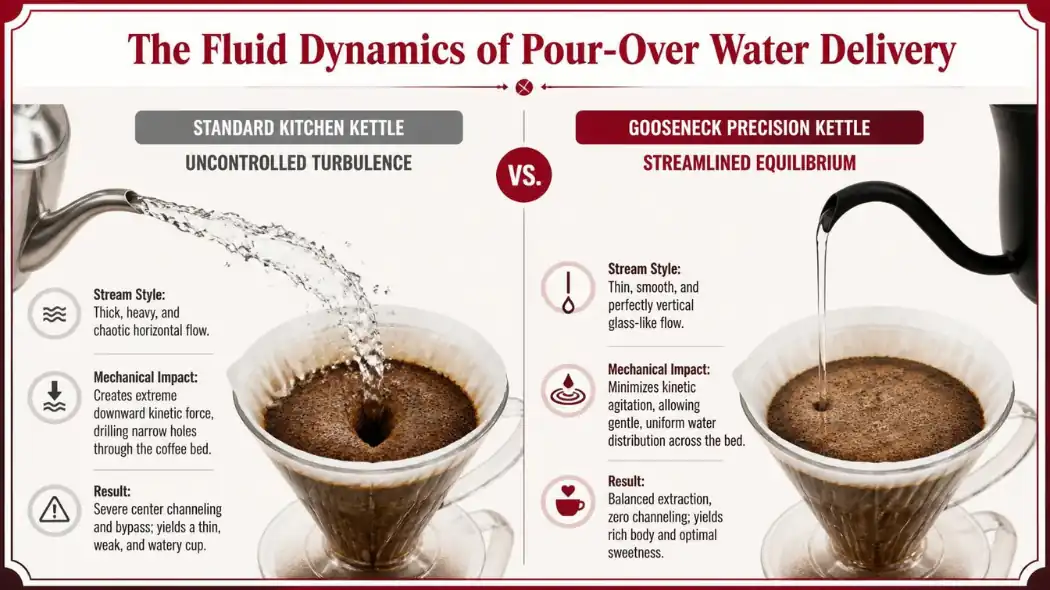
To understand why pouring technique alters taste so dramatically, we have to look at the fluid dynamics inside the filter cone. When you pour hot water from a standard kitchen kettle, the liquid drops in a thick, turbulent, and irregular stream. This aggressive downward force creates immense hydraulic turbulence, violently tossing the coffee grounds around and drilling narrow tunnels directly through the center of the bed.
In brewing science, this structural defect is known as channeling. Water is inherently lazy; it will always follow the path of least resistance. When a fast, heavy stream drills a hole through the coffee bed, the vast majority of your brew water rushes straight down that single channel, passing into your server without dissolving the surrounding grounds. The result is a dual failure: you aggressively over-extract the bitter woody fibers inside the channel, while leaving the rest of the coffee bed completely dry and under-extracted, creating a thin, watery, and hollow drink.
The Tool of Precision: Why a Goose-neck Kettle is Essential
The single most effective way to eliminate channeling and reclaim your flavor clarity is to swap your standard kettle for a specialised gooseneck kettle. These kettles feature a long, narrow, and sweeping curved spout engineered to regulate fluid velocity. No matter how aggressively you tip the handle, the internal geometry restricts the flow, delivering a thin, glass-like stream of water that falls perfectly vertical to the coffee bed.
This streamlined flow grants you complete volumetric accuracy. Instead of dumping water in random sheets, you can drop precise, low-velocity measurements exactly where they are needed. This allows you to wet the entire particle matrix uniformly, ensuring every single grain of coffee releases its soluble fruit acids, caramelized sugars, and rich oils at an identical rate.
How Kettle Movements Direct Your Extraction Balance
Once you have the proper spout control, your physical hand movements shape the extraction architecture. Specialty baristas utilise a strict, concentric circle pouring pattern to manage internal turbulence:
- The Inside-Out Circle: Always begin your pouring circles at the dead center of the coffee bed and slowly spiral outward toward the rim, stopping roughly half a centimetre before hitting the paper filter. Spiralling outward gently coaxes the floating grounds down into a uniform, flat cake, maximising even water contact.
- Avoid the Paper Wall: Never pour hot water directly onto the exposed paper filter edges. If water hits the paper wall above the coffee bed, it will bypass the coffee grounds entirely, sliding down the side of the dripper straight into your cup. This structural mistake—known as bypass—dilutes your liquid, instantly leaving your morning batch tasting weak, watery, and flat.
How Pouring Mistakes Corrupt Your Master Troubleshooting Balance
Failing to master your kettle movements introduces massive inconsistency, making it impossible to diagnose brewing errors. Sourcing metrics verified by The Coffee Guide show that erratic pouring speeds will cause severe layout fluctuations; if your gravity-fed extractions are consistently resulting in a thin, watery, sharp, or salty profile, check out our master troubleshooting guide to completely understand why does my coffee taste sour and discover how to realign your parameters smoothly.
Conversely, if you pour too slowly and allow the water to pool heavily inside a stalled filter cone, you run the risk of dissolving late-stage plant fibers. If your manual pour-overs are turning out unpleasantly harsh, dry, ashy, or aggressively bitter, explore our companion master guide to understand why does my coffee taste bitter and learn how to adjust your grind variables and water parameters cleanly.
The Professional Pour Protocol: Low and Slow
To pull your next manual pour-over straight into the perfect 18% to 22% extraction sweet spot, implement the “low and slow” rule during your next morning routine. Hold the spout of your goose-neck kettle as close to the top of your dripper cone as safely possible. Keeping the drop distance short minimises the kinetic impact of the stream, preventing the water from disturbing the bed or stirring up fine particles that choke the paper filter mesh. Slow down your movement, watch the grounds bloom evenly, and let gravity reveal the true genetic sweetness of your beans!